


1Rollo: The One-Wheeled AI Robot Patrolling Your Property
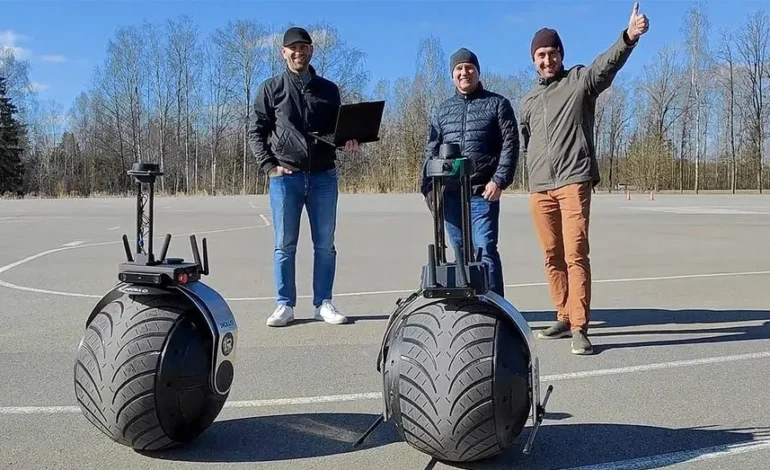

Imagine a security presence that never tires, never needs a coffee break, and navigates your property on a single wheel. This is the vision of 1Rollo, an innovative AI security robot developed by Estonian startup Rollo Robotics. The company aims to revolutionize property surveillance with a compact, cost-effective solution designed to patrol large areas more efficiently than traditional security vehicles.
The 1Rollo robot operates by following pre-programmed routes while continuously monitoring its surroundings. Its advanced artificial intelligence is designed to detect unusual activity, and when something out of the ordinary occurs, it alerts a human operator. This human overseer can then review the situation and determine the appropriate response, potentially dispatching a human guard if necessary. Currently, 1Rollo exists as a functional prototype, with Rollo Robotics targeting a commercial release in 2027. This timeline suggests that the robot’s design and capabilities may evolve before it reaches the market.
How 1Rollo Stays on Track and On Balance
At the heart of 1Rollo’s operation is a sophisticated 360-degree computer vision system that provides comprehensive environmental awareness. Complementing its visual sensors is Real-Time Kinematic Global Navigation Satellite System (RTK GNSS) positioning. Unlike standard GPS, RTK uses correction data to achieve highly precise location tracking, ensuring the robot adheres closely to its designated patrol paths around business or industrial sites. The robot’s cameras and sensors constantly scan for obstacles, allowing its system to dynamically adjust its course and avoid collisions. Simultaneously, the AI analyzes the environment for anomalies, flagging anything unusual and transmitting alerts via Wi-Fi or cellular networks (4G/5G).
Maintaining balance on a single wheel, especially for a robot weighing around 100 pounds, is a significant engineering feat. Rollo Robotics achieves this stability through an internal, vertically oriented spinning flywheel. Positioned in line with the main wheel, this flywheel acts as a gyroscopic stabilizer. To steer, the robot subtly tilts this internal flywheel, initiating turns. Rollo Robotics has filed for patents on the hardware and software that enable this unique balancing mechanism. The single-wheel design results in an exceptionally narrow profile, allowing 1Rollo to navigate tight spaces where larger patrol vehicles would be impractical. However, specific performance data regarding its capabilities on stairs, steep inclines, or highly uneven terrain has not yet been released.
Performance Specifications and Expandability
The current specifications for the 1Rollo robot indicate a height of approximately 43 inches, with a 24-inch diameter wheel. The total weight is around 100 pounds. Rollo Robotics claims a top speed of 19 mph, a considerable advantage over many slower-moving security robots currently in use. The robot is designed to operate for up to eight hours on a single charge, with an integrated autonomous wireless charging system to facilitate continuous operation.
While the standard configuration includes a 360-degree vision system, the 1Rollo platform is engineered for modularity. Customers can enhance its capabilities by adding specialized equipment such as thermal cameras for low-light surveillance, pan-tilt-zoom cameras for extended observation, or night vision systems. Other potential add-ons include RFID readers and custom payloads, allowing businesses to tailor the robot to the specific security needs of their property.
Fleet Management and Operator Interaction
Rollo Robotics envisions a cloud-based management platform that would enable operators to oversee a fleet of 1Rollo robots from a central location. This system would allow security teams to define patrol routes, monitor robot performance, and receive real-time alerts. Upon receiving an alert, an operator could view a live video feed from the robot. The inclusion of a microphone and speaker on the robot allows for two-way communication, enabling operators to interact with individuals detected by the robot without immediately deploying a human guard. This approach mirrors systems like the Ascento Guard, another autonomous security robot that relies on human operators for incident resolution.
The effectiveness of such autonomous systems is still under scrutiny. For instance, a recent pilot program in Dublin, Ohio, saw an AI robot cop retired after recording no arrests during its deployment in a parking garage. While this specific case doesn’t predetermine 1Rollo’s success, it highlights the importance for businesses to establish clear objectives and performance metrics before adopting autonomous security technologies.
Robotics-as-a-Service and Future Rollout
Rollo Robotics plans to offer 1Rollo through a Robotics-as-a-Service (RaaS) subscription model. This approach would allow customers to access the technology without the significant upfront cost of purchasing the hardware. According to CEO and co-founder Sander Sebastian Agur, the subscription would encompass not only the robot itself but also ongoing software updates and technical support. This model aims to reduce the overall operating expenses for businesses compared to traditional security measures and simplify maintenance and future upgrades. While the company’s objective is to lower operational costs, specific subscription pricing has not yet been announced.
Addressing Privacy and Cybersecurity Concerns
The integration of connected robots like 1Rollo into security infrastructure introduces both enhanced physical security and potential digital vulnerabilities. Given its reliance on wireless connectivity and cloud platforms, robust cybersecurity measures are paramount. Potential customers should inquire about data encryption for camera feeds, the security of operator accounts, and data storage policies, including clear deletion protocols for recorded footage. Ensuring the robot can operate safely and autonomously, even during internet outages, by continuing to avoid obstacles and people, is also crucial.
Furthermore, the method by which Rollo Robotics delivers security updates to its robots needs careful consideration. A compromised robot could lead to unauthorized access to sensitive video feeds or control systems. These concerns are not unique to 1Rollo; lawmakers have already voiced similar apprehensions regarding autonomous machines, with proposed legislation in some regions aiming to restrict the use of certain foreign-made robots due to national security risks. Regardless of its origin, any connected robot warrants thorough cybersecurity scrutiny.
The Future of Autonomous Property Patrol
While a one-wheeled robot patrolling residential driveways is unlikely in the immediate future, businesses with large campuses, warehouses, or industrial facilities may soon see machines like 1Rollo in action. These robots could take over repetitive patrol duties, freeing up human guards to focus on more complex tasks and critical decision-making during incidents. They could also provide valuable situational awareness in hazardous areas before human personnel are dispatched.
However, the presence of a mobile, recording camera can raise privacy concerns for employees and visitors. Transparency regarding when and where recording occurs, who has access to the footage, and how long it is retained is essential. Addressing these questions proactively will be key to the successful adoption of such technologies.
Key Takeaways
The 1Rollo robot presents an intriguing and unconventional approach to property security. Its narrow, single-wheeled design offers potential advantages in navigating large areas efficiently and at a lower operational cost than conventional methods. The integration of AI for anomaly detection, coupled with human oversight for response, strikes a balance between automation and human judgment. Nevertheless, Rollo Robotics faces the challenge of proving 1Rollo’s reliability in diverse real-world conditions, including varying weather, crowded environments, and extended operational periods without constant human intervention. The ultimate success and market adoption will likely hinge on competitive pricing, demonstrable cost savings, and superior security performance compared to existing solutions. The question remains: would the presence of a one-wheeled AI sentry enhance your sense of security, or would it spark concerns about constant surveillance?