



NY AG Hopeful Slams James on Medicaid Fraud Drop
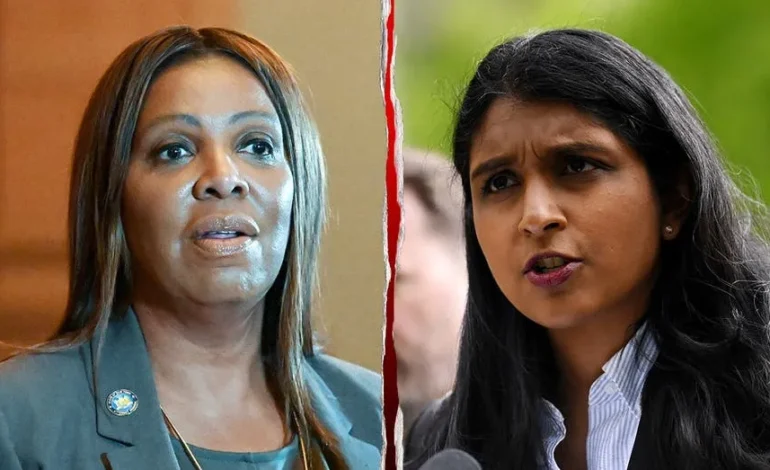

Saritha Komatireddy, a Republican candidate vying for New York’s attorney general position, has made the state’s approach to Medicaid fraud a central theme of her campaign, asserting that prosecutions and recoveries have significantly declined under the tenure of current Attorney General Letitia James.
The issue of combating Medicaid fraud has gained national prominence following revelations of billions of dollars in alleged fraud linked to public assistance programs in Minnesota. This scandal prompted the Trump administration to elevate fraud prevention as a priority, with Vice President JD Vance spearheading federal initiatives. Consequently, Republican candidates nationwide, including those in New York’s attorney general race, are advocating for increased state-level efforts to prosecute Medicaid fraud and reclaim taxpayer funds.
In a recent interview, Komatireddy sharply criticized James, alleging a lack of aggressive pursuit of Medicaid fraud cases. She suggested that New York taxpayers could be forfeiting hundreds of millions of dollars in potential recoveries. “They’re totally failing to prosecute Medicaid fraud, and you can look at that based solely on the record of Letitia James and her Democratic predecessors,” Komatireddy stated. “This is not a partisan issue.”
Medicaid Fraud Recoveries Plummet Under James
Komatireddy’s campaign highlights data indicating a steep drop in Medicaid fraud recoveries since James took office. According to annual reports from the New York Attorney General’s office, recoveries fell from $168 million in 2019, James’s first year, to just $31 million in 2024. This represents a dramatic decrease compared to previous administrations.
Prior to James’s leadership, New York’s attorneys general consistently achieved some of the highest Medicaid fraud recovery figures in the nation. For instance, under Eliot Spitzer, the Medicaid Fraud Control Unit recovered $243.6 million in 2006. Andrew Cuomo’s tenure saw recoveries of $113.8 million in 2007, $263.5 million in 2008, and over $283 million in 2009, accumulating more than $660 million in his initial three years as attorney general. His successor, Eric Schneiderman, secured over $335 million in 2012, marking the second-highest annual total in the unit’s history and its best performance in seven years.
“Even her Democratic predecessors used to bring in $200 to $300 million per year in fraudulent proceeds,” Komatireddy observed. “When Tish James comes into office, it goes down to $20 to $30 million per year. According to her own year-end reports, she’s just decided not to do that part of the job.”
Rising Costs, Declining Enforcement
While New York’s recoveries from Medicaid fraud have diminished under James, the state’s expenditure on its fraud recovery program has concurrently increased. Spending rose from approximately $45 million in fiscal year 2020 to an estimated $70 million for fiscal year 2025.
Komatireddy also pointed to a decline in criminal convictions related to Medicaid fraud. “It used to be the case the New York Attorney General’s office would get around 100 criminal convictions a year, holding people who are stealing from Medicaid accountable,” she said. “Under Tish James, that number is very low. There’s one year where she got eight criminal convictions.”
Federal Scrutiny on New York’s Fraud Efforts
The state’s handling of Medicaid fraud has drawn attention from federal authorities. Earlier this year, Dr. Mehmet Oz, Administrator of the Centers for Medicare & Medicaid Services, dispatched a letter to Governor Kathy Hochul seeking further details on New York’s provider screening and fraud prevention strategies. Oz indicated that this review aims to bolster protections for Medicaid beneficiaries and uphold public trust in the program. New York was among only three states, alongside California and Minnesota, to receive such a letter.
Komatireddy contends that this reduction in enforcement has tangible negative consequences for New Yorkers. She argues that decreased recoveries not only inflate healthcare costs but also divert funds that could otherwise support other essential state services. “It’s New Yorkers who pay the price, because when people steal from Medicaid, that increases our healthcare costs,” Komatireddy explained. “When we are just letting a billion dollars go out the door over the course of her term, that’s money that we could be getting back as taxpayers.”
She further suggested that the current situation forces state lawmakers to seek additional revenue streams from taxpayers. “The folks in Albany keep thinking of new ways to take more money away from taxpayers,” Komatireddy remarked. “If you had an attorney general who actually prosecuted fraud properly, you wouldn’t have to worry about a tax hike.”
Komatireddy’s Proposed Solutions
As a potential solution, Komatireddy has pledged to bolster the Medicaid Fraud Control Unit by adding 20 criminal prosecutors. Drawing on her background as a former federal prosecutor with over a decade in the U.S. Attorney’s Office for the Eastern District of New York and a subsequent role as chief of staff at the Drug Enforcement Administration, Komatireddy is positioning the race as a choice between experienced law enforcement leadership and an incumbent she deems ineffective.
“Like I said, we have to actually just do the job of attorney general,” Komatireddy stated. “That job involves prosecuting crime and fraud.”
The New York Attorney General’s Office has not yet provided a comment in response to inquiries.
Key Takeaways
- Republican AG candidate Saritha Komatireddy criticizes incumbent Letitia James for a significant decline in Medicaid fraud recoveries.
- Recoveries reportedly dropped from $168 million in 2019 to $31 million in 2024 under James.
- Komatireddy contrasts this with higher recovery figures under previous attorneys general, including Democrats.
- State spending on fraud recovery has increased while enforcement actions appear to have decreased.
- Federal officials have also expressed concern, with CMS Administrator Dr. Mehmet Oz sending a letter to Governor Hochul.
- Komatireddy proposes strengthening the Medicaid Fraud Control Unit with additional prosecutors.
Frequently Asked Questions
What is Medicaid fraud?
Medicaid fraud involves intentionally deceiving the Medicaid program to obtain benefits or payments unlawfully. This can include providers billing for services not rendered, beneficiaries misrepresenting their eligibility, or pharmaceutical companies engaging in illegal kickback schemes.
Why is Medicaid fraud a significant issue?
Medicaid fraud diverts billions of taxpayer dollars away from essential healthcare services, increasing costs for everyone and potentially reducing the quality of care available to eligible beneficiaries. It undermines public trust in vital government programs.
What is the role of the Attorney General in combating Medicaid fraud?
The Attorney General, through their Medicaid Fraud Control Unit, is responsible for investigating and prosecuting individuals and entities that defraud the state’s Medicaid program. This includes recovering stolen funds and holding perpetrators accountable through criminal and civil actions.
Conclusion
The sharp decline in Medicaid fraud recoveries and prosecutions under Attorney General Letitia James, as highlighted by her challenger Saritha Komatireddy, presents a critical point of contention in the upcoming election. Komatireddy’s campaign centers on her law enforcement background and a promise to revitalize the state’s efforts against healthcare fraud, arguing that a more robust approach is essential to protect taxpayer money and ensure the integrity of the Medicaid program. The issue has also attracted federal attention, underscoring its importance at both state and national levels.