Ex-NFL Players Criticize WNBA Star’s ‘White Privilege’ Remark After Ejection
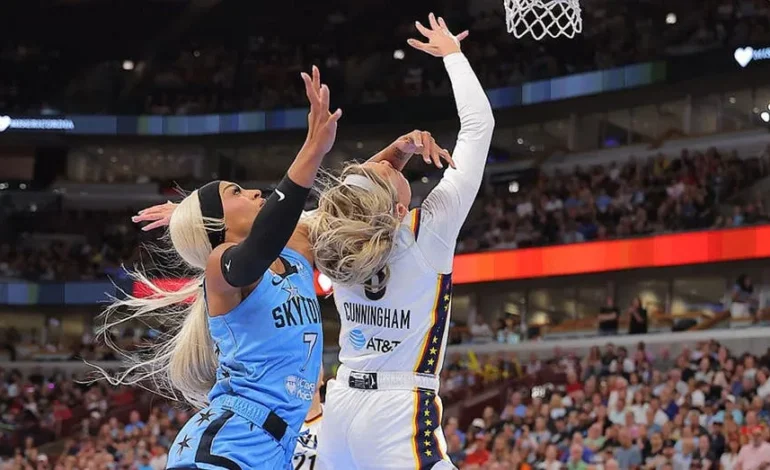

A controversial post by WNBA player DiJonai Carrington, suggesting her ejection from a game was a result of “white privilege,” has drawn sharp criticism from former NFL athletes Emmanuel Acho and Breiden Fehoko. Both former players believe Carrington’s comments not only misrepresent the situation but also hinder broader societal progress.
Incident Sparks Debate Over Ejection and Racial Accusations
The controversy unfolded during a game on Saturday when Carrington, playing for the Chicago Sky, committed a hard foul on Indiana Fever forward Sophie Cunningham. The play, described as resembling a clothesline, left Cunningham with a bloody mouth. Officials deemed the foul a Flagrant 2, leading to Carrington’s immediate ejection from the game.
Shortly after leaving the court, Carrington took to social media platform Threads to post “white privilege.” This statement implied that racial bias, rather than the nature of the foul, was the reason for her ejection.
Former NFL Players Condemn Carrington’s Statement
Breiden Fehoko, a former NFL player, expressed his dismay on the social media platform X (formerly Twitter), stating that Carrington’s accusation exemplifies the divisions preventing national progress. “This is a prime example of why we can’t ever move forward as a country,” Fehoko wrote. He added, “For every person who liked this bullsh*t and is encouraging this victim-a** mentality, you should be ashamed. It’s honestly sad how far we’ve drifted as a country.”
Emmanuel Acho, also a former NFL player and now a podcast host, echoed these sentiments. Reacting to a screenshot of Carrington’s post, Acho wrote on X, “DiJonai Carrington posted ‘White Privilege’ from the locker room after being ejected for fouling Indiana Fever’s Sophie Cunningham. Judge for yourself, but color didn’t have nothing to do with the flagrant 2. IMO.”
Acho’s Podcast Analysis
During his podcast, Acho elaborated on his position, urging a focus on the basketball aspect of the incident. “Can we stick to basketball for a moment?” he asked. “She flagrantly hit Sophie Cunningham in the head. The refs made the right call.”
Acho argued that attributing the ejection to white privilege was a misapplication of the term and a disregard for basketball rules. “Now, I’d be remiss if I didn’t mention.. this was not a race-based decision,” he stated. “To call that a white privilege-based foul is to completely undermine the term of white privilege and to also completely ignore the rules in basketball. You hit her in the head. You drew blood. You didn’t connect with the ball at all whatsoever.”
He concluded, “So to me, it was just very ignorant and, to some degree, asinine by D.J. Carrington to suggest that that call was based on white privilege. Have we seen examples of white players make that same foul and get away with it? Have we seen examples of black players make that same foul and get away with it? Yes. There was no white privilege involved in that specific call.”
Media Reactions and WNBA Discipline
The commentary from Acho and Fehoko stands in contrast to what some observers describe as a more lenient media response to Carrington’s statement. Reports suggest that some media outlets have downplayed the incident or defended Carrington’s remarks.
Specifically, a former ESPN anchor was noted for arguing that Cunningham, the player who was fouled, should have been the one ejected. Meanwhile, WNBA pregame shows on networks like NBC and ESPN reportedly avoided discussing Carrington’s “white privilege” post. One host was quoted as accusing critics of Carrington of injecting the situation into a “culture war,” despite Carrington’s own social media statement.
The WNBA itself faces a challenge in addressing Carrington’s post, which some believe complicates the league’s stance on player conduct and social commentary. The consensus among critics like Acho and Fehoko is that Carrington’s ejection was a straightforward basketball decision, unrelated to race, and that her subsequent comments were misguided.
Conclusion: A Call for Focus on Play
The incident highlights a recurring tension in sports, where athletic actions can become intertwined with broader social and racial discussions. While players and commentators often engage with social issues, former NFL players Emmanuel Acho and Breiden Fehoko are urging a return to evaluating the specific event on its merits. They maintain that Carrington’s ejection was a consequence of a dangerous play, not racial bias, and that her comments detract from a rational understanding of both the game and the complex issue of privilege.