



Sanders: Some Democrats May Want Senate Nominee to Lose
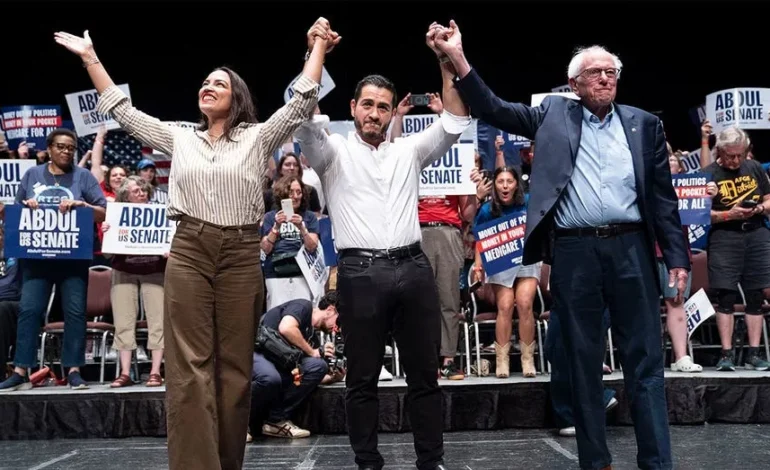

Senator Bernie Sanders has voiced concerns that a segment of Democratic leadership and major donors might be less than enthusiastic about the electoral prospects of Michigan’s Democratic U.S. Senate nominee, Abdul El-Sayed. Sanders suggested in a recent interview that these individuals may be willing to see El-Sayed lose his bid for the Senate, citing El-Sayed’s progressive stances that could challenge established wealthy interests and the party’s approach to foreign policy, particularly concerning Israel. These comments come as El-Sayed faces increased scrutiny over his past associations, notably with far-left streamer Hasan Piker.
Internal Democratic Divisions Surface
Speaking to “Politico Playbook,” Sanders elaborated on his assertion, indicating that the reservations extend to individuals at the highest echelons of the Democratic Party and its primary financial backers. “You’re talking about a small number of people who are at the head of the Democratic Party. You’re talking about the donor class… Are they less than enthusiastic about Abdul? Yes, they are,” Sanders stated. He posited that candidates like El-Sayed represent a threat not only to entrenched financial interests but also to current U.S. foreign policy, especially regarding continued support for Israel under Prime Minister Netanyahu’s government. Sanders characterized such progressives as a “threat to oligarchy” and a “threat to American foreign policy.”
Counterarguments from Within the Party
The framing offered by Sanders was met with a differing perspective from Democratic strategist Yemisi Egbewole, a former chief of staff in the Biden White House. Egbewole emphasized the party’s overarching goal of securing a Senate majority and highlighted El-Sayed’s responsibility to unite the Democratic base following a closely contested primary. “Dems want a majority in the Senate. El-Sayed apologized for his comments about the Temple Isreal attack and hasn’t campaigned with Hasan. No one is as caught up in this oligarchy business as Sanders is. Stevens lost. She endorsed Abdul. It’s now his job to win those voters,” Egbewole remarked. She suggested that El-Sayed has already taken steps to address past controversies, including apologizing for remarks made after a synagogue attack and distancing himself from Piker’s more extreme statements.
El-Sayed Navigates Controversy
The controversy surrounding Hasan Piker, who had previously campaigned with El-Sayed during the primary, has intensified following remarks Piker made about American Jews and Israel. These comments drew widespread condemnation from prominent Democrats, including House Minority Leader Hakeem Jeffries, Senators Cory Booker, Elissa Slotkin, and Jacky Rosen. El-Sayed himself has faced pressure to definitively sever ties with Piker, but has largely sought to pivot the campaign’s focus back to core economic issues impacting Michigan residents.
During a recent Michigan Democratic Party convention, El-Sayed resisted repeated questioning about Piker. “We’re in the state of Michigan. If you want to make this race about a streamer in California, I just think you’re missing the boat,” El-Sayed told reporters. “This is about affordability in Michigan. This is about seeing a doctor in Michigan. This is about Donald Trump’s disastrous policies in Michigan. That’s what I’m focused on right now.”
Apology for Past Remarks
El-Sayed also issued an apology for comments made in the aftermath of a terrorist attack on a Michigan synagogue. Following the incident, he had stated, “Hurt people, hurt people,” a remark that drew criticism from Michigan Democrats, including Attorney General Dana Nessel. “To anybody who feels like my comments may have been hurtful, I’m really sorry. That was not my intention. We condemned that terrorist attack. We condemned it outright,” El-Sayed said. He clarified that his intention was to offer context for the event’s origins, but acknowledged that it was “not the time for context, and you don’t ever want to trample somebody’s pain.”
El-Sayed’s Campaign Strategy
Sanders, who had supported El-Sayed throughout the primary, advised the campaign to maintain its focus on economic issues pertinent to working families in Michigan. “Stay on the issues that impact working families in Michigan,” Sanders urged. “Do that, you’re going to win — and I think he will.” This strategy aims to counter what Sanders perceives as distractions orchestrated by Republicans and the media, diverting attention from substantive policy debates.
Meanwhile, the Republican National Committee’s national press secretary, Natalie Baldassarre, criticized Sanders’ defense of El-Sayed. Baldassarre asserted that El-Sayed’s record and associations render him unfit for the Senate, making accusations about his past statements and connections to individuals she deemed radical. She argued that his potential presence in the Senate would constitute a national security risk.
Electoral Landscape
Recent polling indicates a close race in Michigan. An August poll showed Republican nominee Mike Rogers leading El-Sayed by a narrow margin, within the survey’s margin of error. Another subsequent survey also depicted the candidates in a tight contest. Within the Democratic primary, El-Sayed secured strong backing, with a significant majority of Democrats supporting his candidacy.
El-Sayed’s campaign has been working to mend relationships with Jewish Democrats, though he has maintained his stance regarding Hasan Piker. The ongoing debate highlights the internal dynamics within the Democratic Party as it navigates the general election, balancing progressive ideals with broader electoral concerns and established foreign policy considerations.