




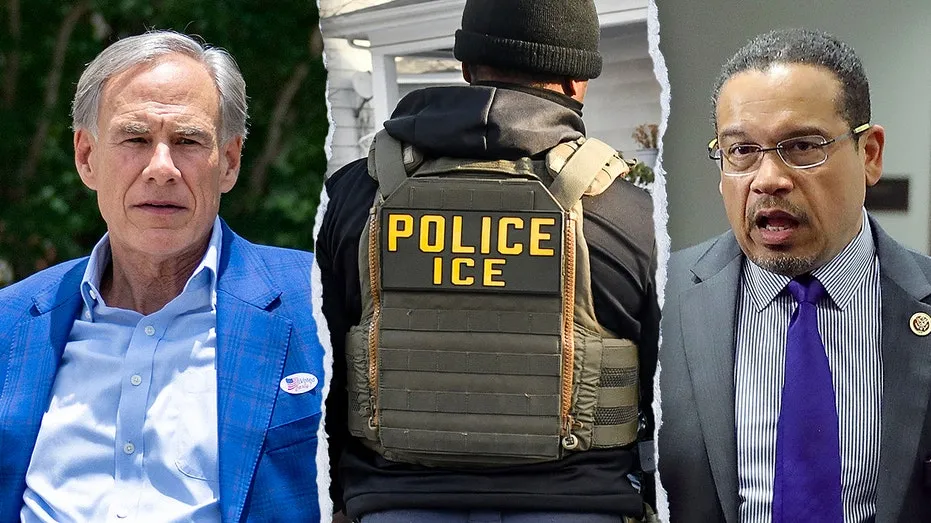
A heated dispute has erupted between Texas Governor Greg Abbott and Minnesota Attorney General Keith Ellison over the extradition of an Immigration and Customs Enforcement (ICE) agent. The conflict escalated after a federal judge denied Minnesota’s request to detain the agent, Christian Castro, in Texas pending extradition. Castro, an ICE agent, faces state charges in Minnesota related to a January shooting incident in Minneapolis.
The Extradition Fight Ignites
The core of the controversy lies in Governor Abbott’s decision not to immediately sign an extradition warrant for Christian Castro. Castro, an ICE agent, is accused of firing through the front door of an occupied Minneapolis home in January, striking a man named Julio Cesar Sosa-Celis in the leg. Castro maintains he acted in self-defense, claiming he was attacked with a broom and a snow shovel. However, surveillance footage and other evidence reportedly contradict his account, according to Minnesota prosecutors.
Minnesota’s Attorney General Keith Ellison sharply criticized Abbott’s stance, accusing the Texas governor of transforming the Lone Star State into a “sanctuary state for violent criminals.” Ellison argued that allowing governors to delay or selectively approve extraditions undermines the ability of states to hold fugitive criminals accountable. “This is not politics — this is not a game,” Ellison stated. “If a governor can delay extraditions and cherry-pick cases according to their political tastes, then no state will be able to hold fugitive criminals accountable.”
Abbott Retorts with Legal Scathing
Governor Abbott responded forcefully to Ellison’s accusations, taking to social media platform X (formerly Twitter) to dismiss the Minnesota AG’s legal arguments. Abbott characterized Ellison’s team as “such bad lawyers,” asserting they were “unprepared, uninformed & unpersuasive” and demonstrated a lack of legal understanding. Abbott also turned the tables, labeling Minnesota, and specifically Minneapolis, as the “literal definition of a sanctuary state” for allegedly refusing to cooperate with federal immigration law enforcement.
In a pointed remark, Abbott also alluded to Texas’s controversial practice of busing migrants to other cities, suggesting Minneapolis could be a destination for future “bus drop offs” if a future administration, like that of President Joe Biden, were in power. This jab directly links the extradition dispute to the broader political tensions surrounding immigration policy.
Details of the Charges and Investigation
The charges against Castro, filed by the Hennepin County Attorney’s office, include four felony counts of second-degree assault and one misdemeanor count of falsely reporting a crime. The initial investigation was conducted by the Minnesota Bureau of Criminal Apprehension. Notably, the Trump administration initially framed the incident as an attack on a federal ICE officer. However, ICE later placed Castro and another agent on administrative leave, with its acting director indicating they may have provided “untruthful statements” regarding the events.
Further complicating the narrative, federal assault charges initially brought against Sosa-Celis and another individual were later dismissed. Prosecutors cited new evidence that they deemed “materially inconsistent” with the original allegations, suggesting a re-evaluation of the incident’s circumstances.
Texas’s Legal Position and Judicial Ruling
Governor Abbott’s office has indicated that Texas is reviewing whether Castro qualifies as a fugitive subject to extradition. A key point of contention is that Castro returned to Texas under federal orders, rather than fleeing Minnesota voluntarily. Texas law generally permits pre-extradition detention for a maximum of 90 days. Abbott’s administration praised the federal judge’s ruling that denied Minnesota’s emergency request, viewing it as a rejection of Minnesota’s attempt to impose an arbitrary deadline on Abbott’s review process.
The legal back-and-forth highlights the complex interplay between state and federal authority, particularly in cases involving federal law enforcement officers accused of state crimes. The governor’s office has emphasized its commitment to a thorough review, while Minnesota officials express urgency in bringing Castro to justice within their state’s jurisdiction.
Broader Implications and Political Undercurrents
This high-profile clash underscores the deep political divisions and ongoing debates surrounding immigration, sanctuary cities, and the enforcement of laws across state lines. The involvement of ICE agents in state criminal proceedings often triggers intense scrutiny and political maneuvering. Governor Abbott’s actions align with a broader strategy of challenging policies perceived as lenient on immigration and asserting state authority in immigration-related matters.
Conversely, Attorney General Ellison’s strong reaction reflects concerns about potential political interference in the justice system and the implications for inter-state cooperation. The case serves as a potent example of how legal disputes can become entangled with national political narratives, particularly in an election year. The outcome of this extradition fight could set precedents for how similar cases are handled in the future, impacting both law enforcement operations and inter-state relations.
Conclusion
The extradition battle between Texas and Minnesota over ICE agent Christian Castro remains ongoing. While a federal judge has allowed Castro’s release from a Texas jail, the ultimate decision on his extradition rests with Governor Abbott, who is conducting a review. The dispute highlights significant legal and political tensions, with both states’ top legal officials publicly exchanging sharp criticisms. The situation continues to unfold, with implications for criminal justice cooperation and immigration policy debates across the nation.


