




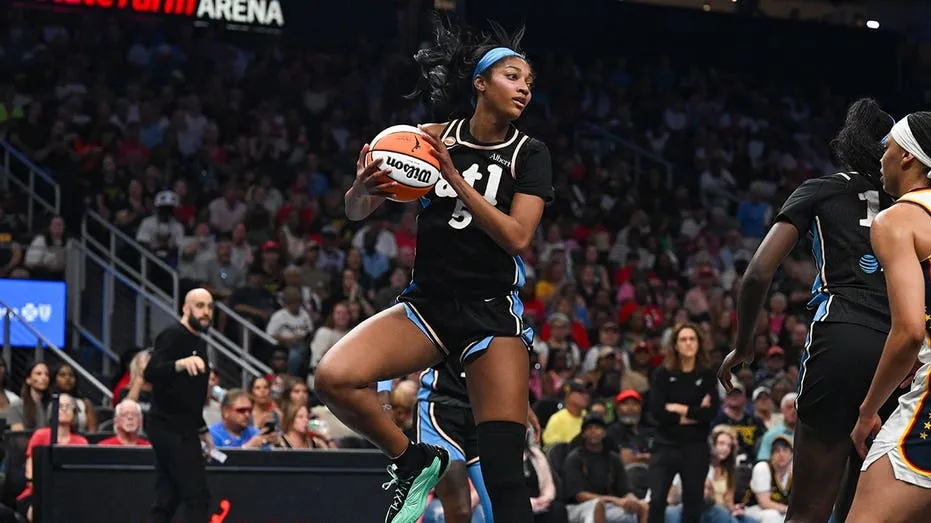
ESPN recently dedicated significant attention to WNBA rookie Angel Reese’s exceptional rebounding abilities, publishing a detailed feature that explored the factors behind her prowess on the boards. The network then amplified this narrative during its broadcast of the Chicago Sky vs. Indiana Fever game, prompting multiple mentions from commentators.
ESPN’s Feature on Angel Reese’s Rebounding Prowess
The ESPN article, penned by Katie Barnes, delves into what makes Angel Reese such a dominant force in rebounding. It highlights her impressive statistical achievements, noting that she reached 1,000 career rebounds in just 79 games, a pace faster than WNBA legend Tina Charles. Reese currently leads the league in rebounds per game, with her production being described as historically significant.
To illustrate Reese’s unique impact, the feature introduced the concept of the “mebound.” This term refers to rebounds secured by Reese after she has missed her own shot. According to the article, Reese has recorded 49 such “mebounds” this season, a figure that stands out significantly, being 25 more than the next closest player in the league. The story also pointed out that 148 of Reese’s points this season have originated from second-chance opportunities, accounting for 30% of her total scoring. Furthermore, her shooting percentage in the paint is reported at 46.0%, which is noted as the lowest among WNBA players with at least 175 attempts in that area.
Commentary During the Fever-Sky Broadcast
During the broadcast of the Chicago Sky vs. Indiana Fever game on Sunday, ESPN commentators Ryan Ruocco and Holly Rowe made several references to the feature story. Ruocco initially brought up the article in the first quarter, commending Barnes for her work on Reese’s rebounding skills. Later in the second quarter, Rowe echoed these sentiments, specifically praising the piece and sharing her favorite aspects of the story, concluding with a direct endorsement: “Great article, Katie Barnes.” This repeated promotion, occurring twice before halftime, underscores the network’s effort to draw attention to the feature.
The commentary continued even into overtime, with a third mention occurring after Reese missed a potential game-winning layup in the final seconds of regulation. The overarching message conveyed throughout the broadcast was that Angel Reese is not merely a great rebounder, but a “legendary” one.
Analysis of Reese’s Rebounding and Offensive Game
The ESPN article attempts to frame Reese’s rebounding success through various lenses, drawing comparisons to notable players like Dennis Rodman and Charles Barkley. It explores explanations ranging from the seemingly mystical – such as “rebounding DNA,” “basketball magnets in her palms,” and powers “beyond human understanding” – to the more grounded, like geometry and physics. Reese herself offers a simple, almost enigmatic explanation: “I just know.”
However, the piece also presents statistics that invite a more nuanced interpretation. The “mebound” phenomenon, while highlighting Reese’s tenacity and ability to pursue the ball, is also linked to her offensive efficiency. The article notes that a significant portion of her points come from second-chance opportunities, and her shooting percentage within the paint is relatively low compared to other high-volume scorers in that area. This suggests that while Reese excels at generating extra possessions through her rebounding, her offensive game, particularly her finishing around the basket, still presents areas for development.
The narrative presented by ESPN positions Reese’s ability to rebound missed shots as evidence of extraordinary skill, akin to having “basketball magnets in her palms.” Critics argue that this framing overlooks the fundamental aspect of basketball strategy and player effort. Chasing down one’s own misses, while indicative of hustle, is also a consequence of missed scoring opportunities. The article acknowledges Reese’s own assessment of her first-half performance against the Fever as playing “like s—,” despite the broadcast’s efforts to highlight her versatility, such as her ability to bring the ball up the court – an action that, in one instance, involved dribbling to the frontcourt and passing to a teammate.
Context and Corporate Synergy
The repeated promotion of the ESPN feature during a live game is a clear example of “corporate synergy,” a strategy employed by media companies to leverage different platforms for cross-promotion. While such tactics are common, the extent to which the broadcast seemed to pivot into a promotional tour for the article has drawn attention. The narrative pushed was that Reese’s rebounding is not just good, but legendary, supported by specific metrics like the “mebound” count.
Ultimately, while Angel Reese is undeniably a highly effective rebounder whose stats are historically impressive, the ESPN feature and subsequent broadcast commentary offered a particular interpretation. By emphasizing extraordinary explanations and highlighting specific metrics like “mebounds,” the network aimed to solidify her status as a unique and legendary talent. However, a closer look at the accompanying statistics also reveals a player still refining her offensive game, with a significant portion of her production stemming from relentless pursuit of the ball, including her own misses.
Reese’s ability to secure offensive rebounds, even off her own misses, contributes to her team’s opportunities and showcases her determination. The “mebound” statistic, while framed in a way that suggests almost supernatural talent, can also be seen as a reflection of her offensive struggles around the rim, coupled with her exceptional effort to correct those misses. This duality offers a more complete picture of her impact on the game.


