




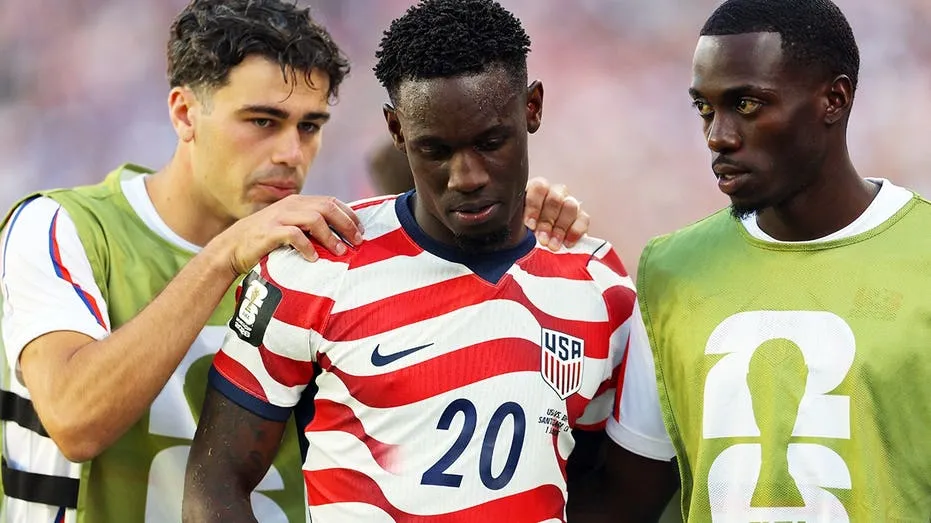
The Royal Belgian Football Association (RBFA) is formally challenging FIFA’s decision to overturn a red card suspension handed to U.S. World Cup standout Folarin Balogun. Reports indicate the RBFA has secured the right to appeal the governing body’s move, which effectively nullified the ban Balogun received during a recent match. The Belgian federation has formally requested a comprehensive explanation from FIFA regarding this unprecedented ruling.
FIFA’s Controversial Decision
The controversy stems from an incident where Folarin Balogun was shown a red card after VAR review for stepping on the ankle of Bosnia and Herzegovina defender Tarik Muharemovic. Typically, a red card in a World Cup match results in an automatic suspension for subsequent games. However, FIFA announced on Sunday that it was suspending Balogun’s ban for a probationary period of one year. This means Balogun can continue playing in the tournament without serving the suspension, provided he avoids similar offenses during the probationary year.
This decision marks a significant departure from historical precedent, with reports suggesting it’s the first time since 1962 that a red card issued during a World Cup has not led to an immediate suspension. The ruling has understandably caused consternation within the Belgian football community.
Belgian Federation’s Astonishment and Concerns
The RBFA expressed its profound astonishment at FIFA’s decision. Belgium’s coach, Rudi Garcia, did not mince words, humorously remarking through a translator, “I didn’t know that in the offices of FIFA the fifth of July was the first of April in Europe.” He further elaborated on the federation’s stance, stating, “The Belgian federation does not defend itself, it does not protect the national team. She defends football in general, she defends its integrity, her ethics. I think it’s the first time in the history of the World Cup that there is this kind of decision.”
Garcia declined to comment on potential appeals to the Court of Arbitration for Sport or speculate on any external influences on FIFA’s ruling. However, the RBFA issued a statement affirming its commitment to safeguarding the integrity of the sport: “In order to safeguard the legitimate rights of all participating teams and to protect the fundamental principles of fair play in our sport, both at this FIFA World Cup and at future editions of the tournament, the RBFA is investigating all potential options.”
U.S. Coach’s Reaction
In contrast to the Belgian reaction, U.S. coach Mauricio Pochettino lauded FIFA’s decision. He argued that his team had already suffered sufficiently from the initial red card incident, which forced them to play with ten men for a significant portion of the match against Bosnia and Herzegovina. Pochettino described the original decision as “completely unfair,” suggesting that the subsequent lifting of the ban was a necessary correction.
The Role of External Influence?
Adding another layer to the unfolding situation, a source indicated to The Athletic that former U.S. President Donald Trump had contacted FIFA President Gianni Infantino to request a review of Balogun’s red card. While the specifics of their conversation remain unconfirmed, the report suggests this intervention may have played a role in FIFA’s ultimate decision to suspend the ban.
FIFA’s Official Statement
FIFA’s official announcement regarding the probationary suspension stated: “The implementation of the match suspension is suspended for a probationary period of one year. If Folarin Balogun commits another infringement of a similar nature and gravity during the probationary period, the suspension shall be revoked and the sanction enforced without prejudice to any additional sanction imposed for the new infringement.” This clearly outlines the conditions under which the original suspension could be reinstated.
Looking Ahead
The RBFA’s decision to appeal signals a potential legal and ethical battle over FIFA’s disciplinary procedures. The federation’s commitment to upholding the principles of fair play suggests they will pursue all available avenues to contest a ruling they deem detrimental to the sport’s integrity. The outcome of this appeal could set a significant precedent for how red card offenses and subsequent suspensions are handled in future international tournaments.
The U.S. and Belgium are scheduled to face each other in a Round of 16 match in Seattle, adding an intriguing subplot to their upcoming encounter. The ongoing dispute over Balogun’s suspension casts a shadow over the tournament, raising questions about transparency and consistency in FIFA’s decision-making processes.


