

Sanders to Carville: Start Your Own Party Amidst Dem Divide
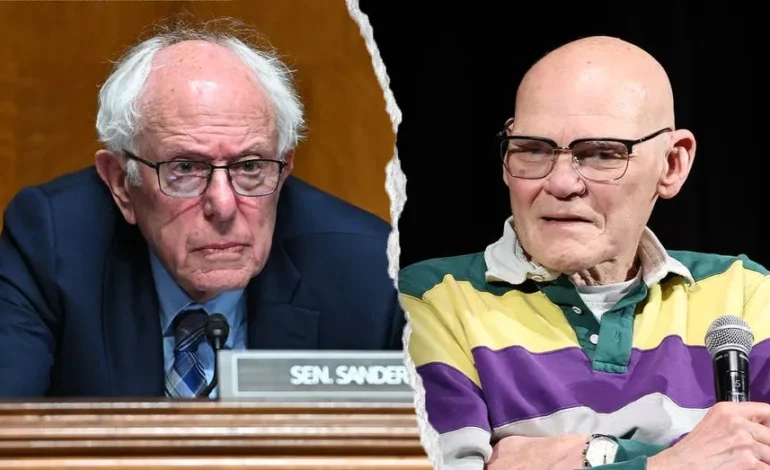

Senator Bernie Sanders has offered a pointed response to Democratic strategist James Carville’s threat to leave the party if it embraces figures like far-left streamer Hasan Piker. When asked by CNN’s Abby Phillip whether he’d choose a party that included both Carville and Piker, Sanders suggested Carville could simply form his own political movement if he found himself out of step with the current Democratic coalition.
Sanders Defends Inclusivity, Challenges Moderates
The Vermont senator, a prominent voice on the left, defended the inclusion of figures like Piker, who campaigned alongside Democratic Michigan Senate candidate Abdul El-Sayed. El-Sayed’s primary victory over moderate Rep. Haley Stevens was seen as a significant win for the progressive wing of the party.
“If Mr. Carville doesn’t want to be in my party, the party that I belong to, that Piker, that El-Sayed belongs to, he can start his own party,” Sanders stated. He framed the choice not as one between Carville and Piker, but rather as a broader question of the party’s direction. Sanders also turned the tables, questioning whether moderates would prefer a party that accepts funding from entities like AIPAC or supports what he termed an “extremist” Israeli government under Prime Minister Benjamin Netanyahu. He also raised concerns about the party’s stance on the AI industry, suggesting financial ties might influence policy.
“I think we need a big tent, and I think people like Piker should be welcomed into that, certainly,” Sanders added, emphasizing a desire for broad inclusion within the Democratic Party.
Moderate Democrats Sound Alarm on ‘Extremism’
Meanwhile, moderate Democrats and centrist organizations have voiced strong concerns about the party’s perceived shift to the left. The think tank Third Way shared data suggesting that voters in key battleground states viewed the Democratic Party as more extreme than the Republican Party in the 2024 election cycle, with 44% holding this view compared to 41% for Republicans. This perception, they argue, contributed to the party losing political power.
“Embracing extremism will only serve to hand Republicans a key pickup opportunity and imperil Democrats elsewhere,” the group warned. Third Way specifically pointed to El-Sayed’s association with Piker, highlighting Piker’s past controversial statements, including a 2019 remark where he suggested “America deserved 9/11.” While Piker later clarified that he did not intend to suggest the attacks were deserved and framed it as a critique of U.S. foreign policy, the comments have drawn condemnation from human rights groups and are seen by moderates as damaging political ammunition.
Third Way elaborated on the potential electoral consequences: “Republicans are salivating at the opportunity to pummel swing voters with ads of El-Sayed embracing extremist stances. Videos of El-Sayed with his arms around Hasan Piker alongside anti-American and misogynistic quotes, like claiming America ‘deserved’ 9/11, tweets about defunding the police, and photos of El-Sayed calling to abolish ICE will fill the timelines of voters in the middle.” The group stressed the mathematical necessity for Democratic candidates to secure significant support from moderate voters to win general elections, stating, “Democratic candidates like El-Sayed need to win over 60% of moderate voters to take back power and put a check on Donald Trump. That’s not spin — that’s math. So El-Sayed has work to do as he turns to the general election and it starts with dropping the extremism.”
Sanders Addresses Piker’s Past Remarks
When questioned about Piker’s 2019 comment regarding 9/11, Senator Sanders acknowledged it was a “dumb statement.” However, he also contextualized it by noting Piker’s large following and the resonance of many of his other messages. Sanders urged a move beyond “cancel culture,” suggesting that public figures, like anyone else, might occasionally say things they regret over the course of their careers.
“I suspect if you go back over your career, there may be one or two things that you’ve said that you may have regretted,” the senator remarked to Phillip. “But I think what we have got to do is look at the totality of where people are coming from and go forward.” He emphasized evaluating individuals based on their overall trajectory rather than isolating specific controversial remarks.
Carville’s Stance and Piker’s Response
James Carville had previously stated his unwillingness to be part of a Democratic Party that includes Hasan Piker. “I am not going to be in the same party with Hasan Piker,” Carville declared on “The Briefing.” “If he becomes a force in a Democratic Party, I’m out of here. I have no intention of ever being in the same political party with that guy.” Carville predicted a schism, stating, “One of us is going to leave. It might even be me.”
Hasan Piker, in turn, reacted to Carville’s remarks during a video discussion with Abdul El-Sayed. Piker seemed to playfully interpret Carville’s threat as an enticement, suggesting it was “sweetening the deal” for progressives. He also alluded to other figures like Senator John Fetterman, implying a broader internal debate within the Democratic Party about its ideological direction.
The exchange highlights the ongoing tension between the progressive and moderate factions of the Democratic Party, particularly as they navigate the influence of new media personalities and grapple with electoral strategies in an increasingly polarized political landscape.