




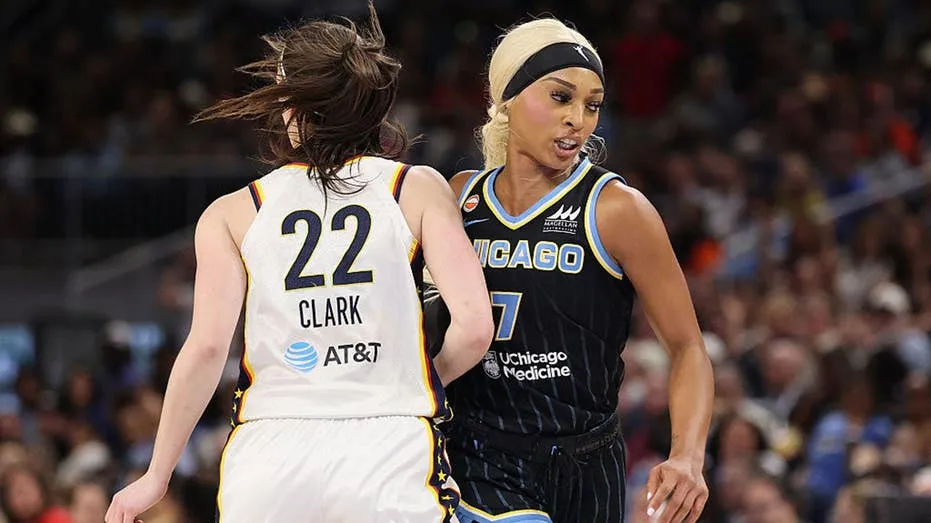
Former ESPN host Cindy Brunson has recently drawn attention for her commentary on the WNBA, particularly concerning player Caitlin Clark and a controversial play involving DiJonai Carrington. Brunson’s remarks have sparked debate about objectivity and bias in sports media coverage.
Carrington Incident and Brunson’s Stance
The discussion began following an incident where DiJonai Carrington was ejected from a game after a hard foul on Sophie Cunningham, which some characterized as a “clothesline.” Following the ejection, Carrington posted on social media about “white privilege.” In the aftermath, Brunson publicly defended Carrington, arguing that the foul should have been classified as a Flagrant 1, not a Flagrant 2, and that Cunningham, not Carrington, should have faced ejection. Brunson also shared a post suggesting “reverse DEI” benefited white WNBA players.
Brunson later elaborated on her position via Threads, stating, “I’m team @dijonai all day every day and at most that should’ve been a flagrant 1 not an ejection.” This declaration of allegiance to Carrington highlighted her strong feelings about the incident.
Critique of Caitlin Clark’s Performance
In a separate online discussion, Brunson appeared to criticize Caitlin Clark’s performance, even when Clark was not playing in the game being referenced. On a Sunday when Clark scored 37 points and dished out 10 assists in a victory for the Indiana Fever against the Chicago Sky, Brunson downplayed the achievement. She posted on Threads, “Miss me with that stat padding 37 points, on the floor up 20 w/ a minute to go BS. The 32 points in just 26 minutes was WAY more impressive from the ⭐ on the playoff team from the lone star state.” This comment was made while referencing a game between the Seattle Storm and the Dallas Wings, a game in which Clark did not participate.
Brunson subsequently deleted this post, attributing its removal not to its content, but to the “racist” and “transphobic” comments she received in response. This pattern of criticism and subsequent claims of victimhood has been noted by observers.
Record-Breaking Achievements and Brunson’s Reaction
More recently, Brunson’s commentary has focused on Caitlin Clark’s statistical milestones. Clark achieved her fifth career game with at least 30 points and 10 assists, a feat that surpasses the combined total of all other players in WNBA history. Despite this significant accomplishment, Brunson dismissed it as a “small sample size.” This assertion has been met with skepticism, given that Clark has reached this milestone in fewer than three full seasons, while the rest of the league’s players have achieved it only four times in the WNBA’s 30-year history.
In contrast, Brunson celebrated Paige Bueckers’ performance of 22 points and 11 assists in a game where her team won by 18 points. Notably, Brunson did not apply the same “stat-padding” or “small sample size” criticisms to Bueckers’ performance, despite a similar margin of victory.
Divergent Standards for Angel Reese
The commentary extended to Angel Reese, another prominent player. When Reese broke a rebounding record, Brunson praised her enthusiastically, posting, “So impressive @Reese10Angel just broke a record that has stood since May of 2003 when Chamique Holdsclaw hauled in 24 rips for her Mystics vs the Shock. Reese finished w/ 26 rebounds, 18 on the defensive glass. So TUFF. #WNBA.”
When users pointed out that Reese’s record-breaking game also involved a significant margin of victory, mirroring the conditions Brunson used to diminish Clark’s achievements, Brunson’s response shifted. She argued that for Reese, “It doesn’t matter who the competition is, she set not one, but two WNBA records tonight!!️” She further emphasized that the starters were playing until the end of the game, implying the context was less relevant than the record itself.
This selective application of criteria has led to accusations that Brunson holds different standards for different players. The article notes instances where Angel Reese’s stats have allegedly been padded late in games, with videos circulating as evidence, yet these instances did not draw the same level of scrutiny from Brunson as Clark’s statistical achievements.
Impact on Credibility
The author suggests that while Brunson may not exhibit the same level of overt bitterness as some other critics of Clark, her commentary has significantly damaged her own credibility. The perceived inconsistency in her evaluations of players like Clark and Cunningham compared to others in the league is seen as undermining her objectivity.
The piece concludes by positing that Brunson, and others who exhibit similar patterns of commentary, may be contributing more to the WNBA’s divisiveness than external factors like fan bases. The author questions whether the perceived need to cater to a specific segment of WNBA fans on social media platforms is worth sacrificing broader public trust and journalistic integrity.


