




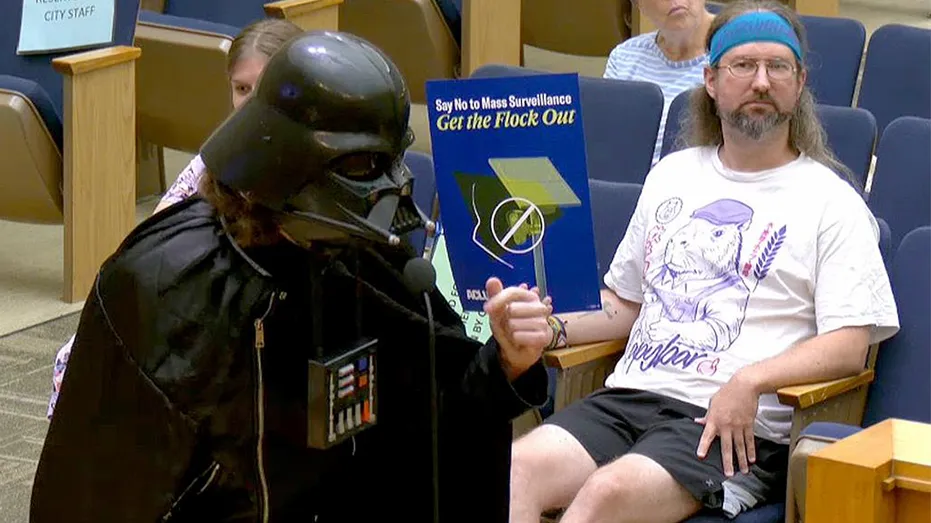
In a move that blended galactic villainy with local civic discourse, a man clad as the iconic Star Wars antagonist Darth Vader appeared before the San Diego City Council’s Public Safety and Livable Neighborhoods Committee. His mission? To offer a darkly humorous, yet pointed, defense of the city’s controversial Flock surveillance cameras.
Arriving with the unmistakable, heavy breathing of the Sith Lord amplified through the council chamber’s microphone, the caped crusader took to the podium. Committee members, seemingly playing along, addressed him as ‘Darth Vader’ as he launched into a critique that drew heavily from the Star Wars saga to highlight concerns about the surveillance technology.
The Emperor’s New Surveillance Tools
The man, channeling the Dark Lord of the Sith, suggested that the Flock system was precisely the kind of tool the Emperor would covet. “This is what the emperor needs,” he declared, his voice modulated to mimic Vader’s menacing tone. “This technology will help us find the rebel scum and the hidden base on Hoth.”
He continued his theatrical performance, drawing parallels between the cameras’ capabilities and the Galactic Empire’s pursuit of the Rebel Alliance. “This technology will help us find Luke Skywalker as he traverses the universe in his X-Wing. This technology is a necessary, necessary force.”
The critique took a more pointed turn as the man elaborated on the perceived reach of the cameras. “The Emperor is a fan of Flock, and we must continue utilizing Flock technologies so that we can follow and surveil the rebel scum as they move from playground to playground, from playground to pool, from pool to gymnasium,” he stated. He then voiced a common concern raised by privacy advocates: “because we all know that the Flock cameras are not only following the license plate readers, they are following children.”
Adding a layer of personal, albeit mock, grievance, he quipped, “I need the cameras so I can stalk my ex-girlfriend.”
A Plea for Jedi Mind Tricks
Turning his attention to City Council member Jennifer Campbell, the faux Vader suggested she needed to brush up on her Jedi skills, particularly when it came to public trust and technology adoption. “And how will the people trust this City Council when this City Council continues to vote for surveillance technology that imprisons them? Ms. Campbell, you must work on your Jedi mind tricks,” he advised, concluding with a characteristic Vader-esque hand wave.
Understanding Flock Surveillance in San Diego
The theatrical protest comes amidst ongoing debate about the proliferation of automated license plate recognition (ALPR) systems. The San Diego Police Department (SDPD) has deployed Flock ALPR cameras at approximately 500 locations across the city, according to the department’s 2025 annual surveillance report. These cameras capture license plate numbers along with vehicle characteristics like make, model, and color. Some Flock systems can also identify distinguishing features such as bumper stickers or aftermarket modifications.
In December 2025, the SDPD entered into a one-year pilot agreement for Flock Nova, an investigative platform intended to integrate data from various sources. However, the department later clarified that it was not using this specific platform and had no plans to integrate its ALPR data into it. This clarification was reported by Axios.
Concerns about such surveillance technologies are not unique to San Diego. Local activists and some city officials nationwide have voiced criticisms, prompting calls for alternative solutions. A crowdsourced map maintained by the anti-surveillance project DeFlock attempts to document camera locations, though it is not an official city registry.
Police Department’s Stance on Camera Use
San Diego police maintain that the Flock cameras are utilized strictly for official law enforcement purposes, including the identification of vehicles linked to ongoing investigations. The department asserts that access to its ALPR database is restricted to authorized SDPD personnel. Furthermore, data is typically retained for a maximum of 30 days and is automatically deleted unless it is preserved as evidence in an active case.
Flock’s product offerings include automated license plate readers, video cameras, and audio-detection devices, contributing to a growing landscape of public surveillance technologies that continue to spark debate about privacy versus public safety.
Conclusion: A Galactic Analogy for Local Concerns
The appearance of Darth Vader at the city council meeting, while unconventional, served as a memorable and attention-grabbing way to voice concerns about government surveillance. By using the familiar narrative of Star Wars, the protestor highlighted anxieties about data collection, potential misuse, and the erosion of privacy in an increasingly monitored world. The incident underscores the broader national conversation surrounding the implementation and oversight of advanced surveillance technologies in public spaces.


