




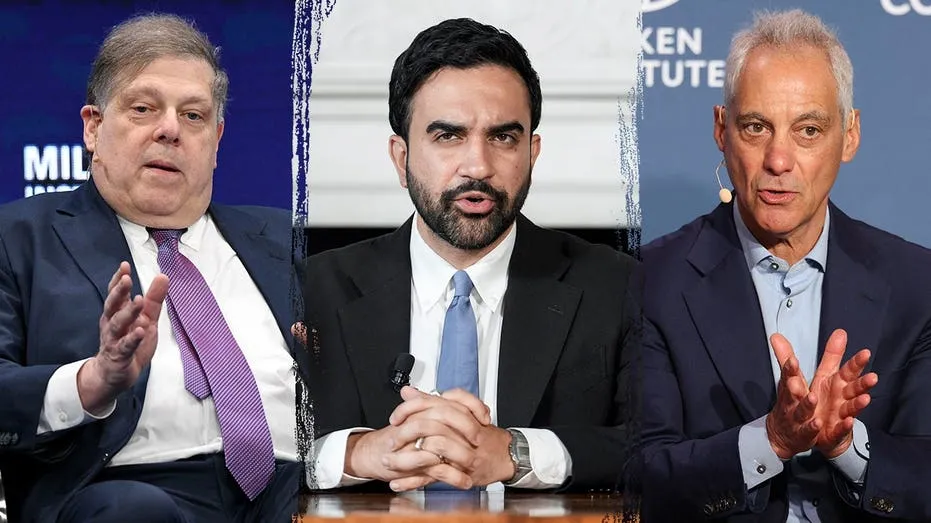
Two influential figures from the Democratic Party’s past administrations have publicly voiced strong criticisms of New York City Mayor Zohran Mamdani, targeting his proposed property tax policies and his stance on Israel. The critiques come from Mark Penn, a former advisor to President Bill Clinton, and Rahm Emanuel, who served as White House Chief of Staff under President Barack Obama. Their criticisms are particularly noteworthy as they originate from within the Democratic establishment, rather than from Republican opposition, and address key issues that have shaped Mamdani’s political ascent: his progressive economic platform and his views on the Israeli-Palestinian conflict.
Penn Challenges Mamdani’s Property Tax Proposal
Mark Penn, a seasoned Democratic strategist and former pollster for Bill Clinton, has sharply disputed Mayor Mamdani’s characterization of a proposed tax on high-value properties, often referred to as a “pied-à-terre” tax. Following the release of a public database by the city identifying property owners potentially subject to the tax, Penn argued that the scope of the proposal has been significantly understated by the mayor’s office.
In a detailed post on the social media platform X, Penn asserted that the city’s valuation methods have inadvertently included nearly one million property owners. This figure, he contended, is vastly larger than the approximately 30,000 owners of luxury homes that Mamdani’s administration had initially indicated would be the target. “The $5 million figure was a fake,” Penn declared, elaborating that the city’s valuation system had improperly categorized properties. He further suggested that homeowners would now bear the burden of proving why they should be exempt from the tax.
Beyond the numbers, Penn also raised concerns about the potential economic repercussions of Mamdani’s tax plan. He suggested that the policy could lead to a decline in property values across the city, deter potential investment, and possibly face legal challenges on constitutional grounds. The implication is that such a tax could harm New York City’s broader economic health.
Emanuel Recounts Confrontation Over Israel Stance
Meanwhile, Rahm Emanuel, a prominent Democrat and former Mayor of Chicago, revealed details of a private meeting he had with Mayor Mamdani. Speaking on the “Unholy Podcast,” Emanuel stated that he met with Mamdani for about 90 minutes and used the opportunity to challenge the mayor’s rhetoric concerning Israel. While Emanuel acknowledged appreciating certain aspects of Mamdani’s domestic policy agenda, such as his focus on childcare, he expressed strong disapproval of Mamdani’s past use of the slogan “from the river to the sea.”
Emanuel recounted his exchange with Mamdani, stating, “I know where there’s a line. You don’t.” He argued that both the concept of a “Greater Israel” and the slogan “from the river to the sea” are inherently linked to “perpetual conflict.” The former White House official’s comments, particularly after clips circulated online, drew a swift response from Mamdani’s office.
Anna Bahr, Mamdani’s communications director, publicly disputed Emanuel’s account on X, writing, “can confirm this…. did not happen.” It remained unclear from her statement whether she was refuting the occurrence of the meeting itself or Emanuel’s interpretation of their conversation. The exchange highlights the deep divisions within the Democratic Party regarding foreign policy and the Israeli-Palestinian conflict.
Broader Criticism of the Democratic Socialists of America
Emanuel’s critique of Mamdani extends to a broader commentary on the direction of the progressive wing of the Democratic Party, specifically targeting the Democratic Socialists of America (DSA). In a separate post on X this week, Emanuel argued that the party’s focus should be on electoral victories rather than what he perceives as ideological distractions.
He articulated a stark choice for Democrats: “You can be focused on winning tough races, flipping red seats blue. Or you can be focused on abolishing prisons and… the Senate and Supreme Court? You can’t do both,” Emanuel wrote. He concluded by stating his priority: “I’m for winning this November and ending Trump’s corruption — and I’m also for putting an end to all the distractions from the DSA.” This sentiment reflects a tension within the party between pragmatic, centrist Democrats and the more ideologically driven left wing.
Context of the Criticisms
The public criticisms from Penn and Emanuel underscore a significant debate within the Democratic Party concerning economic policy and foreign relations. Mayor Mamdani, who has risen to prominence with a platform advocating for wealth redistribution and a critical stance on certain Israeli policies, finds himself at the center of these internal party discussions. His policy proposals, particularly the tax on high-value properties, have generated considerable debate about their economic impact and fairness. Similarly, his remarks on Israel have drawn scrutiny from more traditional or centrist Democrats who view his positions as potentially harmful to the party’s broader goals and international relationships.
The involvement of figures like Penn and Emanuel, who have held powerful positions in previous Democratic administrations, lends considerable weight to these critiques. Their willingness to publicly challenge a rising figure like Mamdani signals a potential internal struggle over the party’s future direction and its core policy priorities. As New York City navigates complex economic challenges and the nation grapples with geopolitical issues, the internal debates within the Democratic Party, as exemplified by these exchanges, are likely to continue shaping political discourse.


