




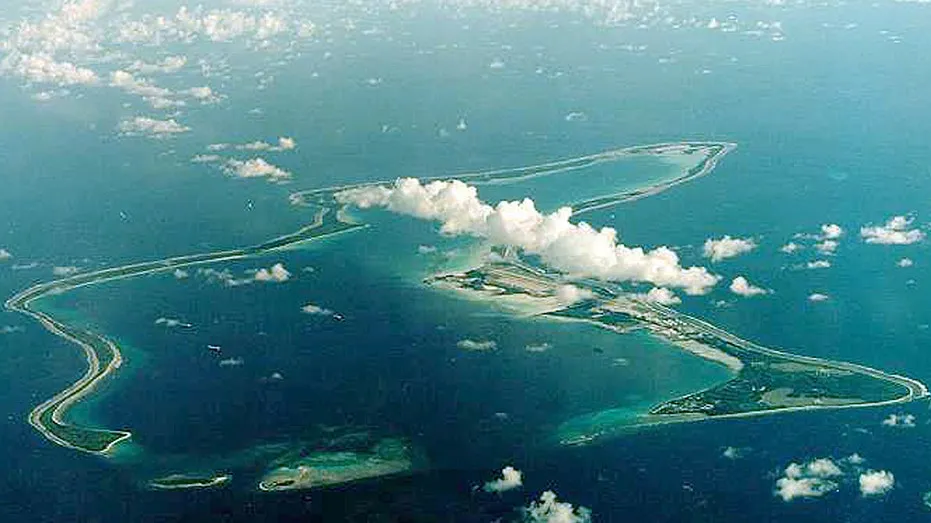
The ongoing conflict with Iran has brought the remote U.S. military base on Diego Garcia into sharp focus, highlighting its critical role in regional stability and U.S. logistical operations. Following an Iranian strike on a significant American installation in Bahrain, the Pentagon has reportedly shifted logistical support to the U.K.-U.S. base situated in the southern Chagos Archipelago, located in the Indian Ocean.
Diego Garcia: A Vital Hub in Shifting Military Logistics
The strategic repositioning underscores Diego Garcia’s importance as a secure alternative for military supply lines. According to reports, the base has been instrumental in supporting carrier strike groups, including the USS Abraham Lincoln, which has conducted air operations and enforced blockades on Iranian ports. The U.S. military’s wartime logistics network now spans an approximate 2,200-mile maritime route to Diego Garcia. This extended route allows forces to bypass coastal facilities that are more vulnerable to Iranian attacks, though it necessitates longer transit times and slower replenishment cycles.
James Tumbridge, serving as attorney general for the self-described Chagossian government-in-exile and an international lawyer, commented on the situation. “That is an inconvenience, but it shows the importance of the base,” he stated. “The base is integral to regional security for the U.K., U.S. and our allies. This latest news emphasizes it.” Tumbridge further noted the practicality of the logistical shift, explaining, “Bahrain is a far easier target, so the U.S. change of supply arrangement makes sense.” He expressed hope that the new British Prime Minister would support continued U.S. access to the base.
Sovereignty Debates and U.S. Interests
The heightened reliance on Diego Garcia has also reignited discussions surrounding its sovereignty. A treaty signed in 2025 between the U.K. and Mauritius aimed to recognize Mauritian sovereignty over the Chagos Archipelago, while granting the U.K. control of Diego Garcia for an initial 99-year period. However, the British government later paused the implementation of this agreement due to renewed concerns from the U.S. regarding the sovereignty transfer.
Reports from June indicated that U.S. officials had explored options to bypass the U.K. and negotiate directly for control of Diego Garcia, presenting an alternative to the then-Prime Minister Keir Starmer’s plan to transfer sovereignty to Mauritius. In response to these developments, the first minister of the Chagossian government-in-exile asserted that the Chagos Islands were not for sale. While acknowledging the U.S. desire to secure the military base, he clarified that only the U.K. possesses the authority to sell the islands.
Tumbridge elaborated on the complexities of the sovereignty issue, stating, “The arguments over sovereignty do not get fixed via a sale, and Mauritius cannot sell them unless the U.K. first gives them away.” He emphasized his preference for the U.K. to retain control, saying, “It is not in the U.K.’s interest to sell them. Whether we keep them and continue our support for the U.S. base or we cede them to Mauritius is the choice — my desire is the former.”
International Court Rulings and U.K. Policy
Mauritius has long asserted its claim to sovereignty over the archipelago, a position supported by a 2019 advisory opinion from the International Court of Justice and subsequent United Nations actions. Despite this, the U.K. government had initially withheld approval for offensive strikes from Diego Garcia. However, in March, the U.K. permitted the U.S. to conduct limited defensive operations targeting Iranian missile capabilities.
Tumbridge recalled the initial U.S. request for broader operational use of Diego Garcia for air strikes. “The U.S. wanted to use Chagos Diego Garcia for air strikes at the very beginning. The U.K. consulted Mauritius and refused — hence Trump finally appreciating why sovereignty transfer was a problem,” he explained. He also mentioned that following attacks on Cyprus, the U.K. allowed certain defense uses, and that Iran had indeed fired missiles toward Diego Garcia, though they missed their intended target.
Iranian Missile Incident and Base Security
On March 20, reports indicated that Iran had launched two ballistic missiles toward Diego Garcia. One missile reportedly failed during flight, while a U.S. warship engaged the other with an interceptor, though the success of the interception was initially uncertain. British officials later confirmed that one missile fell short and the other was successfully intercepted.
Regarding the incident, Tumbridge downplayed significant security concerns, stating, “No serious concerns have been shared — the earlier attempt showed a lack of range and targeting ability.” He added that claims by the British Government and the Commissioner for the Territory suggesting the attack made the islands unsafe were not widely believed. “No one seriously believes that Iran would try to target the outer islands that presently only have a population of six people,” he commented.
Naval Deployments and Future Operations
The renewed focus on Diego Garcia and the reported logistical challenges for U.S. forces occurred as the USS Abraham Lincoln neared nine months of continuous deployment in the region. During an event at Joint Base Andrews on August 14, then-President Trump announced that a new aircraft carrier was en route to the Middle East to relieve the Lincoln. “That ship is moving,” Trump remarked when questioned by reporters about the carrier’s status.
Meanwhile, Admiral Brad Cooper, commander of U.S. Central Command, met with service members aboard the carrier. The vessel is expected to be replaced amid concerns raised by military families regarding the extended deployment duration. Inquiries were made to the Pentagon for comment on the situation.


