
DiJonai Carrington’s Foul, ‘White Privilege’ Claim Spark Controversy
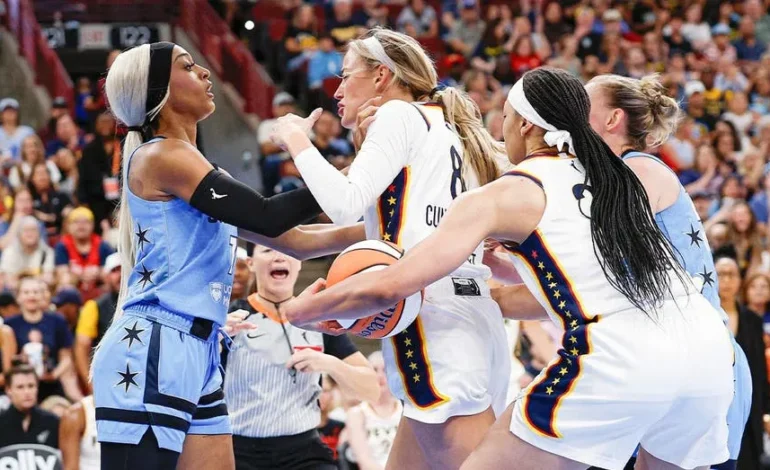

A contentious play during a recent WNBA game between the Chicago Sky and Indiana Fever has ignited a firestorm of debate, centering on a hard foul by DiJonai Carrington on Sophie Cunningham and Carrington’s subsequent social media post. The incident, which saw Carrington ejected from the game, has drawn scrutiny not only for the on-court action but also for the post-game commentary and the broadcast coverage.
The Foul and Ejection
The controversy began Saturday afternoon when Chicago Sky player DiJonai Carrington committed a flagrant foul against Indiana Fever forward Sophie Cunningham. Video footage widely circulated online shows Carrington making contact with Cunningham around the neck area as Cunningham attempted a layup. The aggressive nature of the foul led to Carrington’s immediate ejection from the game.
Following the ejection, Carrington posted a statement on social media from the locker room, attributing her removal from the game to “white privilege.” This claim immediately amplified the situation, turning a significant on-court infraction into a broader discussion about race and privilege within the league.
Contextualizing the Players Involved
The identities of the players involved add layers of complexity to the unfolding narrative. Sophie Cunningham has recently been at the center of public discussion following her comments regarding the inclusion of transgender athletes in women’s sports. Cunningham stated that biological males should not compete against biological females, a stance that has sparked debate extending beyond the sports arena into broader cultural conversations.
DiJonai Carrington also brings a history of controversial play. Notably, she was involved in an incident where she made contact with the eye of Caitlin Clark during a previous game. This occurred shortly after Carrington had publicly commented on Clark’s perceived “white privilege” via social media, drawing parallels that some observers found significant.
Broadcast Coverage Under Fire
The handling of the incident by ESPN’s broadcast has become a focal point of criticism. According to reports, the network showed only one replay of Carrington’s foul immediately after it occurred. Furthermore, the halftime show, which focused on the Fever-Sky game, reportedly did not address Carrington’s social media post or the “white privilege” accusation.
Critics have drawn comparisons to other major sports leagues, suggesting that a similar incident involving high-profile players and a social media accusation of racism would likely receive more extensive coverage. The absence of commentary on Carrington’s post during the broadcast has led to accusations that ESPN is selectively reporting on events to fit a particular narrative.
In response to inquiries, ESPN has not detailed its awareness of Carrington’s post during the broadcast. A source familiar with the network’s production plans indicated that while Carrington’s ejection for the flagrant foul was addressed during the game, the plan was not to cover off-court social media developments as the broadcast continued. A second replay of the foul was shown later in the game, but it was reportedly used to contrast with another, less severe foul.
Narrative and Accusations
Commentators and observers have suggested that the perceived lack of coverage stems from a narrative that some ESPN personalities have promoted regarding racial dynamics within the WNBA. These narratives have suggested that popular white players like Caitlin Clark and Sophie Cunningham, along with their fan bases, are somehow co-opting the league to express animosity towards Black women and lesbians.
Conversely, some argue that the popularity of players like Clark and Cunningham has generated feelings of jealousy and bitterness among certain Black women in the league and those covering it. This perspective posits that accusations of racism and white privilege are used as a coping mechanism to address this disparity in attention and success.
The incident involving Carrington and Cunningham, in this view, is presented as tangible evidence that challenges the narrative of systemic racism within the league, suggesting instead that the aggressors might be those making the accusations. The question remains open as to which ESPN personalities might defend Carrington and attribute blame to Cunningham or broader issues of racism.
Call for Accountability
The debate extends to calls for disciplinary action. Some critics argue that DiJonai Carrington’s actions warrant a suspension of multiple games due to the dangerous nature of the foul. The assertion is that Carrington is not a victim of racial bias but rather an aggressor with a perceived issue towards white women, and that her foul was a clear instance of unsportsmanlike conduct.
This complex situation highlights the intersection of on-court performance, player conduct, social commentary, and media coverage, leaving many to dissect the motivations and implications behind the foul, the subsequent accusations, and the way the events were presented to the public.