




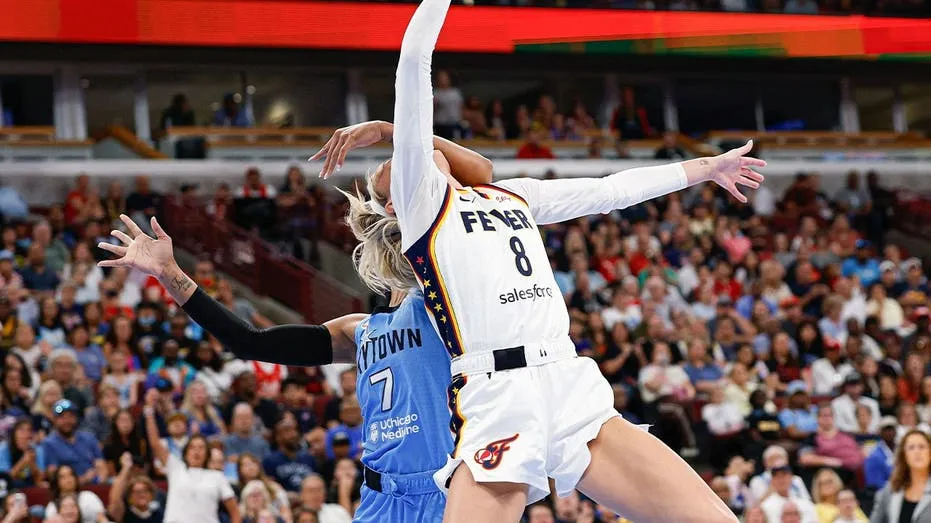
The WNBA has found itself in the spotlight recently, though not always for the reasons its players or fans might prefer. A particularly charged moment involved Indiana Fever guard DiJonai Carrington and a controversial social media post following an on-court incident. After a flagrant foul that left opponent Sophie Cunningham with a bloody mouth, Carrington posted “White privilege” and tagged the Fever, sparking widespread debate and speculation.
The Incident and the Post
The foul occurred during a game between the Indiana Fever and another team, where Carrington committed what was deemed an aggressive foul, earning her an ejection. The incident gained further traction because Cunningham has previously drawn attention for her stance on transgender athletes participating in women’s sports. The situation escalated when Carrington took to social media shortly after the game.
Her post, “White privilege,” accompanied by a tag to the Indiana Fever’s official account, was widely interpreted by many observers as an accusation that the severity of the foul’s assessment was influenced by racial bias. The implication, as many saw it, was that Carrington believed she received a harsher penalty because she is Black and Cunningham is White.
Carrington’s Defense and Lack of Clarity
The immediate backlash to Carrington’s post prompted a response from the player herself. Addressing the criticism, particularly from commentator Emmanuel Acho, Carrington clarified that her post was not about the foul’s assessment itself. She stated on X (formerly Twitter), “I’ve never once claimed that the assessment of the foul was White privilege (that was your assumption).”
Carrington emphasized her understanding of the term “White privilege,” asserting her educational background and research on the subject. “I would never use that term as a rhetorical weapon knowing the historical and social weight it holds without having the proper evidence to substantiate it,” she wrote, suggesting that her use of the phrase was deliberate and based on a deeper context.
However, as of Wednesday evening, Carrington had not provided the specific “proper evidence” she mentioned, leaving the precise meaning of her post ambiguous to the public and many commentators. The WNBA itself has largely remained silent on the matter.
Jemele Hill’s Interpretation
Amidst the confusion and ongoing discussion, sports analyst Jemele Hill weighed in on X, responding to Acho’s criticism of Carrington. Hill stated that it was “pretty clear” to her that Carrington “wasn’t talking about the foul.” This assertion led many, including Acho and OutKick, to seek further clarification from Hill, hoping she could illuminate Carrington’s intended meaning.
When pressed for an explanation, Hill offered a partial insight. She responded to one user by saying, “I knew exactly what she meant, especially since Sophie Cunningham wasn’t assessed a technical for her reaction when other players have been.” This comment suggests Hill believes Carrington’s post might have been related to perceived disparities in how players’ reactions to fouls are penalized.
Analyzing Hill’s Explanation
Hill’s interpretation, however, presents its own set of challenges. Carrington herself indicated that her post wasn’t about the foul’s assessment. If Hill’s view is correct, then Carrington’s “White privilege” comment would be linked to the aftermath of the foul—specifically, Cunningham’s reaction and the lack of a technical foul against her. This still seems indirectly connected to the foul itself, despite Carrington’s disclaimer.
Furthermore, the officiating crew addressed the very point of Cunningham’s reaction after the game. Lead official Maj Forsberg explained that Cunningham’s response was deemed acceptable given the severity of the foul she endured. “After Cunningham was flagrantly fouled, we deemed her reaction to the severity of the contact to be acceptable,” Forsberg stated to pool reporters. This official explanation suggests that Cunningham’s reaction was a natural response to being physically impacted, rather than an instance of preferential treatment.
The question then arises: is Hill implying that it’s “White privilege” to not receive a technical foul for reacting strongly after being severely fouled? Such an interpretation seems to strain credulity, especially considering how most athletes would react under similar circumstances. It also overlooks the established disciplinary records within the league. For instance, Caitlin Clark and Angel Reese are among the league leaders in technical fouls, with Cunningham having accumulated three this season, while Carrington has only one. This data does not readily support a narrative of racial bias in technical foul assignments.
The Lingering Mystery
Ultimately, DiJonai Carrington’s “White privilege” post, despite Jemele Hill’s assertion of clarity, remains a subject of considerable mystery. While Carrington has defended her use of the term based on her understanding and research, and Hill has offered a potential interpretation related to in-game officiating reactions, the precise context and intended message have not been definitively communicated. Without further explanation from Carrington or a clearer elaboration from Hill, the meaning behind the post continues to be a topic of speculation among fans and media alike.
The incident highlights the complexities of social commentary in sports and the challenges that arise when sensitive terms are used in public forums, especially when the intended meaning is not immediately apparent to a broad audience. The WNBA’s quiet stance further adds to the intrigue, leaving many to wonder what, if anything, will bring further resolution to this debated moment.


