




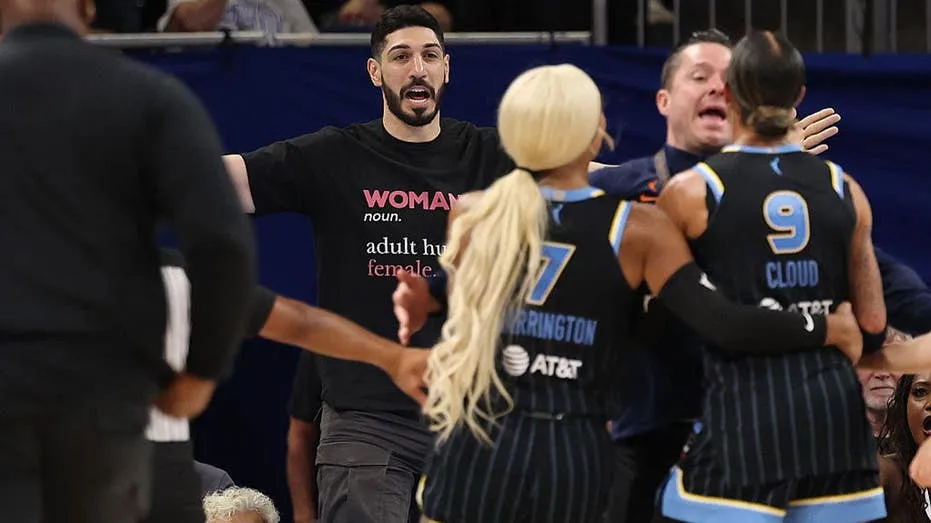
An investigation into the removal of former NBA player Enes Kanter Freedom from a Chicago Sky game has been initiated, with his legal representatives filing a public records request to scrutinize the incident. The America First Policy Institute (AFPI), representing Freedom, submitted a detailed request on Friday to the Metropolitan Pier and Exposition Authority (MPEA), the government body overseeing Wintrust Arena, where the ejection occurred. This move comes after Freedom was removed from a WNBA game and subsequently banned from the venue.
Details of the Incident and the FOIA Request
The controversy unfolded during a WNBA game between the Chicago Sky and the Indiana Fever. Enes Kanter Freedom, attending the game, was seen wearing a shirt with the message “WOMAN noun. adult human female.” During a third-quarter timeout, Sky guard Natasha Cloud reportedly approached Freedom’s courtside seat, leading to a verbal exchange. Following the interaction, security personnel intervened and escorted Freedom out of the arena after he moved toward the court. He was later banned from Wintrust Arena.
In response, AFPI, acting on Freedom’s behalf, has invoked the Illinois Freedom of Information Act to obtain crucial documents. The six-page request aims to shed light on the decision-making process and the authorities involved in Freedom’s removal and ban. Leigh Ann O’Neill, chief legal affairs officer at AFPI, stated, “Enes Freedom exercised his constitutional right as an American when he attended the WNBA game in Chicago. Today, we launched an investigation, seeking critical documents that will assist in our efforts to ensure that public entities are held accountable when American’s constitutional rights are trampled.”
Scope of the Records Sought
The MPEA, a municipal corporation established by the Illinois General Assembly with board members appointed by the state’s governor and Chicago’s mayor, owns Wintrust Arena. The arena operates under a public-private partnership involving DePaul University. AFPI’s request targets several key areas:
- Agreements between the MPEA, arena operator Oak View Group, the Chicago Sky, and the WNBA.
- The MPEA’s security policies and any law enforcement agreements related to the arena.
- Documentation identifying the specific individuals or entities that authorized Freedom’s removal and subsequent ban.
- Records detailing any federal funding received by the arena.
- Information clarifying who holds ultimate authority over access, security, and event operations at the publicly owned facility.
AFPI has also formally requested that the MPEA preserve all potentially relevant electronic communications, including emails, text messages, and internal correspondence, while the records are being compiled and produced on a rolling basis. It is important to note that the filing of this records request does not, in itself, constitute proof that Freedom’s constitutional rights were violated. Rather, AFPI is seeking information that could help establish whether the actions of the Sky or arena personnel can be linked to a public entity, thereby potentially implicating constitutional concerns.
Context and Precedent
Enes Kanter Freedom has previously been a vocal critic of various political figures and policies, leading to public attention and sometimes controversy. His ejection from the WNBA game and the subsequent legal action highlight ongoing discussions about free speech, public venues, and the intersection of personal expression with event policies. While no lawsuit has been filed to date, the FOIA request represents a significant step in gathering information that could inform future legal or public relations strategies.
The MPEA and the Chicago Sky have been approached for comment regarding the incident and the records request. The outcome of the FOIA request is anticipated to provide greater clarity on the operational protocols and decision-making hierarchies within Wintrust Arena concerning spectator conduct and access.
Moving Forward
The investigation launched by AFPI signifies a commitment to scrutinizing the handling of the incident and ensuring accountability for public entities. By leveraging the Freedom of Information Act, the organization seeks to uncover the specific policies and individuals involved in the decision to remove and ban Enes Kanter Freedom. The findings could have implications for how similar situations are managed in the future, particularly concerning the rights and treatment of individuals expressing views within publicly managed spaces. The process of obtaining and reviewing these public records is expected to take time, but the initial filing marks a determined effort to seek transparency and justice for the incident.


