




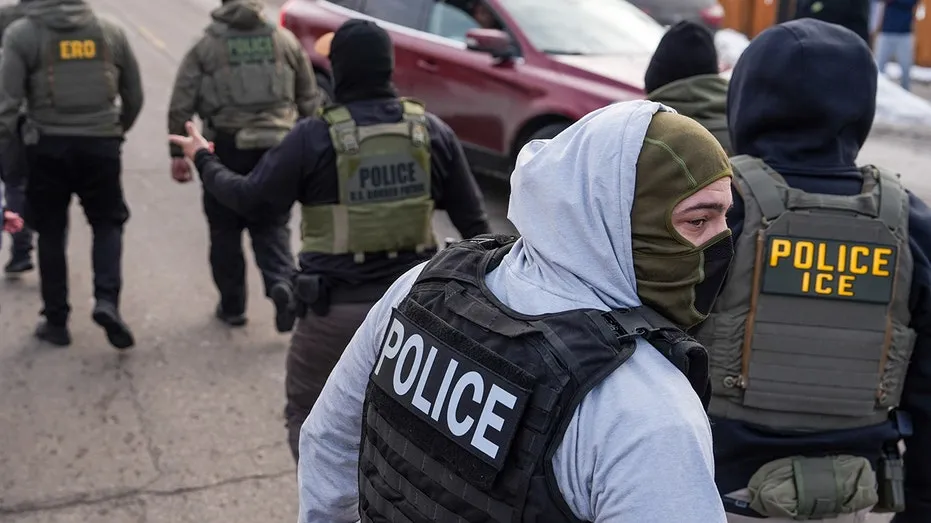
A federal judge has temporarily blocked key provisions of a New York law that would have prevented federal immigration agents from wearing masks and required them to display visible identification while on duty. U.S. District Judge Mae D’Agostino, presiding in the Northern District of New York, issued a preliminary injunction on Monday, halting the state’s enforcement of these specific measures as a legal challenge proceeds.
Interference with Federal Authority Cited
In her ruling, Judge D’Agostino determined that the challenged parts of the law were likely unconstitutional. She reasoned that they improperly interfere with the operations of federal law enforcement agencies, including Immigration and Customs Enforcement (ICE), the FBI, the Drug Enforcement Administration (DEA), and U.S. Customs and Border Protection (CBP). The judge emphasized that only the federal government possesses the authority to set policies governing federal law enforcement activities.
“New York cannot impose its own uniform requirements on federal agents simply because it disagrees with how the Federal Government is exercising its authority,” the ruling stated. This means the state cannot dictate the operational procedures for federal agents carrying out their official duties.
State Officials Reviewing Options
Governor Kathy Hochul and New York Attorney General Letitia James expressed disappointment with the court’s decision to block the mask ban. In a joint statement, they indicated that their offices are currently reviewing all available legal avenues. “While the court enjoined enforcement of New York’s mask ban, we stand firm in our belief that masked agents do not make New York safer and our offices are reviewing all legal options at this time,” the statement read.
Provision on Local Enforcement Remains
However, Judge D’Agostino did not block a separate provision of the law that prohibits New York’s local law enforcement agencies from engaging in certain federal immigration enforcement functions through 287(g) agreements. The judge explained that participation by state and local agencies in federal civil immigration enforcement is voluntary under federal law. Therefore, the state’s decision not to cooperate in this capacity, a choice contemplated by federal statutes, does not constitute discrimination against the federal government.
Governor Hochul and Attorney General James welcomed this aspect of the ruling. They reiterated their stance that New York taxpayers should not be obligated to fund local cooperation with federal immigration authorities. “As we have said from the start, New York’s ban on 287(g) agreements is legal and will keep our communities safe. Local law enforcement should be focused on local matters, and New York taxpayers should not have to foot the bill for any collaboration with ICE,” their statement concluded.
Background on the Law
The law in question, passed by New York State, aimed to enhance transparency and accountability in immigration enforcement within the state. Proponents argued that requiring federal agents to be identifiable and prohibiting masks would help distinguish them from other law enforcement personnel and prevent potential misuse of authority. The ban on masks, in particular, was framed as a measure to ensure public safety and prevent individuals from concealing their identities while acting in an official capacity.
The legal challenge was brought forth by the federal government, arguing that the state law overstepped its boundaries by attempting to regulate the conduct of federal officers. The core of the federal argument centered on the Supremacy Clause of the U.S. Constitution, which generally holds that federal law supersedes state law when there is a conflict. Federal agencies contended that the state’s restrictions on their agents’ attire and identification procedures could hinder their ability to conduct sensitive operations effectively and safely.
The Role of 287(g) Agreements
The 287(g) program, referenced in the ruling, is a provision of the Immigration and Nationality Act that allows the Department of Homeland Security (DHS) to enter into agreements with state and local law enforcement agencies. These agreements authorize designated officers of those agencies to enforce federal immigration law. New York’s decision to ban these agreements means that local police departments in the state will no longer be able to perform functions such as identifying and arresting individuals suspected of immigration violations on behalf of the federal government.
The state officials’ satisfaction with this part of the ruling underscores a broader policy debate about the division of responsibilities between federal and local law enforcement, particularly concerning immigration matters. The argument that local resources should be focused on local concerns, and that funding should align with state priorities, appears to be a significant factor in New York’s approach.
Broader Implications
This legal battle highlights the ongoing tension between state and federal authority, particularly in areas like immigration enforcement. While the judge’s decision provides a temporary reprieve for federal agents regarding mask mandates and identification requirements, the underlying legal questions about the extent of state power to regulate federal operations remain. The preliminary injunction means that, for now, federal agents can continue their work under existing federal guidelines without adhering to the specific New York state mandates that were challenged.
The case is likely to continue, with both sides presenting further arguments regarding the constitutionality of the New York law. The outcome could have significant implications for how federal law enforcement agencies operate within state borders and the degree to which states can influence or restrict those operations.


