




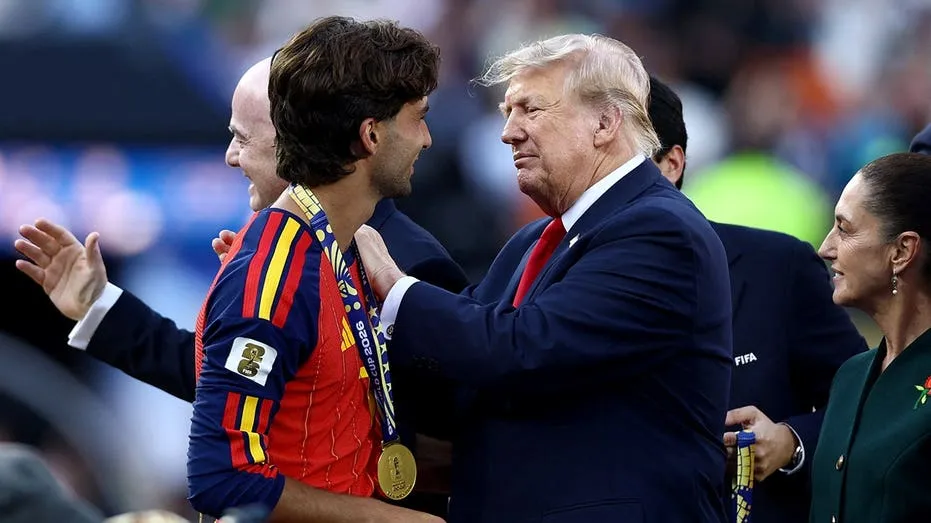
Ferran Torres, the hero of Spain’s recent 2026 FIFA World Cup victory, has publicly doubled down on his decision to wear a “Make Spain Great Again” hat during the team’s homecoming parade. The forward, who scored the decisive extra-time goal against Argentina to secure Spain’s second-ever World Cup title, posted photos on X (formerly Twitter) prominently featuring the controversial headwear, seemingly unfazed by the ensuing criticism.
World Cup Triumph and a Controversial Accessory
Spain’s path to the 2026 World Cup title was marked by a formidable defensive effort, conceding only a single goal throughout the entire tournament. Their journey saw them overcome formidable opponents including Belgium, France, and finally Argentina, led by one of history’s greatest goal scorers, Lionel Messi. However, in the aftermath of this significant sporting achievement, it was not the stoic defense or the tactical brilliance that dominated headlines, but rather the celebratory actions of goal scorer Ferran Torres.
Following the thrilling final, Torres attributed the victory to the collective spirit and support of the Spanish people. “I think in the end the goal came from 47 million people, not just those of us that are here,” he stated to FIFA broadcasters, as reported by ESPN. “Today destiny was written, it was made for us to win. We’re far from our people today but we tried to be as close as possible to them.”
The controversy ignited during the team’s celebratory parade through the streets. Torres was photographed wearing a red hat emblazoned with the slogan “Make Spain Great Again.” This phrase is a clear echo of former U.S. President Donald Trump’s signature “Make America Great Again” slogan, sparking immediate reactions, particularly from political circles in Spain.
Criticism and Torres’s Response
The political left in Spain was quick to voice its disapproval. A spokesperson for the left-wing coalition “Sumar” issued a statement, with one example of criticism suggesting Torres was engaging in political posturing. The progressive media outlet El Plural characterized the hat as a “clear ideological message, provoking a multitude of criticism” across social media platforms.
Despite the vocal backlash, Torres appeared undeterred. In a post on X on Tuesday evening, he shared several images from the parade, with the “Make Spain Great Again” hat a central feature. The accompanying caption, “Somos los reyessssss! Vaya locura!,” translates to “We are the kings! It’s absolutely crazy!” conveying his elation from the victory and celebration.
Interpreting the Message
The precise intention behind Torres’s choice of headwear remains a subject of interpretation. Speculation ranges from a genuine endorsement of right-wing political ideals within Spain to a potential attempt at satire or even a lighthearted nod to the fact that the trophy presentation was attended by a dignitary whose political leanings might be associated with such slogans. However, many commentators and politicians on the left perceived it as a direct statement of support for political reform in Spain, particularly in contrast to the current left-leaning socialist government led by Prime Minister Pedro Sanchez.
Recent polling data indicated challenges for the current administration, with a YouGov poll from June revealing a 33% approval rating for Prime Minister Sanchez, and 63% holding unfavorable views. Some analyses have linked this sentiment to specific government policies, such as plans to grant residence permits to undocumented immigrants, a stance that some observers have contrasted with the more restrictive immigration policies often associated with Donald Trump and the “Make America Great Again” movement.
Regardless of the underlying motive, Torres’s decision to wear the hat and his subsequent reaffirmation of his celebratory mood without issuing an apology have been noted. As a prominent figure in Spanish football and a star player for Barcelona, his actions and symbols carry significant weight, ensuring this conversation is likely to continue.
Looking Ahead
The World Cup victory represents a monumental achievement for Spanish football. The team’s remarkable performance on the field has cemented their place in history. The debate surrounding Ferran Torres’s choice of attire during the celebrations, however, highlights the often-blurred lines between sport and politics, and how symbols can be interpreted in diverse and sometimes contentious ways within the public sphere. As the dust settles on the tournament, the focus will inevitably shift back to the pitch, but the echoes of this particular celebration may linger.


