




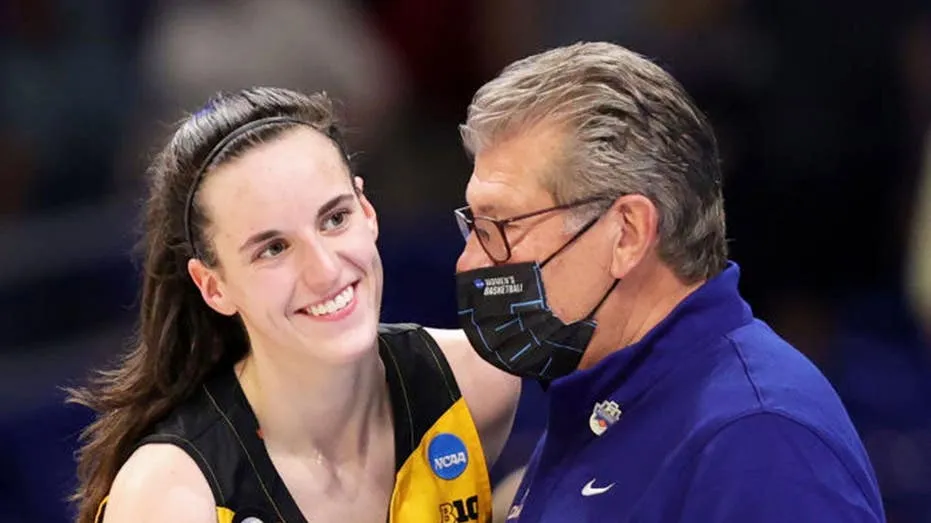
Legendary UConn women’s basketball coach Geno Auriemma has ignited a fresh wave of discussion surrounding Caitlin Clark and her impact on the WNBA, offering perspectives that have drawn sharp disagreement from many observers. Speaking on the “Sports Media Podcast with Richard Deitsch,” Auriemma shared his views on the attention Clark has garnered and her place within the league’s history.
Auriemma Questions Clark’s Transformative Impact
Auriemma suggested that the immense attention on Clark was not solely her own creation but rather a phenomenon fueled by external expectations. “This was not something created by her,” Auriemma stated. “It was created about her by all the people in America who are delusional that think one player who’s not Wemby is going to come in and transform the league.” He characterized the sentiment as a “s—storm” of people viewing Clark as a savior for the WNBA, akin to a religious figure.
He elaborated on this point by drawing a comparison to Tiger Woods’ arrival in professional golf. While acknowledging that Clark has undeniably increased attention and valuation for the WNBA, Auriemma differentiated her impact from Woods’ transformative effect on the PGA Tour. “It’s not like when Tiger [Woods] came into the PGA Tour. He changed the PGA Tour forever. Why? Well, there was so much money that came to the PGA Tour, but in addition, he won every tournament. So that’s the big difference.” Auriemma emphasized that Woods’ dominance and the subsequent influx of wealth fundamentally altered his sport in a way he doesn’t see replicated by Clark, despite the heightened interest she has brought.
Counterarguments Highlight Clark’s Financial and Viewership Impact
Critics of Auriemma’s assessment point to substantial data demonstrating Clark’s profound financial and viewership impact on the WNBA, arguing that her influence is indeed comparable to Woods’ effect on golf, especially considering the league’s prior financial standing. They contend that the WNBA was struggling significantly before Clark’s entry, with low viewership and financial instability.
Evidence cited includes viewership statistics: prior to Clark’s arrival, only one WNBA game in the preceding 15 years had surpassed 1 million viewers (a 2008 Sparks-Mercury game). Since Clark joined the league in 2024, there have been at least 59 games with over 1 million viewers, with her Indiana Fever team alone accounting for 21 of those games in her rookie season. This dramatic increase in viewership is seen by many as a direct result of Clark’s popularity and the attention she commands.
Furthermore, proponents of Clark’s impact highlight the significant financial gains within the league. They point to the Collective Bargaining Agreement (CBA) that expired after the 2023 season, which saw team salary caps increase by nearly $6 million and maximum player salaries rise from approximately $249,000 to $1.4 million. The average player salary reportedly quadrupled. The implementation of charter flights for all teams is also noted as a perk that became feasible, suggesting a newfound financial health within the league that many attribute to Clark’s drawing power.
The argument is made that the substantial improvements in the post-Clark CBA reflect her economic influence. The assertion is that Clark has not only made the WNBA more watchable but also demonstrably more profitable, creating a more lucrative environment for all players.
Debate Over Fouls and League Dynamics
Auriemma also addressed the physicality Clark has faced on the court, including a recent incident where Alyssa Thomas fouled her significantly. Auriemma suggested that such fouls are not necessarily a unique commentary on Clark but rather a common occurrence for high-profile draft picks. “And so instead of it becoming Caitlin Clark gets fouled hard… no s—, every first-round draft pick gets fouled hard,” he remarked. He distinguished between regular fouls, flagrant fouls, and framed these incidents as basketball plays rather than a broader societal statement.
“Not every foul is a good foul. Not every foul is a bad foul, but there are fouls that are flagrant. But that’s all they are. They are not a referendum on America, which is what the whole goddamn thing has become,” Auriemma added, pushing back against the idea that the treatment of Clark reflects larger issues.
This perspective contrasts sharply with the view held by many fans and analysts who see the aggressive play against Clark as a reaction to her unprecedented popularity and a potential sign of underlying tensions within the league. The narrative that Clark is being targeted, despite her role in elevating the league’s financial status, remains a point of contention.
Conclusion: A Clash of Perspectives
Geno Auriemma’s comments have underscored a significant debate about how to measure player impact. While he emphasizes on-court dominance and a fundamental shift in the sport’s financial structure, as exemplified by Tiger Woods, others argue that Caitlin Clark’s unprecedented surge in viewership and revenue generation constitutes a comparable, if not more significant, transformation, particularly given the WNBA’s previous economic landscape. The differing viewpoints highlight the complex dynamics at play as the WNBA navigates its newfound popularity, with Clark at its center.


