




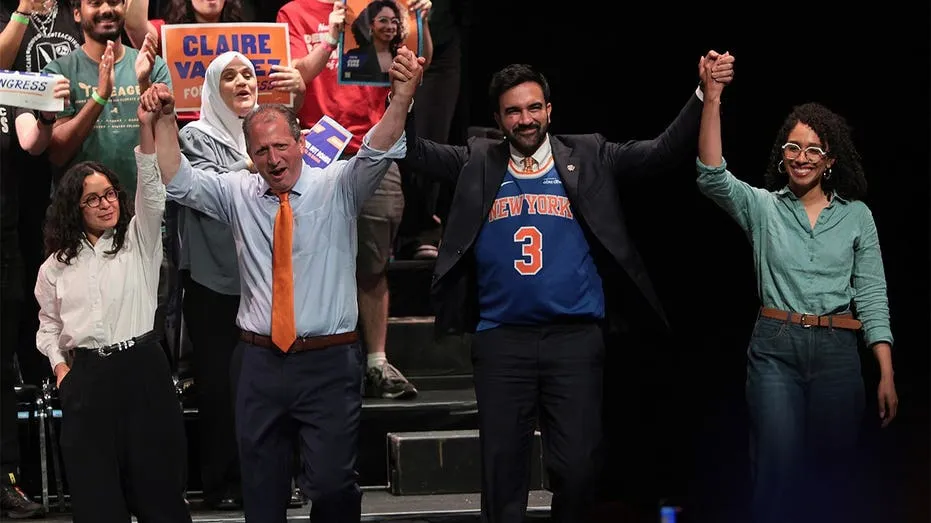
As the midterm elections draw closer, House Republicans are strategically leveraging internal Democratic Party conflicts, particularly the tension between progressive and centrist factions, to frame their opponents as radical and out of touch with mainstream voters. This tactic is especially prominent in crucial swing districts across suburban New York, where the ideological battles within the Democratic Party are playing out in high-stakes primaries.
Suburban New York: A Key Battleground
Congressional districts such as New York-17, NY-3, and NY-4 are considered pivotal for determining control of the House of Representatives. Republicans, aiming to maintain their slim majority, are capitalizing on recent primary outcomes where candidates aligned with the more progressive wing of the Democratic Party, sometimes backed by groups like the Democratic Socialists of America (DSA), have defeated establishment-favored rivals. These contests have garnered significant national attention, providing fodder for Republican messaging.
Representative Mike Lawler, who represents NY-17, a district encompassing northern New York City suburbs, articulated this strategy. “Democrats have gone further and further and further to the left with no end in sight,” Lawler stated in an interview. He highlighted the impact of these shifts on his constituents, who include essential workers like police officers, firefighters, nurses, and teachers. Lawler contends that “radical socialists are taking over the Democratic Party,” not just at the federal level but also within the state legislature, and he has pointed to figures like Zohran Mamdani as emerging leaders of this movement.
While Lawler’s Democratic challenger in the general election may not explicitly align with socialist groups, Lawler argues that their policy stances are effectively the same. He characterized his opponent as a “rubber stamp for the radical socialists” who would lack the fortitude to resist their agenda. This narrative aims to paint the Democratic Party, even its more moderate candidates, as beholden to a far-left ideology.
Democratic Response: Dismissing ‘Desperate Attacks’
The Democratic Congressional Campaign Committee (DCCC) has pushed back against these Republican characterizations. Representative Suzan DelBene, chair of the DCCC, dismissed the GOP’s efforts as “desperate attacks.” She asserted that the midterms will ultimately be a judgment on which party can address the core concerns of everyday Americans, such as lowering costs, and argued that House Republicans have failed to deliver on these fronts.
DelBene suggested that Republicans, recognizing their waning public support, are resorting to “baseless spin” rather than focusing on substantive issues that resonate with voters. She believes these tactics will ultimately fail to sway the electorate, who are reportedly eager to reject the Republican platform.
Caitlin Connoly, Lawler’s opponent in NY-17, who is a West Point graduate and decorated military veteran, directly challenged Lawler’s portrayal. She criticized “political insiders, politicians, [and] political operatives” who she believes prioritize their own careers over solving the nation’s problems. Connoly advocated for “new leaders” rather than those entrenched in the “political insider network,” implicitly including Lawler, a former political strategist.
Broader Implications and Other Key Districts
The races in NY-17, NY-3, and NY-4 are among dozens nationwide that could decide the balance of power in the House. On Long Island, in NY-4, Republican nominee Jeanine Driscoll is facing incumbent Democrat Laura Gillen. Driscoll expressed concern that the victories of progressive Democrats in New York City could alienate voters in her Nassau County district, which borders the city. She warned that the influx of candidates identifying as socialists or communists could “wake people up” to what she perceives as a radical shift within the Democratic Party.
In NY-3, Republican challenger Mike LePetri is up against veteran Democratic Representative Tom Suozzi. Both Suozzi and Gillen are part of a group of moderate House Democrats who have promoted the “Pledge to America,” a centrist initiative emphasizing traditional values, capitalism, and public safety, while explicitly rejecting socialism. Suozzi described himself as a “new kind of old-fashioned Democrat” committed to these principles.
Suozzi acknowledged the internal diversity within the Democratic Party, noting that many members are not aligned with the far-left. He stressed the need for better organization to amplify the voices of those who advocate for collaboration and problem-solving, contrasting this with the often louder, more visible rallies for extremist candidates on both ends of the political spectrum.
However, LePetri accused Suozzi of hypocrisy, claiming he votes with the broader Democratic leadership despite presenting a more moderate public image. Similarly, Driscoll questioned Gillen’s claims of moderation, asserting that her voting record does not align with centrist positions.
National Figures Weigh In
Prominent Republican figures have also amplified concerns about the Democratic Party’s leftward shift. Former President Donald Trump has frequently warned of a “communist” threat, while Vice President JD Vance has argued that certain Democratic viewpoints equate to a desire to dismantle the United States, characterizing such ideologies as fundamentally communist.
Conversely, strategists within Democratic-aligned groups argue that Republicans are on the defensive due to their own lack of legislative accomplishments. CJ Warnke, communications director for the House Majority PAC, stated that Republicans have supported policies like tariffs and healthcare cuts that have driven up costs. He characterized the GOP’s focus on Democratic divisions as a “desperate ploy” to salvage sinking poll numbers, predicting its ultimate failure with voters.
As the election cycle progresses, the strategic framing of Democratic ideological disputes by Republicans, particularly in competitive suburban districts, remains a central theme. The effectiveness of this strategy will likely depend on how voters in these swing areas perceive the balance between policy substance and partisan attacks.


