




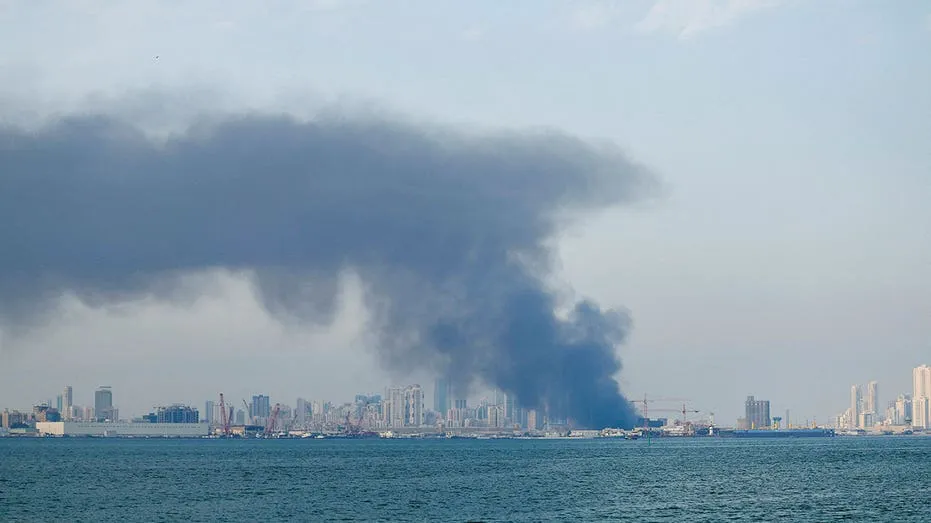
Several Gulf nations have issued strong condemnations following Iran’s drone attacks on Bahrain, signaling a significant escalation in regional tensions and casting a shadow over recent diplomatic efforts. The coordinated strikes, which occurred on Saturday, have raised alarms about the stability of the Middle East and the future of a recently signed memorandum of understanding involving the United States and Iran.
The incident marks a critical juncture, following a series of retaliatory actions. On Friday, Iran reportedly struck a cargo ship in the vital Strait of Hormuz. In response, the U.S. launched overnight airstrikes targeting Iranian missile, drone, and radar installations. Iran’s subsequent drone attacks on Bahrain, home to the U.S. Navy’s Fifth Fleet, represent a direct challenge to regional security.
GCC Secretary-General Denounces ‘Treacherous’ Attack
Jasem Mohamed Albudaiwi, the Secretary-General of the Gulf Cooperation Council (GCC), described Iran’s actions against Bahrain as “treacherous.” He emphasized that such aggression would likely impede ongoing peace initiatives in the Middle East. The GCC, which includes Bahrain, Oman, Saudi Arabia, Qatar, Kuwait, and the United Arab Emirates, has seen several of its member states release their own statements condemning the strikes.
Bahrain officially confirmed that multiple drones had entered its airspace, characterizing the strikes as a “flagrant threat” to national security. The specific locations targeted within Bahrain remain undisclosed.
Kuwait and UAE Express Solidarity with Bahrain
Kuwait and the United Arab Emirates (UAE) also released statements on Saturday denouncing Iran’s actions. Kuwait’s Foreign Ministry stated that the Iranian strikes pose “a dangerous undermining of endeavors for peace and stability, and a threat to the security and stability of the region.” Both Kuwait and the UAE reiterated their commitment to supporting Bahrain’s safety and stability.
The Bahraini Foreign Ministry elaborated on its condemnation, noting the timing of the attacks amidst regional and international efforts toward de-escalation. The ministry placed “sole responsibility on Tehran for undermining peace efforts,” accusing Iran of adopting an approach based on destabilizing security, exporting chaos, and undermining regional stability.
Saudi Arabia and Qatar Join Condemnations
Saudi Arabia and Qatar also publicly denounced the Iranian strikes, asserting that they violate Bahrain’s sovereignty and contravene international law. These statements underscore a unified front among key Gulf Arab states in opposing Iran’s aggressive posture.
Oman Maintains Neutrality Amidst Tensions
Notably, Oman’s foreign ministry has not yet issued a statement regarding the drone attacks. Oman has historically maintained a neutral stance in regional conflicts and has often served as a mediator between the United States and Iran. The Sultanate is currently engaged in negotiations with Iran regarding a framework for managing navigation in the Strait of Hormuz, a critical global shipping lane.
Iran’s Revolutionary Guard Claims Responsibility
Iran’s Revolutionary Guard claimed responsibility for the drone strikes on Bahrain, stating on state-run television that they targeted “several locations of the U.S. terrorist army in the region.” The Guard did not provide specific details about the areas hit, according to reports from The Associated Press.
As of the latest reports, there have been no confirmed casualties or significant damage resulting from the drone attack. The incident occurred just days after U.S. Secretary of State Marco Rubio met with Gulf allies in Bahrain, highlighting the heightened geopolitical activity in the region.
Key Takeaways
- Gulf Cooperation Council (GCC) members, including Bahrain, Kuwait, Saudi Arabia, and the UAE, have strongly condemned Iran’s recent drone attacks on Bahrain.
- The attacks are seen as a significant escalation of regional tensions, potentially jeopardizing diplomatic efforts and a recent memorandum of understanding between the U.S. and Iran.
- Iran’s Revolutionary Guard claimed responsibility for the strikes, labeling targets as related to the “U.S. terrorist army.”
- Bahrain confirmed the drone incursions, calling them a “flagrant threat” to its security.
- Oman has remained notably silent, continuing its traditional role as a neutral mediator.
- No casualties or significant damage have been reported from the drone attacks thus far.
Frequently Asked Questions
What were the recent actions leading up to the drone strikes?
The drone attacks on Bahrain followed Iran’s reported strike on a cargo ship in the Strait of Hormuz on Friday. The U.S. responded with airstrikes on Iranian missile, drone, and radar sites overnight, prompting Iran’s retaliatory drone attacks on Bahrain.
Which countries form the Gulf Cooperation Council (GCC)?
The GCC comprises six member states: Bahrain, Kuwait, Oman, Qatar, Saudi Arabia, and the United Arab Emirates.
What is the significance of Bahrain hosting the U.S. Navy’s Fifth Fleet?
Bahrain’s strategic location in the Persian Gulf makes it a key base for the U.S. Navy’s Fifth Fleet, which is responsible for naval operations in the Middle East. Drone attacks targeting Bahrain, therefore, have direct implications for U.S. military presence and regional security.
Conclusion
The recent drone attacks by Iran on Bahrain have significantly heightened tensions across the Middle East. The strong condemnations from multiple Gulf nations underscore a unified stance against perceived Iranian aggression. As diplomatic channels remain strained and military actions escalate, the region faces a period of heightened uncertainty, with the recent memorandum of understanding between the U.S. and Iran now facing considerable challenges.


