




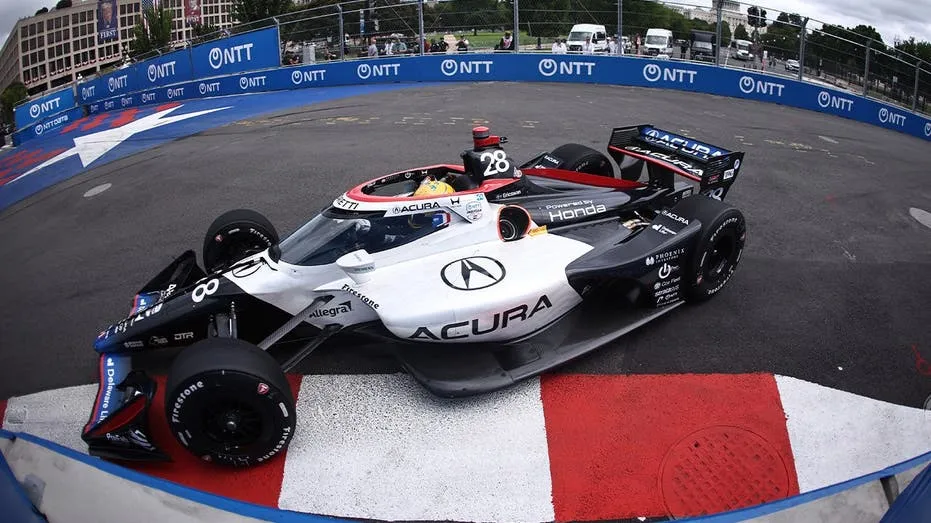
Hours before the green flag drops for the IndyCar Freedom 250 Grand Prix in Washington, D.C., several drivers are facing an uphill battle due to grid penalties. The penalties, primarily stemming from unapproved engine changes, will force competitors to fight harder for track position on the challenging National Mall circuit.
Key Drivers Hit with Grid Penalties
Nolan Siegel, piloting the No. 5 Arrow McLaren Chevrolet, Marcus Ericsson in the No. 28 Andretti Global Honda, and Mick Schumacher driving the No. 47 Rahal Letterman Lanigan Honda have each been assessed a six-place grid penalty. These penalties are a consequence of utilizing unapproved engine changes, a move teams sometimes make late in the season when managing their allocated engine count.
Santino Ferrucci, behind the wheel of the No. 14 AJ Foyt Racing Chevrolet, also received a similar grid penalty for an unapproved engine change. This brings the total number of prominent drivers facing a significant starting disadvantage to four.
Strategic Implications of Engine Penalties
While penalties are not uncommon in the latter stages of an IndyCar season, their impact can be amplified on circuits where overtaking proves difficult. The Freedom 250, set to navigate the streets around the National Mall, presents an element of uncertainty regarding passing opportunities. A six-place drop on the starting grid means drivers will have considerably more work to do to advance through the field and contend for victory.
All three cars penalized on Sunday morning had demonstrated competitive pace throughout the weekend, suggesting they would be contenders. Marcus Ericsson, prior to the penalties, had expressed optimism about the potential for overtakes on the D.C. street course. Now, he and his fellow penalized drivers will have a prime opportunity to test that theory from further back in the pack.
Final Preparations in the Warm-Up Session
The brief, half-hour warm-up session held Sunday morning offered teams a final chance to fine-tune their cars and ensure readiness for the demanding 250-mile race. The session was largely uneventful, with only a few cars venturing into runoff areas, providing a collective sigh of relief for teams aiming for a clean start to the main event.
This final practice period is crucial for confirming race setups and driver confidence, especially on a new or less familiar street circuit like the one in Washington, D.C. Teams meticulously analyze data from the session to make last-minute adjustments to aerodynamics, suspension, and tire strategy, all critical factors for success in a long-distance street race.
Race Day Details
The IndyCar Freedom 250 Grand Prix is scheduled to commence at 1 p.m. ET. Pre-race coverage is set to begin earlier, at 11:30 a.m. ET, allowing viewers to catch all the build-up and analysis before the race action unfolds.
The Challenge of Street Circuits
Street circuits like the one in Washington, D.C., are known for their demanding nature. The close proximity of barriers, the often bumpy surface, and the lack of forgiving runoff areas create a high-stakes environment. Drivers must maintain absolute precision lap after lap, as even a minor mistake can lead to contact with the wall and significant damage, potentially ending their race prematurely.
The Freedom 250 adds another layer of complexity as it marks a new venue for the IndyCar series. Drivers and teams have had limited track time to learn the nuances of the circuit, making strategy and adaptability even more critical. The lack of extensive historical data for this specific track means that race-day performance could be influenced by factors such as tire degradation, fuel management, and the ability to navigate traffic effectively.
Understanding Engine Regulations
IndyCar’s engine regulations are designed to control costs and ensure parity among manufacturers. Each driver is permitted a limited number of engine uses throughout the season. Exceeding this limit, whether due to unforeseen mechanical issues or strategic choices, results in penalties. These penalties are often applied as grid drops for upcoming races, serving as a deterrent against unnecessary engine usage and encouraging teams to manage their resources carefully.
The decision to take an engine penalty, especially a significant one like a six-place drop, is usually a calculated risk. Teams weigh the potential performance gain from a fresh or different engine against the disadvantage of starting further down the grid. In a season where championship points are paramount, such decisions highlight the fine margins and strategic depth within the sport.
Looking Ahead to the Race
Despite the setbacks, the drivers facing penalties are known for their resilience and skill. Nolan Siegel, Marcus Ericsson, Mick Schumacher, and Santino Ferrucci will undoubtedly be looking to make strong recoveries through the field. Their ability to navigate the challenges of the D.C. street course and overcome the initial grid disadvantage will be a key storyline to watch as the Freedom 250 unfolds.
The race promises to be an exciting spectacle, with the added drama of drivers fighting their way forward. Fans can anticipate a strategic battle, intense on-track action, and a compelling conclusion as the IndyCar series makes its mark on the nation’s capital.


