




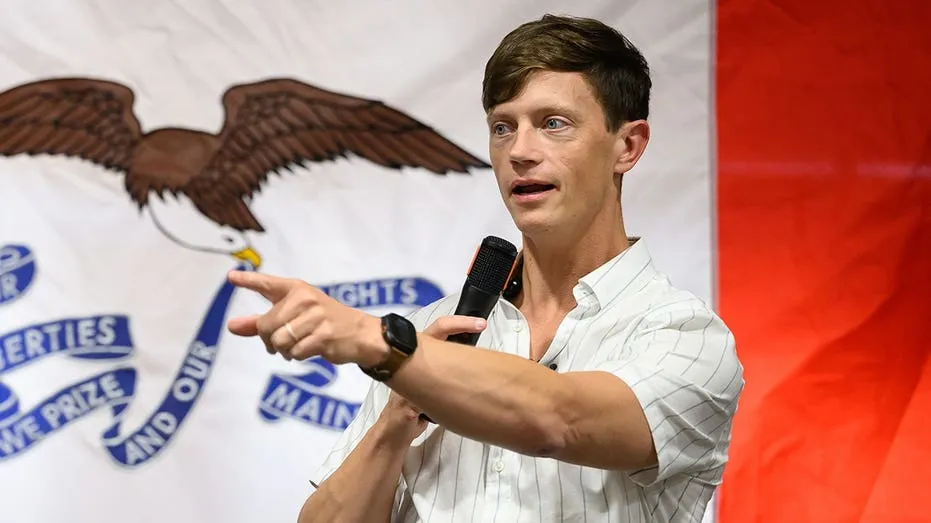
Iowa Democratic gubernatorial hopeful Rob Sand has made it clear that he does not want President Joe Biden or Vice President Kamala Harris to participate in his campaign efforts. When pressed by Politico’s Jonathan Martin about the prospect of Biden campaigning for him, Sand responded with a definitive “No,” adding a question about the President’s current capacity to do so. He then directly declined the idea of Harris joining his campaign, stating, “No thanks. Let’s move on. We need some new leadership.”
Shifting Political Landscape in Iowa
Sand, who currently serves as the Iowa State Auditor, is preparing to face off against Zach Lahn, a candidate endorsed by former President Donald Trump, in the 2026 gubernatorial race. The political field in Iowa is experiencing a significant shift, with current Republican Governor Kim Reynolds having announced last year that she will not seek re-election. This opens up a key statewide office, intensifying the focus on candidates like Sand and Lahn.
The gubernatorial contest is shaping up to be a battleground influenced by national political figures. Trump has publicly thrown his support behind Lahn, characterizing him as an “America First Patriot” and a “tremendous Candidate” for the governorship of Iowa, a state he claims to have won decisively in recent presidential elections. This endorsement highlights the national implications of the race and the potential for Trump’s influence to play a role.
Sand’s Stance on Future Leadership
Sand’s rejection of campaign assistance from Biden and Harris signals a strategic decision to distance himself from the current national Democratic leadership. When Martin inquired further about Harris’s potential role in future elections, specifically in 2028, Sand reiterated his opposition, stating “Nope.” This suggests a desire to project an image of forward-thinking leadership and a break from established political figures, potentially aiming to appeal to a broader range of voters who may be seeking change.
The question of Harris’s future political ambitions was previously raised by Al Sharpton in April, to which she responded with a non-committal “I might,” indicating she was contemplating a potential run. Sand’s comments, however, suggest that even if Harris were to pursue another presidential bid, he would prefer not to align his gubernatorial campaign with hers.
Context of National Politics
The political climate has been significantly shaped by recent presidential election cycles. Following a widely criticized debate performance, President Biden, who was the presumptive Democratic nominee for re-election in 2024, withdrew from the race and endorsed Vice President Harris. Harris subsequently lost the general election to former President Donald Trump. This backdrop likely informs Sand’s decision to seek a distinct political identity, separate from the recent national outcomes.
Sand’s campaign is thus positioned at the intersection of state-level aspirations and national political currents. His clear stance on distancing himself from Biden and Harris suggests a calculated approach to navigating the complexities of the current political environment in Iowa, aiming to carve out his own path to the governorship.
The Republican Field
On the Republican side, Zach Lahn has been vocal about his political adversaries. Reports indicate Lahn has characterized Democrats as “ruthless” and suggested they are attempting to conceal unfavorable policies. This framing sets a combative tone for the upcoming election, emphasizing ideological differences and potential policy debates that will likely define the campaign narrative.
The race for Iowa’s governorship is poised to be a closely watched contest, with candidates navigating the influence of national party figures and local political dynamics. Rob Sand’s decision to forgo support from the current Democratic national leadership underscores a strategic effort to define his candidacy on his own terms, as he prepares to challenge the Trump-backed Lahn in a state where presidential politics often cast a long shadow.


