




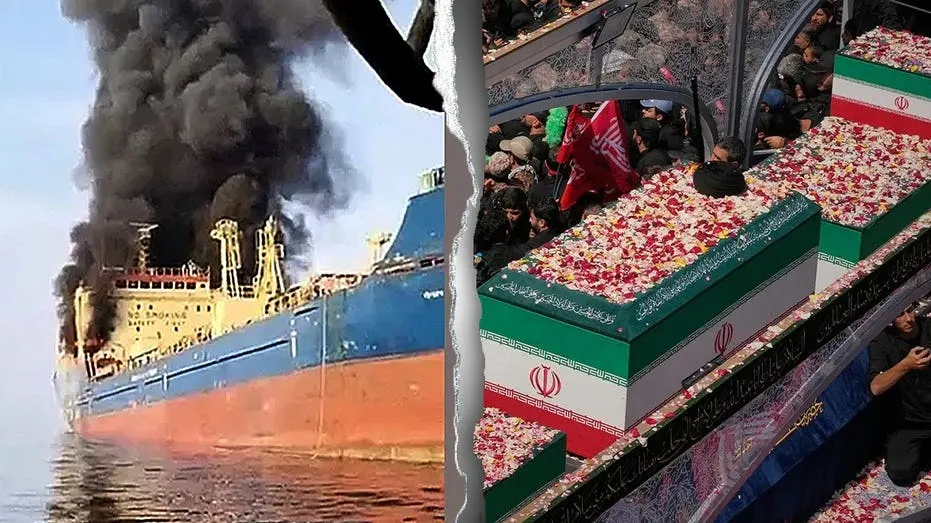
Commercial vessels faced attacks in the Strait of Hormuz on Monday and Tuesday, escalating regional tensions just days after President Donald Trump suggested the U.S. had granted Tehran a pause in hostilities during funeral ceremonies for the late Supreme Leader Ali Khamenei. The incidents involved multiple ships being struck in one of the world’s most critical maritime passages.
Attacks Disrupt Key Shipping Lane
A U.S. official confirmed that three commercial ships were targeted in the Strait of Hormuz between Monday and Tuesday. These attacks occurred in a vital waterway through which a significant portion of global seaborne oil passes, making any disruption a potential threat to international energy markets.
On Monday, British maritime authorities reported that a vessel sustained damage near the coast of Oman. Iranian state media indicated the ship had disregarded warnings from Iranian forces before being struck, resulting in a fire onboard, though no fatalities were immediately reported.
The following day, the U.K. Maritime Trade Operations (UKMTO) issued a report detailing another incident where a tanker transiting the Strait of Hormuz was hit by an unidentified projectile. The UKMTO stated that the vessel appeared to have suffered structural damage but confirmed there were no casualties or environmental harm. The agency advised ships navigating the strait to remain vigilant and report any suspicious activities as investigations continue.
Specific Vessels Targeted
Among the vessels affected on Monday was the Al Rekayyat, a Qatari liquefied natural gas carrier. Iran acknowledged its involvement, with state media asserting that the tanker ignored repeated warnings and proceeded through the southern route of the strait near Oman, reportedly with U.S. assistance. Another ship, the Saudi-flagged crude tanker Wedyan, also sustained damage in the vicinity of the Strait of Hormuz, according to a U.S. official. The precise cause of the damage to the Wedyan was not immediately clear.
Diplomatic Strategy Questioned
These renewed attacks cast a shadow over the Trump administration’s diplomatic approach to Iran. The incidents followed a period where the White House had reportedly paused negotiations, allowing Iran to observe mourning rituals for the slain Supreme Leader Ali Khamenei, with the expectation of resuming talks afterward.
President Trump, in a recent address, had characterized Iran as eager to reach a settlement following sustained U.S. pressure. He remarked that the U.S. had granted Tehran “a week off for a funeral because we’re nice,” implying a gesture of goodwill. While the specifics of this pause were not detailed, U.S. and Iranian officials had indeed postponed discussions until after Khamenei’s funeral ceremonies concluded.
The strikes on commercial shipping raise significant questions about the viability of the diplomatic opening Trump had described, particularly in light of renewed hostilities in such a strategically crucial waterway. Iran has consistently asserted its right to manage traffic through the Strait of Hormuz and has previously sought to impose fees on commercial vessels traversing the area. The U.S. administration, however, maintains that the strait must remain open to unimpeded international navigation.
Background of Ceasefire and Previous Incidents
Iran had recently issued warnings that commercial tankers using routes not sanctioned by Iranian authorities would face a severe response. The latest strikes come after a series of attacks on commercial shipping that have occurred throughout the ongoing conflict between the U.S. and Iran.
These events represent the latest challenge to a fragile ceasefire established under a memorandum of understanding signed in June. This agreement initiated a 60-day negotiation period aimed at achieving a comprehensive peace agreement between Washington and Tehran. A key provision of the accord included the reopening of the strait during the negotiation period and a cessation of military operations while talks were underway.
Notably, on June 25, Iran attacked the Singapore-flagged cargo ship M/V Ever Lovely with a drone while it was transiting the Strait of Hormuz. This incident prompted retaliatory U.S. strikes on Iranian missile, drone, and radar sites. U.S. Central Command characterized that attack as a “clear violation of the ceasefire.”
Following the U.S. offensive, known as Operation Epic Fury, commercial traffic through the Strait of Hormuz had shown signs of recovery. However, shipping volumes remained considerably below previous levels. Data from the ship-tracking firm Kpler indicated that daily traffic had stabilized between 30 to 60 vessel crossings, a significant decrease from the approximately 140 daily crossings recorded before the U.S. operations.
The renewed attacks underscore the precarious nature of maritime security in the region and the ongoing challenges to diplomatic efforts between the United States and Iran.


