




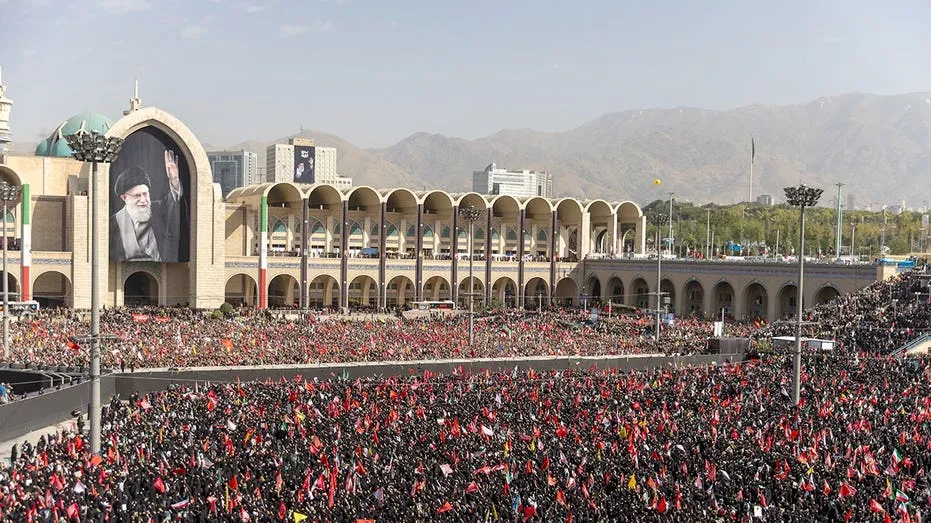
Tehran has issued a stern warning to Washington, vowing to deliver a “hard slap” in response to escalating U.S. military actions. The rhetoric, amplified on social media platform X, signals a significant increase in tensions between the two nations following a series of American strikes targeting Iranian military assets. One prominent Iranian official explicitly stated, “if you strike, you’ll get hit,” underscoring the gravity of the situation.
Escalation in the Strait of Hormuz
The heightened exchange began after U.S. Central Command (CENTCOM) announced it had conducted additional strikes against Iran. These operations, according to CENTCOM, were aimed at degrading Iran’s capacity to threaten maritime navigation in the vital Strait of Hormuz. The U.S. stated its intention to hold Iran accountable for what it described as “recent unjustified aggression against commercial shipping and civilian crews.”
Ebrahim Rezaei, identified as a member of Iran’s Parliament and spokesperson for its National Security and Foreign Policy Commission, took to X to voice his defiance. Citing a religious and nationalistic sentiment, Rezaei wrote, “The martyred Khamenei taught us not to fear America and showed that ‘falsehood will perish.’ Await the hard slap from the Iranians.” His statement invoked a sense of national pride and a commitment to resisting perceived American intimidation.
Adding to the confrontational tone, Mohammad Bagher Ghalibaf, the speaker of Iran’s Parliament, issued a direct warning to the United States. “America still hasn’t learned that bullying and breaking promises are no longer cost-free,” Ghalibaf declared. He elaborated with a blunt message: “if you strike, you’ll get hit.” Ghalibaf also pointedly remarked on the control of strategic waterways, stating, “Don’t flail around pointlessly, or you’ll sink even deeper: the Strait of Hormuz will only open with ‘Iranian arrangements,’ not American threats.” This assertion highlights Iran’s strategic importance and its perceived leverage over international shipping lanes.
U.S. Military Details Recent Operations
CENTCOM provided further details regarding the scope and objectives of its operations. On Wednesday night, the command confirmed the completion of an additional round of strikes on July 8th, reiterating the goal of diminishing Iran’s ability to target commercial vessels and mariners in the Strait of Hormuz. The U.S. military reported hitting approximately 90 Iranian military targets. These included a range of assets such as air defense systems, coastal surveillance equipment, missile and drone storage facilities, naval capabilities, and logistics infrastructure situated along Iran’s coastline.
These latest actions followed a significant offensive operation the preceding night. On July 7th, CENTCOM forces reportedly struck around 80 Iranian military targets. Notably, this included over 60 small boats belonging to the Islamic Revolutionary Guard Corps (IRGC). The U.S. stated these strikes were intended to impose substantial costs on Iran for violating a ceasefire by attacking three commercial vessels transiting the Strait of Hormuz.
Broader Regional Context and International Reactions
The escalating military actions and rhetoric occur against a backdrop of regional instability and previous incidents involving commercial shipping. The U.S. has consistently accused Iran and its proxies of harassing or attacking vessels in the Persian Gulf and the Strait of Hormuz, a critical chokepoint for global oil supplies. Iran, in turn, has accused the U.S. of provocative actions and interference in the region.
The situation also drew commentary from former President Donald Trump, who indicated that a previously established U.S.-Iran Memorandum of Understanding, seemingly related to a ceasefire, was effectively “over.” This statement suggests a potential shift in U.S. policy or perception regarding engagement with Iran.
Adding to the complexity, reports emerged of attacks affecting Kuwait and Bahrain. The Kuwait Army reported intercepting and neutralizing three ballistic missiles, one cruise missile, and ten hostile drones within its airspace on a Thursday morning. Similarly, the Bahrain Defense Force announced that its air defense systems had confronted, intercepted, and destroyed multiple Iranian aerial attacks that occurred on Thursday, July 9, 2026. These incidents, if directly attributable to Iran, would represent a significant expansion of the conflict’s reach and potential consequences.
Strategic Implications and Future Outlook
The exchange of threats and military actions underscores the volatile nature of U.S.-Iran relations. The Strait of Hormuz remains a critical nexus of international trade and geopolitical tension. Iran’s assertions about controlling passage through the strait highlight its strategic positioning and its willingness to use this leverage in confrontations with the U.S. and its allies.
The U.S. military’s stated objective of degrading Iran’s ability to threaten shipping suggests a policy of deterrence through direct action. However, Iran’s defiant response and vows of retaliation indicate a potential for further escalation. The involvement of regional partners like Kuwait and Bahrain in reporting intercepted threats also points to the widening impact of these tensions.
As the situation evolves, the international community will be closely watching for any further military engagements or diplomatic developments. The interconnectedness of regional security and global energy markets means that any sustained conflict in this vital waterway could have far-reaching economic and political ramifications. The “hard slap” promised by Iranian officials remains a potent symbol of their resolve to respond forcefully to perceived aggression, setting the stage for continued uncertainty in the region.


