


Iranian Soccer Fans Divided Over National Team Amid World Cup

Los Angeles Stadium Sees Divided Support for Iran’s National Soccer Team
LOS ANGELES – Iran’s opening match of the World Cup against New Zealand at Los Angeles Stadium saw a near-capacity crowd, dispelling earlier concerns about ticket demand. However, the atmosphere within the stadium mirrored a broader division within the Iranian diaspora, with fans displaying contrasting symbols of national identity. Alongside the flag of the Islamic Republic, some supporters opted for the pre-revolution Lion and Sun emblem, a historical symbol embraced by government opponents. This divergence in symbolism extended to how fans articulated their support for the national soccer team, often separating their allegiance to ‘Team Melli’ from their political views on Iran’s current leadership.
Divergent Views in the Community
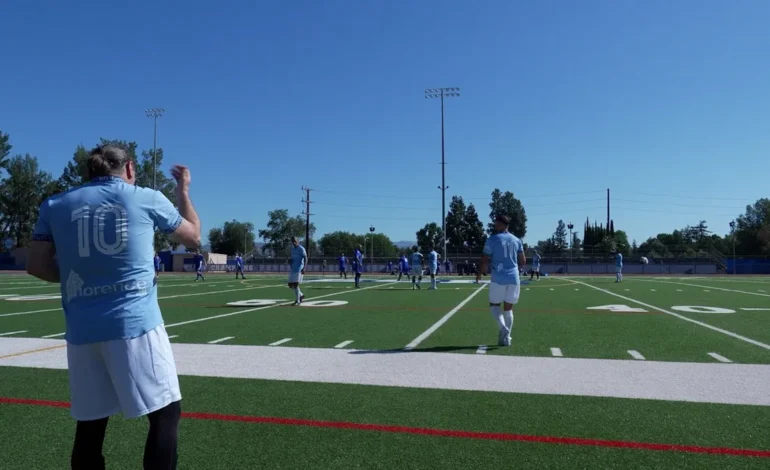
This complex sentiment is palpable within Southern California, home to one of the largest Iranian expatriate communities. Arya FC, a recreational soccer club formed approximately a decade ago, exemplifies this dynamic. Co-founder Nader Adeli, who also manages and coaches the team, explained that Arya FC fields two squads, primarily composed of Iranian-born immigrants who communicate largely in Persian on the field. Adeli emphasized the team’s focus on the sport itself. “Football brings nations together,” he stated. “When we gather, we pray for peace and unity.”
Vartan Golbodaghians, a seasoned Arya FC player, expressed his unwavering support for the national team, irrespective of political considerations. “I support my country 100%. I support my country team 100%,” Golbodaghians said. “Government is government. Team is team. I don’t care about politics. I support my country and my players.” Adeli echoed this sentiment, recounting a deep emotional connection to Iran despite living abroad for most of his life. “I’ve lived 47 years outside of Iran, but I still get goosebumps when I think about Iran, and I support that team,” he shared, referring to the national team known as ‘Team Melli’.
Adeli acknowledged that some within the Iranian community hold reservations about supporting the team but anticipates a shift in sentiment once the tournament progresses. “There is a lot of Iranian people that are against it,” he observed. “But I have told all of them, when Iran scores the first goal against New Zealand, everybody will jump off your seat and start saying, ‘Hooray,’ and support the national team.” He expressed hope for Iran’s performance, stating, “I’m hoping that Iran will have a successful journey in this tournament. This is probably the first time that we can go beyond the group stage.” Adeli believes that the majority of Arya FC players align with this view, supporting Team Melli independently of political or religious affiliations. “Most of the players that I have talked to are supporting Team Melli apart from any political or religious ideas,” he explained. “In my opinion, it is the national team and I will be supporting it.”
Opposition and Disconnection
Conversely, others in the community hold a different perspective. Amin Jafari, a former soccer player in Iran now residing in Southern California, voiced his belief that the national team should have more vocally acknowledged those who lost their lives during recent anti-government protests. “There is nothing more important than the people who lost their lives for Iran,” Jafari stated. “I was expecting those players to show some respect to people who died for the country.” He added that some fans no longer feel a connection to the team. “The connection between the players and the people is already gone,” Jafari remarked.
These contrasting viewpoints highlight a wider debate among Iranians regarding support for the national team. Despite these political differences, soccer continues to serve as a unifying activity for Arya FC players. As Adeli put it, “For the 90 minutes, we all put everything aside in our life, and we play football.”