




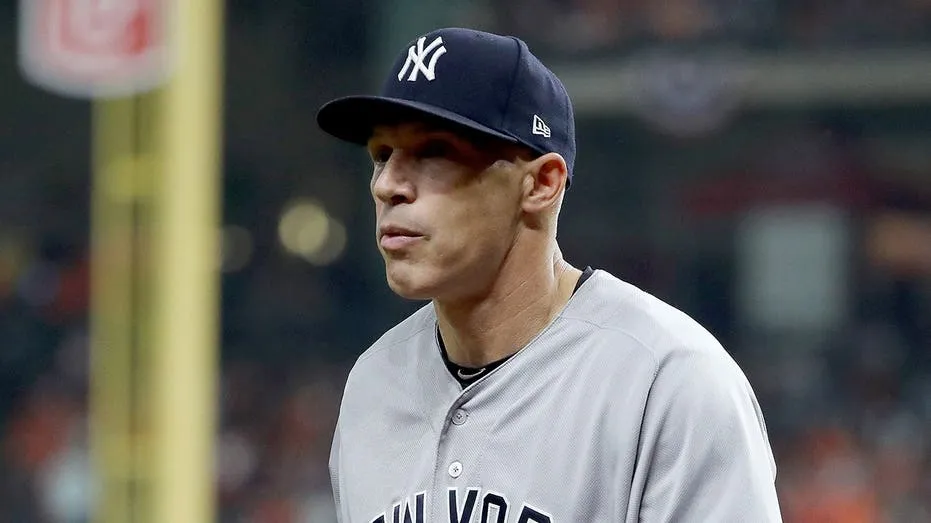
Former MLB manager and World Series champion Joe Girardi finds the current political climate in the United States deeply troubling, primarily because he believes it has become a divisive force that separates people, a stark contrast to his experience in the sports world.
A Shift in the Clubhouse Atmosphere
Girardi, who spent nearly three decades in professional baseball as both a player and a manager, observed a significant change in how politics permeated conversations, particularly within the intimate setting of a clubhouse. “I think politics unfortunately has become a hot button for the United States of America unfortunately and it separates us — before where I felt it didn’t separate us. That’s the most disturbing,” Girardi shared in a recent interview. He noted that while political discussions weren’t entirely absent during his early playing days, they became far more prevalent and potentially contentious as his career progressed into managing.
During his tenure as a manager, Girardi often found himself navigating these evolving dynamics. His approach was always to foster understanding and respect among players with differing viewpoints. “I would just tell guys to be patient and listen to each other and understand that you’re going to have different views and just be respectful,” he explained. “I mean, you don’t have to have the same view. We all grew up different. That’s the bottom line, different backgrounds. And just be patient with each other.” This philosophy underscored his belief that unity, rather than uniformity of opinion, was key to team success.
The Unifying Power of a Common Goal
Despite the increasing polarization in society, Girardi believes that the unique environment of a professional sports team often acts as a buffer. He doesn’t see politics as a significant problem within most clubhouses because the shared objective of winning tends to override personal or political differences. “I don’t think it really becomes a problem in too many clubhouses because I think there’s a common goal and they find a way to come together with a common goal and that’s to win,” Girardi stated.
This focus on a collective aim, he suggested, helps players put aside their individual beliefs and work cohesively. The shared pursuit of victory creates a bond that transcends the societal divisions that might otherwise seep into team dynamics. It’s a testament, in his view, to the power of sports to unite individuals under a common banner, even when the world outside the stadium walls seems increasingly fractured.
Girardi’s Extensive Baseball Career
Girardi’s long and distinguished career in baseball provides a unique vantage point on these changes. As a player, he spent 15 seasons in the majors, notably as a catcher. His playing career included stints with several prominent teams: the Chicago Cubs (where he made the All-Star team in 2000), the Colorado Rockies, the New York Yankees, and the St. Louis Cardinals. He accumulated a.267 career batting average with 36 home runs and 424 runs batted in.
Transitioning to management, Girardi’s success continued. He managed the Miami Marlins for one season before taking the helm of the New York Yankees. Under his leadership, the Yankees achieved significant success, including a World Series championship in 2009. He later managed the Philadelphia Phillies for two and a half seasons, from 2020 to 2022.
Reflections on a Changing Landscape
Girardi’s observations highlight a broader societal trend where political discourse has become more intense and often more acrimonious. His perspective, forged through years of managing diverse groups of individuals toward a singular objective, offers a valuable insight into how such divisions can impact even tightly-knit communities. While he acknowledges the growing presence of politics in everyday life, his experience suggests that shared goals and mutual respect can still foster unity, particularly within the unique ecosystem of professional sports.
The former manager’s comments serve as a reflection on the state of public discourse, emphasizing a longing for a time when differences in opinion were perhaps less polarizing and more easily navigated. His hope, implicitly, is that the principles of patience, listening, and respect he preached in the clubhouse might find broader application in the wider world.


