




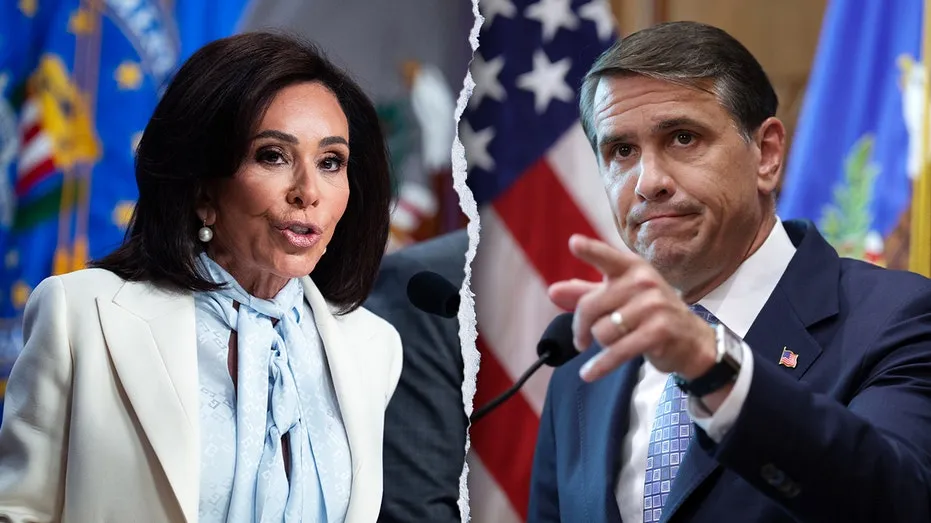
U.S. Attorney General Todd Blanche has publicly backed U.S. Attorney Jeanine Pirro following her office’s decision to dismiss the vandalism case tied to the newly renovated Lincoln Memorial Reflecting Pool. The move to drop charges against Olympic canoeist David Hearn came on July 31, after federal prosecutors reviewed evidence suggesting the damage to the $14 million project might have resulted from a flawed renovation rather than intentional destruction.
Support Amidst Frustration
Blanche stated on NBC’s “Meet the Press” that both he and President Donald Trump stand behind U.S. Attorney Pirro’s work. However, he acknowledged the President’s evident frustration with the case’s outcome, noting that the possibility of “potential vandalism” still lingers.
“I absolutely support U.S. Attorney Pirro, as does President Trump,” Blanche affirmed. He elaborated, “Now, that’s different than whether the president is extraordinarily frustrated at what happened in that case. And I don’t in any way fault him for that.”
Evidence and Uncertainty
The Attorney General clarified that the court filings did not definitively conclude that faulty construction was the sole cause of the damage. He pointed out that a witness had reportedly claimed to have seen Hearn vandalizing the pool. Nevertheless, Blanche conceded that such eyewitness accounts alone might not be enough to secure a conviction.
“Well, there’s a witness that said, ‘I observed the defendant vandalizing the reflecting pool.’ Now, that’s different than whether ultimately we have the proof,” he explained. Hearn has consistently maintained his innocence throughout the proceedings.
Pirro’s Broader Record
Despite the evidentiary challenges in the reflecting pool case, Blanche praised Pirro for her overall performance in prosecuting vandalism cases involving national memorials and monuments. He highlighted her office’s recent action last Thursday in a separate $1,000 property-destruction case.
In that incident, a suspect identified as Melissa L. Farris allegedly spray-painted the words “clean hands, diary money” onto a veterans memorial and poured bubble soap into its fountain. Blanche defended Pirro, stating, “U.S. Attorney Pirro is doing a phenomenal job enforcing that, going after anybody who’s doing it. And I think judging her on a single case because of the evidence that we had is not fair.”
Considering Presidential Input
Blanche also addressed the White House’s request, made last Thursday, for the Justice Department to explore the possibility of bringing a new misdemeanor prosecution against Hearn, even after the original vandalism case was dropped. He indicated that such requests would be taken into consideration.
“Will I take the President of the United States’s view on something into consideration? Yes, of course,” Blanche responded. “That’s certainly something that I listen to.”
Context of the Reflecting Pool Damage
The Lincoln Memorial Reflecting Pool underwent a significant renovation, completed in 2019, aimed at addressing long-standing issues with water leakage and filtration. The project, which cost approximately $14 million, was intended to restore the pool’s functionality and aesthetic appeal. However, shortly after its completion, concerns arose regarding the condition of the pool’s surfaces, including reports of cracks, algae growth, and sealant deterioration.
The initial accusations against David Hearn centered on the idea that his actions, possibly involving entering the pool or interacting with its systems, directly caused this damage. The prosecution’s decision to dismiss the case pivoted on a re-evaluation of the evidence, leaning towards the possibility that the observed defects were pre-existing or a consequence of the renovation work itself, rather than Hearn’s alleged actions.
The Role of Witness Testimony
A key element in Blanche’s explanation was the distinction between a witness’s observation and prosecutable evidence. While a witness may have seen Hearn near or in the pool, potentially engaging in actions that appeared suspicious, the legal threshold for proving vandalism requires more than just an observation. The prosecution must demonstrate intent and causation, proving that the observed actions directly led to the damage and that the damage was not accidental or due to other factors.
The difficulty in meeting this standard, especially when alternative explanations like construction flaws exist, often leads to the dismissal of cases. Blanche’s comments suggest that while the initial report of vandalism was taken seriously, the subsequent investigation and review of evidence did not meet the burden of proof required for a conviction.
Broader Implications for Memorial Protection
The incident and its aftermath highlight the ongoing challenge of protecting national monuments and memorials from damage, whether intentional or accidental. The Justice Department, under both Pirro’s and Blanche’s leadership, appears committed to prosecuting acts of vandalism against these significant sites. The case of Melissa L. Farris, involving spray paint and bubble soap at a veterans memorial, serves as a more straightforward example of the type of deliberate defacement that prosecutors actively pursue.
Ultimately, the situation surrounding the Lincoln Memorial Reflecting Pool underscores the complexities of legal proceedings, where the initial appearance of wrongdoing must be substantiated by concrete evidence. The support expressed by Attorney General Blanche for U.S. Attorney Pirro indicates confidence in her office’s handling of such sensitive cases, balancing the need for accountability with the requirements of due process and evidentiary standards.


