


69 Live Animals Found in Hidden Car Compartment After Border Arrest
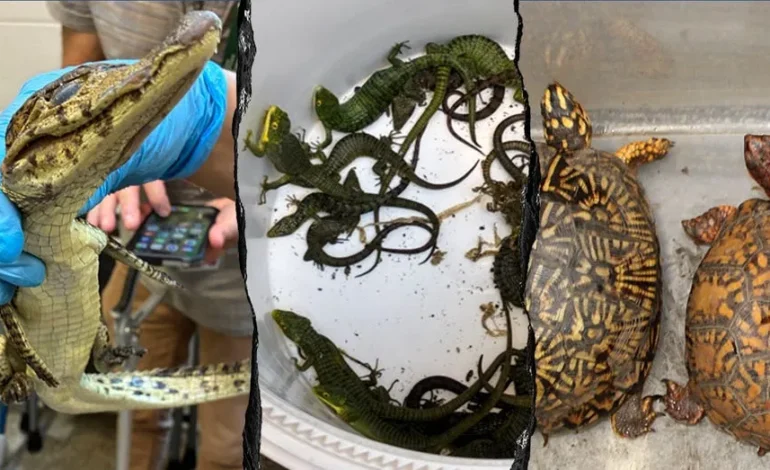

Federal authorities have arrested a 66-year-old woman attempting to cross the U.S.-Mexico border after discovering a shocking cache of live animals concealed within a hidden compartment of her vehicle. The discovery, made by U.S. Customs and Border Protection (CBP) officers at the San Ysidro Port of Entry on August 10, involved 69 animals, including venomous snakes, caimans, and a baby crocodile, allegedly stuffed into pillowcases and hidden from view.
Hidden Compartment Reveals Shocking Cargo
Georgina Bribiesca Chavez, a resident of Tijuana, Mexico, was attempting to enter the United States when she informed a CBP officer that she had nothing to declare. However, a routine records check revealed an active warrant connected to a wildlife trafficking investigation, prompting further scrutiny of her vehicle. While CBP officers initially seized the Volkswagen, the full extent of its illicit cargo wasn’t uncovered until the following morning during a more thorough inspection. Officers located a concealed factory compartment situated behind the rear seat. Inside, they found several pillowcases, tightly knotted shut and sealed with tape, one of which was observed to be moving.
San Diego Zoo Receives Unfortunate Arrivals
The pillowcases were transported to the San Diego Zoo, where animal care specialists carefully opened them to reveal the distressed animals. The inventory included 60 abronia lizards, four venomous yellow-blotched palm pit vipers, three caimans, a baby crocodile, and an indigo snake. Tragically, the extreme conditions and prolonged confinement in the August heat led to the deaths of all three caimans. The remaining animals, though stressed, were reported to be stable and under the care of the zoo as of the following week.
Prosecutors allege that Chavez did not disclose the presence of these animals to the border officers, leaving them trapped in the vehicle for nearly 24 hours. This incident highlights the extreme cruelty involved in illegal wildlife smuggling, where animals are often subjected to inhumane conditions for profit.
Undercover Investigation Uncovers Larger Trafficking Ring
The arrest of Chavez is reportedly the culmination of an extensive undercover investigation spanning approximately 18 months, conducted by the U.S. Fish and Wildlife Service. Authorities believe Chavez and an alleged trafficking partner, 28-year-old Salvador Pelayo of Chula Vista, have been involved in wildlife trafficking since at least 2023, amassing tens of thousands of dollars from the sale of exotic animals.
Pelayo was apprehended in July and has also entered a plea of not guilty to the charges he faces. Court documents detail several alleged transactions, including one in March 2025 where Chavez purportedly handed over four protected Mexican box turtles to an undercover agent for $2,600 in cash shortly after crossing the border. Prosecutors stated that these turtles were already in poor health, believed to be wild-caught and suffering from respiratory issues, and tragically, all four died after being transferred to the Oakland Zoo.
Further allegations against Pelayo include using the alias “Jose Lopez” to ship four protected Mexican and Yucatan box turtles to an undercover agent in New York. The investigation is a collaborative effort involving the U.S. Fish and Wildlife Service’s Office of Law Enforcement, with support from the National Oceanic and Atmospheric Administration and the California Department of Fish and Wildlife.
Legal Ramifications and Ongoing Efforts
Georgina Bribiesca Chavez has pleaded not guilty to a federal wildlife trafficking charge and is currently being held without bond. Both Chavez and Pelayo are facing charges under the Lacey Act, a landmark law that prohibits the trafficking of illegally taken fish, wildlife, and plants. Conviction on these charges can carry a maximum penalty of five years in prison and a fine of up to $250,000.
The case underscores the persistent challenges faced by law enforcement in combating the global illegal wildlife trade, a multi-billion dollar industry that threatens biodiversity and ecosystems worldwide. The meticulous work of CBP officers and investigative agencies has brought to light the lengths to which smugglers will go to traffic protected species, often with devastating consequences for the animals involved.