



Colossal Megalodon Tooth Unearthed on Jersey Shore Beach
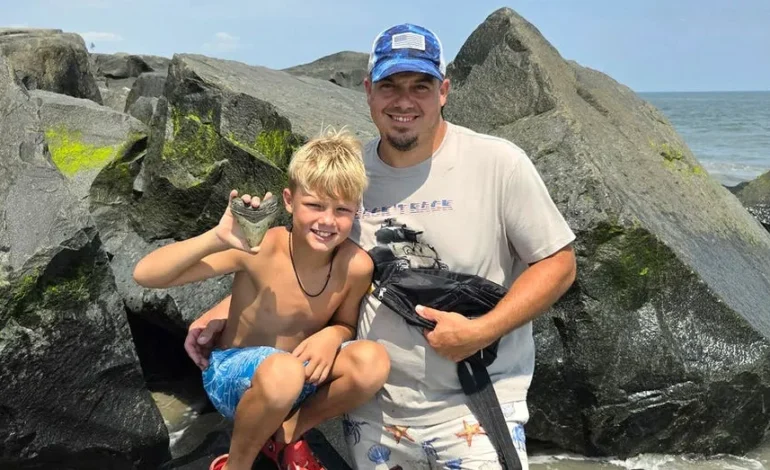

A routine beachcombing excursion for a Pennsylvania family turned into a remarkable paleontological discovery when an 11-year-old boy unearthed a massive tooth belonging to an extinct giant shark, the Otodus megalodon, on a Sea Isle City beach. The fossil, estimated to be millions of years old, was found near the Townsend Inlet on August 11 by Bo Bowers and his father, Mike Bowers.
A Chance Discovery on an Overcast Day
The Bowers family, vacationing in Wildwood, decided to explore a different beach in Sea Isle City due to an uninspiring weather forecast. Mike Bowers recounted how they were drawn to a rock jetty and a promising-looking shoreline. While exploring, he spotted something unusual lodged between two rocks. His own hand was too large to reach it, so he enlisted his son, Bo, to investigate.
Bo, initially a bit hesitant to reach into the rocky crevice, was spurred on by the potential find. Upon seeing the object, he quickly retrieved it. “He likes to look for shark teeth and stuff like that,” Mike Bowers explained, noting that his son’s interest in marine fossils made the discovery particularly exciting, though he admitted they “definitely did not expect to find something of that stature.”
A Giant from the Past
The Otodus megalodon, a species of shark that roamed the oceans from approximately 23 to 3.6 million years ago, was the largest predatory shark known to have ever existed. These colossal creatures could reach lengths of up to 65 feet, dwarfing even the largest modern great white sharks. Their diet consisted of large marine mammals, including whales.
The tooth itself is a testament to the shark’s immense size. Pictures reveal a dark, jagged edge and a substantial length, reportedly measuring roughly the span of young Bo’s hand. For an 11-year-old, grasping such a tangible piece of prehistoric life was an awe-inspiring experience. “It was really hard to believe” when he learned the fossil’s true age, Bo shared.
Authenticating the Ancient Find
After their beach adventure, the Bowers family made a stop at the New Jersey State Museum on their journey back to western Pennsylvania. There, museum officials examined the fossil in the fossil lab and unequivocally confirmed its identity and authenticity. “It 100% is a true megalodon tooth,” Mike Bowers stated, relaying the expert’s assessment.
According to museum officials, the discovery is particularly significant for New Jersey. Dana Ehret, a paleontologist at the New Jersey State Museum, confirmed the tooth’s authenticity and explained the rarity of such finds in the state. “These teeth are highly uncommon in New Jersey because we do not have the right aged sediments preserved at or near the surface,” Ehret noted. He added that the Bowers’ tooth is in “extraordinary good condition” compared to typical New Jersey finds, which are often significantly worn from prolonged exposure to ocean currents.
Ehret mentioned that the condition of the tooth is more akin to those found in areas like North Carolina, where such fossils are considerably more prevalent due to favorable geological conditions. This discovery marks only the sixth confirmed megalodon tooth found on New Jersey beaches, making the Bowers’ find a notable addition to the state’s paleontological record.
A Trend of Young Fossil Hunters
This remarkable find joins a recent series of significant ancient discoveries made by children in unexpected locations. Earlier in the year, an 11-year-old boy in England unearthed a fossilized tooth from an extinct elephant relative, dating back about 1.8 million years, also on a beach. In another instance, an 8-year-old boy in Israel discovered a fragment of a 1,700-year-old Roman statuette, which he brought to school for show-and-tell.
The Bowers family was permitted to keep the megalodon tooth, as it was found on a public beach, a common practice for such discoveries in many areas. The find serves as a powerful reminder that history, in its most ancient and colossal forms, can sometimes be found right beneath our feet, or in this case, wedged between rocks on a familiar shore.