




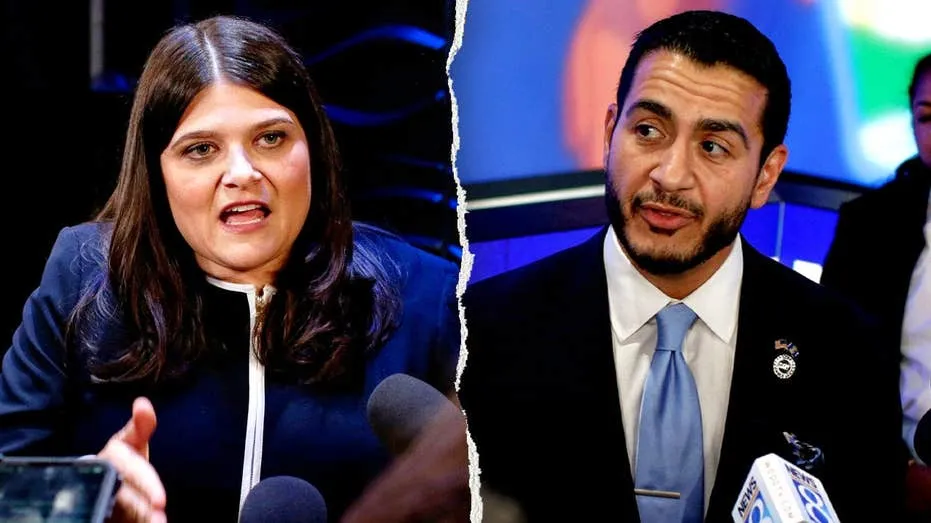
The Democratic Party’s internal divisions were on full display Monday night as two hopefuls for Michigan’s U.S. Senate seat clashed in a heated debate, just a week before their primary election. The contest, set for August 4th, pits the party’s progressive wing against its more moderate establishment, with both candidates, Abdul El-Sayed and incumbent U.S. Representative Shri Thanedar, vying to prove they are the best choice to represent Michigan and, crucially, to defeat Republican former Rep. Mike Rogers in the November general election.
El-Sayed Defends ‘Ogre’ Remark, Targets Fetterman
A central point of contention revolved around El-Sayed’s controversial “ogre on a pike” comment, which had drawn criticism from within his own party. During the debate, El-Sayed clarified that the remark was not aimed at his primary opponent, Thanedar, but rather at Senator John Fetterman of Pennsylvania. El-Sayed accused Fetterman of betraying his progressive platform after being elected.
“I was referring to a guy named John Fetterman,” El-Sayed stated, explaining that he believed Fetterman had compromised his core values. Despite the backlash, El-Sayed declined to apologize for the metaphor, asserting he had previously defended Thanedar against unfair attacks, even when she was booed at a state Democratic convention.
Thanedar offered a pointed response to El-Sayed’s clarification: “Thank you for clarifying that you didn’t call me an ogre.” The original comment surfaced from a Zoom meeting with donors, where El-Sayed reportedly discussed using a Michigan victory to build a national platform and support future primary challenges, including against Fetterman. Audio obtained by news outlets suggested El-Sayed said, “Ideally, you put one ogre on a pike, and then everyone else gets the message.” While El-Sayed did not name Thanedar in the recording, some interpreted the remark as a veiled threat against her. Representative Hillary Scholten, a Thanedar endorser, condemned the language as “violent, vulgar,” urging a de-escalation of political rhetoric. Neera Tanden, a former Biden administration official, linked the comment to broader concerns about sexism in the race.
AIPAC Funding and Israel Policy Ignite Fierce Exchanges
The significant financial backing for Thanedar from pro-Israel groups, particularly AIPAC, emerged as another major flashpoint. Moderators repeatedly questioned Thanedar about whether the substantial outside spending, reportedly over $46 million, would compromise her independence in office. Thanedar firmly denied this, reaffirming her commitment to a two-state solution and stating, “I have been very clear, consistent and transparent. I want to see long-term peace.”
El-Sayed seized on the funding, framing it as a fundamental difference between the candidates. He argued that AIPAC-backed groups supported Thanedar because they expected her to be a “reliable vote.” “The difference between us is $46 million of AIPAC spending,” El-Sayed declared. “They’ve set a record in this race to help elect my opponent.” He directly linked this spending to Thanedar’s recent vote supporting additional aid to Israel, accusing the Israeli government of hindering Palestinian self-determination. El-Sayed expressed his view that U.S. tax dollars should prioritize domestic needs like schools and infrastructure, rather than being used in conflicts that result in civilian casualties. He further asserted that the U.S. should avoid engaging in conflicts promoted by groups like AIPAC.
Thanedar countered that outside groups were supporting both campaigns and pointed to a super PAC partially funded by El-Sayed’s father-in-law. She also accused El-Sayed of using his platform to pursue national ambitions rather than focusing on the needs of Michigan.
Tax Returns and Outside Income Scrutinized
Continuing a theme from their earlier debate, Thanedar pressed El-Sayed on his financial transparency, specifically his refusal to release full tax returns despite earning approximately $300,000 in outside income. “You have not released your full tax returns — $300,000 in other income while you sat in the podcast chair and you hawked junk health care cures that RFK Jr. would thumbs up,” Thanedar charged. She questioned his commitment to campaign finance reform, asking, “You talk about getting money out of politics and putting money in people’s pockets, but still, no one knows who’s putting the money in your pocket.”
El-Sayed responded that he had complied with all required financial disclosures and dismissed the demand for full tax returns as a “distraction.” He then turned the transparency argument back on Thanedar, questioning the sources of funding for organizations supporting her campaign. Thanedar, describing herself as “the only non-millionaire in this race,” suggested that El-Sayed’s financial dealings could become a liability for Republicans to exploit in the general election.
Filibuster, ICE, and Contrasting Visions for the Democratic Party
When asked about a key failing of Senate Democrats, El-Sayed immediately identified the legislative filibuster, calling it “anti-democratic.” He argued that its elimination would enable Democrats to pass legislation such as the PRO Act, strengthen antitrust enforcement, implement a wealth tax on billionaires, and advance Medicare for All. El-Sayed concluded that the filibuster and the influence of money in politics posed the greatest risks to democracy.
The candidates also revealed a sharp divide on immigration policy, particularly concerning Immigration and Customs Enforcement (ICE). Thanedar characterized ICE as a “rogue agency” and outlined her efforts to redirect its funding toward social services. “Not a penny more for this rogue agency that is wreaking havoc,” she stated, accusing ICE of mistreating immigrant families.
El-Sayed, however, took a more extreme stance, labeling ICE “tyrannical” and advocating for its complete abolition. He accused Thanedar of hypocrisy, citing her past votes to increase ICE funding. El-Sayed insisted that while ICE should be dismantled, immigration laws could still be enforced by a new agency. He drew a parallel between abolishing ICE and the “defund the police” movement, but maintained that a different structure could manage immigration effectively. Thanedar criticized his approach as prioritizing rhetoric over practical governance, emphasizing her own work within Congress to reform the agency.
As the August 4th primary approaches, the debate highlighted the significant ideological and strategic differences within the Michigan Democratic Party, setting the stage for a closely watched election that will determine the party’s nominee to challenge for a U.S. Senate seat.


