




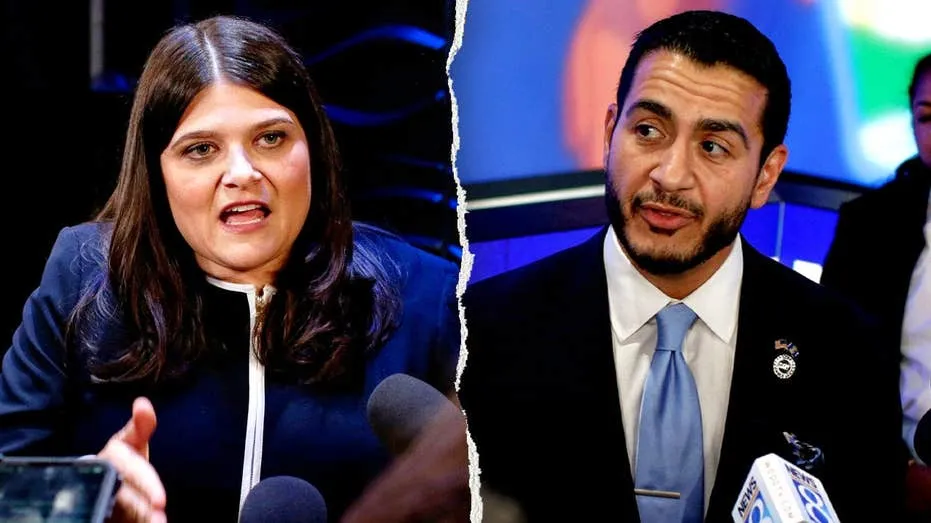
The Democratic Party’s internal ideological struggle took center stage in Michigan’s Tuesday primary, with a closely watched contest for the U.S. Senate seat highlighting the deep divisions between the party’s progressive and centrist wings. As votes were still being tallied early Wednesday, the race between progressive challenger Abdul El-Sayed and establishment-backed Rep. Haley Stevens remained too close to call, underscoring the high stakes of this battleground state contest.
A High-Stakes Senate Showdown
The race to succeed retiring Democratic Sen. Gary Peters is considered a crucial battleground for Democrats aiming to regain or maintain control of the Senate. This primary has become a significant proving ground for the progressive movement’s ability to challenge the party’s traditional establishment figures. Both El-Sayed, a former Wayne County health director, and Stevens, a sitting U.S. Representative, have garnered substantial support from opposing factions within the party.
El-Sayed, who secured endorsements from prominent progressives like Sen. Bernie Sanders and Rep. Alexandria Ocasio-Cortez, held a slim lead as the night wore on. His platform emphasizes policies such as “Medicare for All,” abolishing Immigration and Customs Enforcement, and a strong critique of Israel’s actions in Gaza, which he has characterized as “genocide.” If elected, El-Sayed would be the nation’s first Muslim senator.
On the other side, Stevens, who flipped a Republican-held district in her first congressional election and was endorsed by Senate Democratic leader Chuck Schumer, is viewed by establishment Democrats as the more electable candidate. Her campaign has focused on a more moderate approach, aiming to appeal to a broader electorate.
Record Spending Fuels Intra-Party Conflict
The Michigan Senate primary has shattered records, with over $80 million reportedly spent, making it the most expensive Democratic Senate nomination contest in history. A significant portion of this funding originated from outside groups, many of which have actively supported Stevens or opposed El-Sayed. The United Democracy Project, a political action committee associated with the American Israel Public Affairs Committee (AIPAC), emerged as a major spender, reportedly outspending El-Sayed’s campaign by an 11-to-1 margin.
Addressing supporters late Tuesday, El-Sayed acknowledged the financial disparity but emphasized his campaign’s resilience. “We’re going to have to wait a little longer to see the outcome of this race,” he stated, adding, “We knew that this was going to be a close race, and that’s exactly what we’ve got. A close race.” He also called for party unity, directing criticism toward the Republican nominee, Mike Rogers.
Stevens echoed the sentiment of a close contest, telling her supporters, “I want to give you all an update. We knew that this was going to be a close race, and that’s exactly what we’ve got. A close race.” She also targeted Rogers, framing the general election as a choice between her vision and what she described as a continuation of “Donald Trump’s ridiculous agenda.”
Broader Progressive vs. Establishment Battles
The ideological clashes were not confined to the Senate race. In Michigan’s 7th Congressional District, a competitive Republican-held seat, progressive candidate William Lawrence, supported by groups like the Sunrise Movement and figures like Sanders and El-Sayed, narrowly defeated more moderate contenders. Lawrence will now face Republican Rep. Tom Barrett in the general election.
Another closely watched race was in Michigan’s 13th Congressional District. Early Wednesday, the Associated Press had not yet projected a winner between incumbent Rep. Shri Thanedar, who has backing from House Democratic leadership, and state Rep. Donovan McKinney. McKinney received endorsements from Sanders, El-Sayed, and “Squad” members like Reps. Ilhan Omar, Ayanna Pressley, and Summer Lee, showcasing the progressive wing’s continued efforts to gain ground.
Centrist Victories in Other Key Races
While progressives fought for key nominations, the Democratic establishment also saw notable successes in other primaries. In Missouri’s 1st Congressional District, Rep. Wesley Bell, who was backed by House Democratic Leader Hakeem Jeffries and other centrist figures, defeated Cori Bush, a progressive former representative, in a rematch of their 2024 primary. Bell, who also benefited from significant outside funding, including from the United Democracy Project, emphasized his commitment to his constituents following his victory.
Bush, however, expressed disappointment and frustration, criticizing Bell for not participating in candidate forums and suggesting he was influenced by wealthy donors. “It pisses me off that for the next two years, this community will be represented by someone that didn’t deem you valuable enough to show up to one candidate forum where there were audience comments, even though I showed up to every one,” Bush stated.
In Michigan’s statewide races, more centrist candidates secured nominations. Secretary of State Jocelyn Benson won the Democratic gubernatorial primary, and Attorney General Dana Nessel was renominated, indicating that the party’s base in the state may not have shifted as dramatically leftward as some anticipated. Matt Bennett, a leader at the center-left Third Way organization, suggested that the Michigan Senate race might be an anomaly, influenced by the specific candidates and the strong anti-Trump sentiment among Democratic voters.
Trump’s Influence on the Republican Side
On the Republican side, Tuesday’s primaries reaffirmed the considerable influence of former President Donald Trump. His endorsed candidates secured gubernatorial nominations in both Michigan and Kansas. In Michigan, Rep. John James, a West Point graduate and former Senate nominee, won the Republican gubernatorial primary, setting up a contest against Benson. In Kansas, state Senate President Ty Masterson, also backed by Trump, prevailed in a crowded field for the gubernatorial nomination.
These results suggest that Trump’s endorsement remains a powerful factor in Republican primary contests, potentially shaping the landscape for the upcoming general elections in key battleground states.
Conclusion
The Michigan primaries offered a clear snapshot of the Democratic Party’s ongoing internal debate, with the outcome of the Senate race hanging in the balance. While the progressive wing celebrated wins in congressional districts, the closely contested Senate primary and centrist victories in statewide races indicate a complex and evolving political terrain. As the nation looks toward the general election, the ability of Democrats to bridge these ideological divides will be critical in their efforts to achieve electoral success.


