




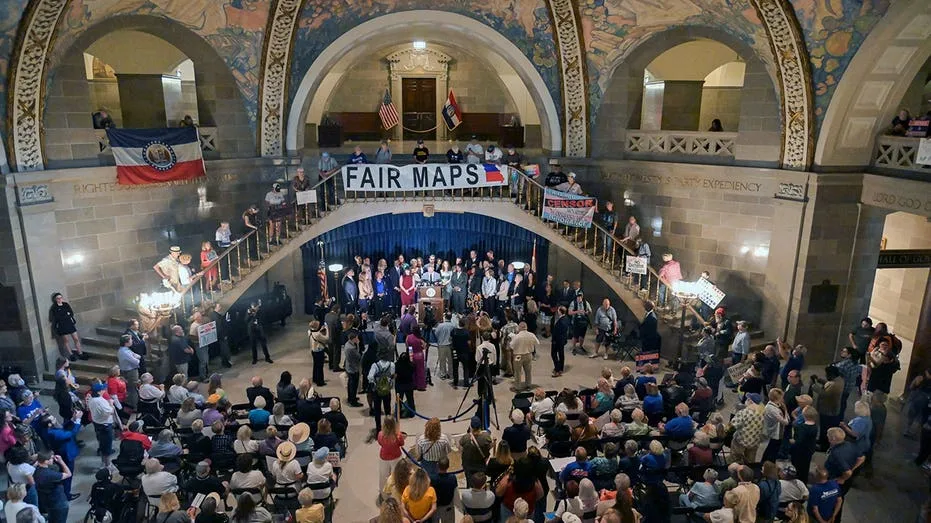
A Missouri judge has delivered a significant victory to Republicans and allies of former President Donald Trump, ruling that the state’s referendum process cannot be used to challenge new congressional maps. This decision allows a Republican-friendly map, drawn by the state legislature, to remain in effect for the upcoming midterm elections.
Referendum Challenge Rejected
Cole County Circuit Judge Daniel Green issued his ruling on Wednesday, stating that Missouri’s constitutional provisions for referendums do not apply to congressional redistricting plans enacted by the General Assembly. The judge sided with Republican Secretary of State Denny Hoskins, who had refused to certify a petition seeking a statewide vote on the map. This legal battle was closely watched, as the new boundaries could influence the balance of power in the U.S. House of Representatives.
Judge Green further determined that Secretary of State Hoskins’ decision to reject the referendum petition was lawful. Consequently, the congressional map, which favors Republicans, will remain fully in place for the 2026 general election. The ruling preserves a map that was passed by the Republican-led state legislature following a push from former President Trump for GOP-controlled states to redraw congressional boundaries in anticipation of the elections.
Impact on Congressional Representation
The newly drawn map is designed to enhance Republican chances of unseating Democratic Representative Emanuel Cleaver of Kansas City. Missouri currently has an eight-member House delegation, comprising six Republicans and two Democrats. The revised map carves up parts of Kansas City, distributing them into neighboring districts held by Republicans. Additionally, the remaining portion of Cleaver’s 5th Congressional District is extended eastward into areas with a strong Republican voter base.
Estimates suggest that approximately 59% of the voters within the redrawn district are new to it. This redistricting effort has already seen its initial impact, as the new boundaries were utilized in Missouri’s August primary elections. Notably, Republican State Senator Rick Brattin secured the GOP nomination in the redrawn district during the primaries, while Representative Cleaver ran unopposed for the Democratic nomination.
Legal and Political Context
Opponents of the map had gathered thousands of signatures in an effort to trigger a statewide referendum. However, Secretary of State Hoskins rejected the petition, asserting that the Missouri Constitution does not permit congressional redistricting plans to be subjected to a referendum. Judge Green’s decision affirmed this stance, leading to a judgment in favor of Hoskins and several Republican committees, including the National Republican Congressional Committee and the Missouri Republican State Committee, which had joined the case.
This legal contest in Missouri is part of a larger, nationwide effort by Republicans to shape congressional districts ahead of the November elections. Following former President Trump’s encouragement for Republican-led states to revise their congressional maps, Missouri’s Republican Governor Mike Kehoe convened a special legislative session last year. This move positioned Missouri as the second Republican-led state, after Texas, to undertake new congressional boundary drawing as part of this broader strategy.
Path Forward
While Judge Green’s ruling allows the Trump-backed map to stand for now, the case is expected to proceed to the appellate court. The White House had not issued an immediate comment regarding the ruling when reached for inquiry.
The legal maneuverings surrounding redistricting are a critical component of electoral strategy, particularly in states where political control of legislative bodies is closely contested. The outcome of such cases can have long-lasting implications for political representation and the balance of power in Congress.
The decision underscores the complex interplay between state legislative powers, constitutional provisions, and the federal electoral process. As the appeals process unfolds, the ultimate fate of Missouri’s congressional map remains subject to further judicial review, but for the immediate electoral cycle, the Republican-aligned map has received a significant judicial endorsement.


