




As Major League Baseball’s brightest stars gathered for media days leading up to the 2026 All-Star Game, the conversation inevitably turned to a contentious issue: the potential implementation of a salary cap. While league owners have been vocal about their desire for such a system, citing competitive balance concerns, many players expressed strong opposition, arguing it would be detrimental to the game.
Players Voice Opposition to Salary Cap
The debate over a salary cap has intensified in recent months, with league officials promoting the idea through social media campaigns that suggest baseball is fundamentally “broken” without one. These narratives often highlight the spending power of teams like the Los Angeles Dodgers, implying that smaller market franchises have little chance of competing for a World Series. However, the players on the field see things differently.
Superstar outfielder Mike Trout of the Los Angeles Angels was unequivocal in his stance. “I think it’s bad for the game,” Trout stated. “The game’s in a great spot right now, you know, I just don’t support that.”
Cody Bellinger, a former MVP and outfielder for the New York Yankees, offered a perspective that touched on the financial motivations of ownership. “I think if the billionaires are wanting it, you know, they’re the billionaires for a reason, and they want to continue to enhance their portfolios as much as possible,” Bellinger remarked. “And us players understand that, and so the answer to your question is no good.”
The sentiment was echoed by many others. Toronto Blue Jays reliever Louis Varland, whose team recently faced the high-spending Dodgers in the World Series, offered a simple, one-word response: “Bad.” Similarly, Detroit Tigers catcher Dillon Dingler described the idea as “Bad. Bad.”
Max Muncy of the Dodgers, a team often at the center of these discussions, pointed out a broader trend across professional sports. “The biggest thing for me is every other league has a cap,” Muncy said. “And not one of those players like it. So why would we agree to something that no other player likes?” This observation highlights a common player grievance: salary caps, by their nature, limit earning potential and are generally unpopular among athletes across various professional leagues.
Sal Stewart, an All-Star third baseman for the Cincinnati Reds, broadened the critique. “I think it’s bad for everyone, I think it’s even bad for the teams, bad for the players, bad for everyone,” Stewart said. “So, yeah, I’m not in favor.” While some players admitted to being less informed on the specifics of a potential cap, the overwhelming consensus among those who spoke was negative.
League’s Narrative vs. On-Field Reality
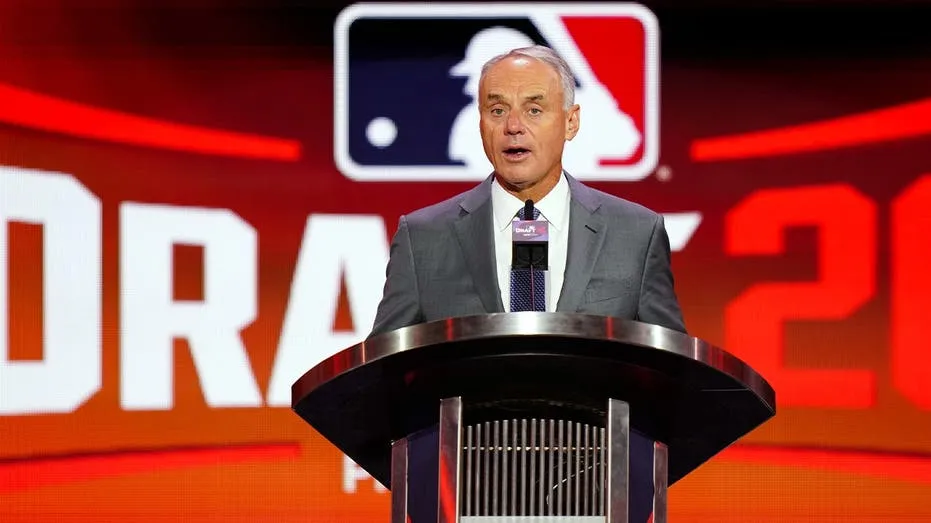
League Commissioner Rob Manfred has defended the league’s public relations efforts, framing them as necessary to “keep fans informed” about the owners’ perspective. He suggested that players’ comments might not always be entirely accurate or fair representations of the situation. “I think when you have a difficult public issue, particularly when the other side of the issue is being very public about what their views are on the negotiation, I think it’s incumbent on us to keep our fans informed of our view of the world,” Manfred stated.
However, Bruce Meyer, Chief of the Major League Baseball Players Association (MLBPA), countered this by calling the league’s narrative “perverse.” Meyer argued that the league’s focus on promoting the idea of a broken game, particularly through advertisements that seem to prioritize the push for a salary cap over celebrating the All-Star Game or its players, is misguided. “I have watched over the last two years [how] the owners, the commissioner’s office, try to convince fans, the consumers of their product, that the product is broken,” Meyer said. “I think it’s perverse.”
Meyer also pointed out perceived inaccuracies in the league’s use of financial data. The league has cited total spending, including luxury tax payments, to illustrate disparities between high-spending teams like the Dodgers and lower-spending ones. The MLBPA argues that this framing often ignores the fact that luxury tax penalties are redistributed to other teams, and that some ownership groups may be pocketing this revenue rather than reinvesting it into their on-field product.
Competitive Balance on Display
The timing of the league’s push for a salary cap has also drawn criticism, especially given the current state of competitive balance in the season. Contrary to the narrative that only big-spending teams can succeed, the 2026 season has showcased a more fluid competitive landscape:
- The Tampa Bay Rays, not a traditionally high-spending team, were leading their division.
- The Toronto Blue Jays, despite a significant payroll, found themselves in last place in their division.
- Teams like the Chicago White Sox and Cleveland Guardians were actively competing for postseason spots.
- The Los Angeles Angels, with a substantial payroll, were struggling near the bottom of the American League standings.
- The Detroit Tigers, possessing the highest payroll in their division, were facing a likely postseason miss.
- Even the Miami Marlins, often cited for their lower spending, were in playoff contention.
This on-field reality, where team success is not strictly correlated with payroll, provides a strong counterargument to the league’s claims that a salary cap is essential for competitive balance. The players’ collective voice, amplified at a high-profile event like the All-Star Game, suggests a significant disconnect between the league’s messaging and the players’ experience and perception of the game’s health.
Ultimately, the push for a salary cap appears to be a strategic move by owners, as players like Mike Trout and Cody Bellinger suggest, aimed at controlling costs and potentially increasing profits. The players, meanwhile, are advocating for the continuation of a system that allows for open competition and rewards teams for investing in their rosters, believing the game is currently in a strong position and that a cap would be a step backward.


