




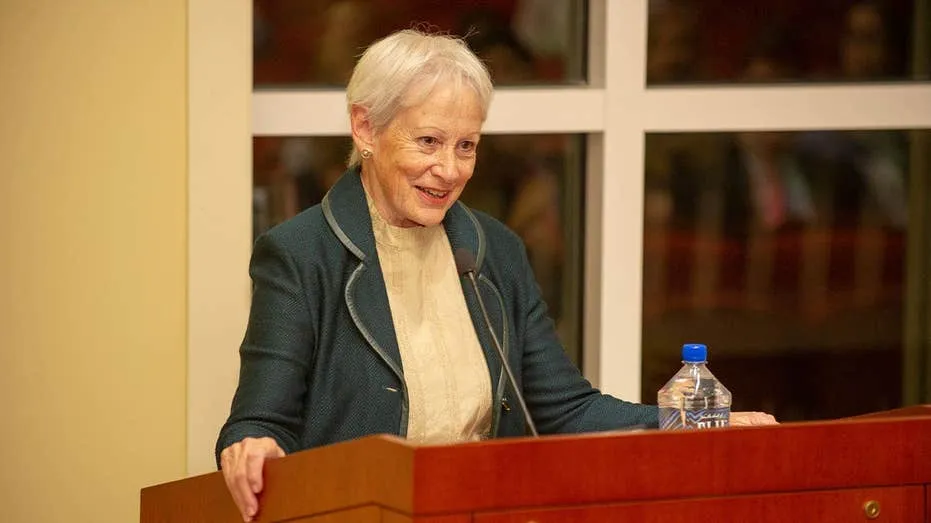
Former Republican Senator Nancy Kassebaum Baker, a pioneering figure in American politics and the first woman elected to the U.S. Senate without a prior congressional connection through marriage, passed away on Friday. She was 94 years old. Her son, Bill Kassebaum, confirmed her death to the Associated Press, stating that she died of natural causes.
Kassebaum Baker represented Kansas in the Senate for 18 years, serving three terms from her election in 1978 until her retirement in 1997. Her son remembered her deep affection for her home state, saying, “She loved Kansas. She loved people from Kansas and representing Kansas for 18 years in the U.S. Senate.” He also highlighted her independent spirit, characterizing her as “an independent-minded Republican who was willing to stand up for what she thought was right, even if that meant going against the party.”
Born into a political family as the daughter of former Kansas Governor Alf Landon, the Republican Party’s 1936 presidential nominee, Kassebaum Baker forged her own path. She cultivated a reputation as a moderate Republican, unafraid to diverge from party lines when she believed it was necessary. Her election to the Senate in 1978 garnered significant national attention, marking a milestone for women in Congress. By the time she concluded her Senate tenure, she was one of only eight women serving in the chamber and notably held the distinction of being the only woman to chair a Senate committee.
A Career Defined by Independence and Bipartisanship
Throughout her career, Kassebaum Baker became known for her ability to work collaboratively across the aisle. A significant piece of legislation, the landmark 1996 Health Insurance Portability and Accountability Act (HIPAA), bore her name alongside that of her Democratic colleague, Senator Ted Kennedy of Massachusetts. This bipartisan effort underscored her commitment to finding common ground on critical issues.
However, her political independence sometimes placed her at odds with the more conservative elements of her party. One notable instance involved her support for an assault weapons ban championed by then-President Bill Clinton. Kassebaum Baker later recalled that this particular vote generated the most intense and angry correspondence of her entire Senate career, illustrating the strong opinions such issues could evoke.
Despite these occasional political headwinds, Kassebaum Baker remained a highly popular figure in her home state of Kansas. Her constituent support was evident in her commanding re-election victories, securing 76% of the vote in 1984 and 74% in 1990. These results demonstrated a strong and consistent mandate from the people of Kansas.
Personal Life and Post-Senate Contributions
In a unique chapter of her personal life, Kassebaum Baker married former Republican Senator Howard Baker of Tennessee in 1996, just before her departure from the Senate. This union was historically significant as it was the first marriage between a man and a woman who had both served as U.S. Senators. Howard Baker, a prominent figure in his own right, had served as President Ronald Reagan’s Chief of Staff and later as the U.S. Ambassador to Japan under President George W. Bush. He passed away in 2014.
Kassebaum Baker did not retreat from public service following her time in Congress. She remained engaged through various initiatives, including her participation in a bipartisan commission focused on campaign finance reform during the Clinton administration. In her later years, she increasingly found herself at odds with the evolving direction of the Republican Party. This divergence led her to endorse Democratic candidates in several Kansas races, including support for current Democratic Governor Laura Kelly.
Her political convictions also extended to national events. Following the January 6, 2021, attack on the U.S. Capitol, Kassebaum Baker publicly called for the impeachment of President Donald Trump. In a statement to KMBC in Kansas City, she expressed her strong disapproval, stating, “This just has gone too far.”
Despite her extensive national political career, Kassebaum Baker maintained a profound connection to Kansas. Reflecting on her life and impending move to Japan during her husband’s ambassadorship, she articulated her deep attachment to her home state. “All I can say is, I will miss the Kansas prairie,” she shared, encapsulating her enduring bond with the landscape and spirit of Kansas.


