




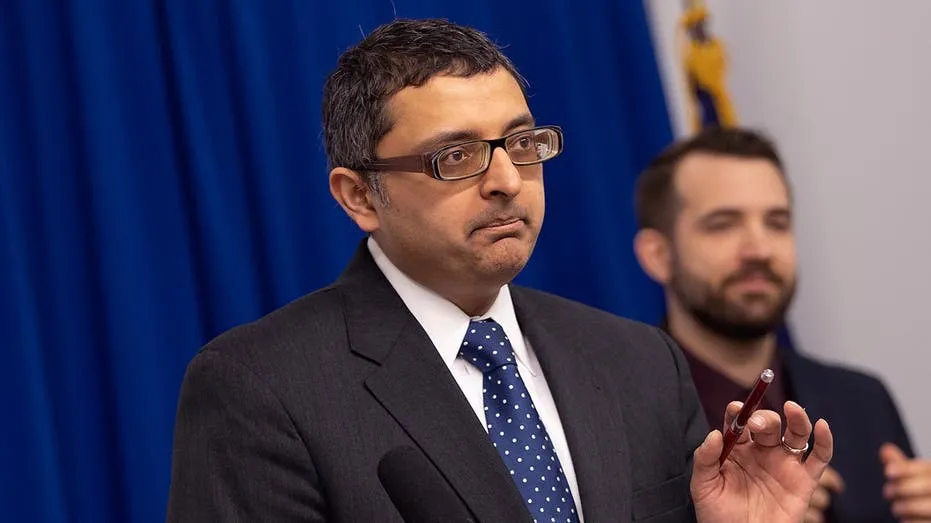
Dr. Nirav Shah, a recent contender for a Maine Senate seat, found himself under a microscope Friday, fielding pointed questions about his handling of a deadly public health crisis years ago. The scrutiny comes just as former Senator Graham Platner withdrew from the race, with Illinois Democratic Senator Tammy Duckworth publicly opposing Shah’s candidacy, citing his record as Illinois Public Health Director.
Controversy Surrounds Legionnaires’ Disease Outbreak
Shah, who previously placed second in Maine’s Democratic gubernatorial primary, is now facing significant opposition from within his own party. The core of the controversy centers on his leadership during a fatal Legionnaires’ disease outbreak at the Illinois Veterans Home in Quincy, which began in 2015 and resulted in the deaths of 13 residents. Senator Duckworth, a decorated combat veteran herself, has been a vocal critic, asserting that Shah prioritized his public image over the well-being of veterans.
“Maine deserves better than someone who put his public image before the safety of our Veterans,” Duckworth stated on social media platform X. “Too many of our heroes lost their lives under Nirav Shah’s watch as Illinois Public Health Director. I called for his resignation then, and I strongly oppose his run for Senate now.”
Shah Defends His Record Amidst Criticism
During an interview, host Brianna Keilar directly addressed Duckworth’s criticisms, asking Shah for his response to the senator’s remarks regarding the Legionnaires’ disease outbreak. Shah acknowledged the tragedy of the outbreak and the loss of life, expressing deep respect for Senator Duckworth and her service.
“The outbreak that she’s referring to back in 2015 was tragic,” Shah stated. “And sadly, American veterans lost their lives. And I deeply respect Sen. Duckworth and her service to this country. In this respect, I happen to disagree with her.”
He elaborated on the role of a public health department during such crises, drawing a parallel to the fire department. “The health department, in the setting of a Legionnaires’ outbreak, responds to the scene of an emergency, much like the fire department does,” Shah explained. “In this situation, we responded after the outbreak was underway. We helped tamp it down, and we made sure that the outbreak didn’t get any worse than it already was.” He noted that the outbreak underwent thorough review by the Centers for Disease Control and Prevention (CDC) and other bodies, and that following this period, he was appointed to prominent public health positions by Maine’s Democratic governor and the Biden Administration.
Questions Raised About Response Time and Accuracy
Keilar challenged Shah’s fire department analogy, pointing out that fire departments are typically known for rapid deployment. She referenced an investigation by the Illinois Auditor General, which reportedly detailed a response that contradicted Shah’s description of it being “quick, coordinated, and responsive.” The report allegedly indicated a delay of approximately three days between the confirmation of multiple Legionnaires’ cases and the state health department’s visit to the veterans’ home.
“Maine voters are known for being very independent. They want it told to them straight. How can they rely on you to be straight with them during tough times, when certainly that report is very different from how you were describing your then department’s response to this Legionnaires’ disease?” Keilar pressed.
Shah refuted the timeline presented, stating, “Well, that latter part is not correct. The county health department was in immediate contact with the facility. And then, as the situation evolved, they then looped in the state health department. And that’s when we became involved.” He conceded that improvements in coordination between state, county, and federal officials are always possible in outbreak and crisis situations.
Shah Points to COVID-19 Leadership and Personal Growth
Looking to bolster his credentials, Shah highlighted his leadership during the COVID-19 pandemic as evidence of his ability to manage crises. He asserted that the experience with the Legionnaires’ crisis ultimately made him a stronger leader.
“I learned a lot during the Legionnaires’ crisis, and I am a better leader for it,” Shah stated. “If what we demand are leaders who are unblemished, then what we will end up with are leaders who are untested. I have been a tested leader, and I am a better leader as a result.”
As Dr. Shah navigates his Senate campaign, the shadow of the 2015 outbreak and the subsequent criticisms continue to be a significant factor, prompting voters to weigh his past performance against his aspirations for future public service.


