




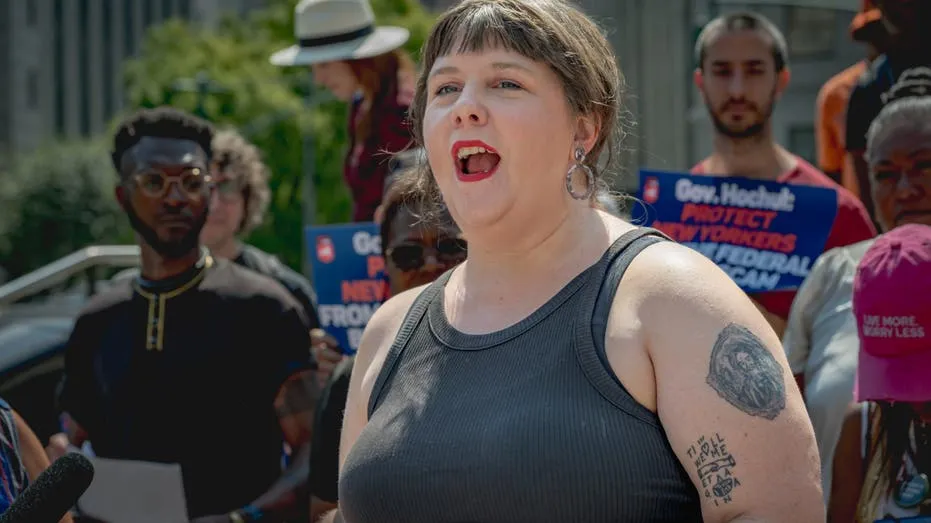
A New York State Assemblywoman has ignited a firestorm of criticism after suggesting that shoplifting essential items like soap and toothpaste stems from a “biological need.” The remarks, made by Democratic socialist Emily Gallagher, who represents parts of Brooklyn, have drawn sharp rebukes from law enforcement officials and legal experts who argue her perspective downplays accountability and ignores the realities of crime victims.
‘Biological Need’ vs. ‘Poverty’
During a news conference outside Manhattan Criminal Court on Thursday, Gallagher, alongside members of Court Watch NYC and other lawmakers, characterized misdemeanor theft of basic necessities as “crimes of poverty.” She stated, “The true crime is that there is such incredible wealth disparity in this city that there are people who can be thrown in jail simply for having a biological need.” Gallagher elaborated that individuals stealing items like toothpaste and soap “need them,” implying a fundamental requirement driving the behavior.
She contrasted the struggles of ordinary New Yorkers with the profits of large drugstore chains, arguing that the system prioritizes “billion-dollar companies, like CVS and Walgreens, over the people who are struggling to get by.” Organizers from Court Watch NYC reported monitoring 360 arraignments over four days, with more than half involving misdemeanor offenses.
Criticism from Legal and Law Enforcement Circles
The Assemblywoman’s comments quickly drew fire. Former Palm Beach County State Attorney Dave Aronberg, now heading his own law firm, told Fox News Digital that Gallagher’s framing was fundamentally flawed. “This is exactly the wrong way to talk about crime and poverty. Poverty can help explain why someone commits an offense,” Aronberg stated. “It should matter when prosecutors decide how to handle a case. But poverty is not a permission slip to steal.”
Aronberg emphasized that prosecution does not automatically equate to incarceration, particularly for first-time offenders. He pointed to the availability of diversion programs, treatment options, and conditional dispositions as means of holding individuals accountable without resorting to severe penalties that could ruin their lives. “Suggesting that someone who steals toothpaste for the first time is automatically being thrown in jail creates a false picture of how the system actually works,” he added.
Retired New York Police Department Sergeant Joe Imperatrice, founder of Blue Lives Matter NYC and a veteran with over two decades of service, voiced strong opposition to Gallagher’s stance. He urged politicians to focus on the victims of crime rather than making excuses for perpetrators. Imperatrice also defended policing strategies like “Broken Windows,” which he believes holds individuals accountable for their actions.
“The tides are turning and everyday New Yorkers are getting sick and tired of this reckless narrative,” Imperatrice remarked. He expressed optimism that public sentiment would eventually lead to a resurgence of stricter law enforcement approaches, reminiscent of the late 1990s and early 2000s.
Political Ramifications and Policing Strategies
Gallagher and her allies have also called for an end to “broken windows policing” in New York City, a strategy that emphasizes addressing minor offenses to prevent more serious crimes. Mayor Zohran Mamdani, who entered office with a promise to shift some responses for issues like homelessness and mental illness away from the police, has maintained enforcement against violent crime.
Despite the controversy, official NYPD data indicates a citywide decline in retail theft. During the first half of 2026, the department reported a 16.3% decrease compared to the same period the previous year. This reduction was attributed to enhanced crime pattern analysis, strategic officer deployment in high-theft areas, and sustained investigative efforts.
Aronberg cautioned that Gallagher’s argument could have significant political consequences for the Democratic Party. “Democrats should reject the idea that enforcing laws against theft is somehow incompatible with caring about poverty,” he advised. “That is bad policy, and politically it is a gift to Republicans who want to portray Democrats as indifferent to public safety.”
Conclusion
The debate highlights a deep ideological divide in New York regarding how to address petty theft, poverty, and wealth inequality. While Assemblywoman Gallagher advocates for understanding the underlying socioeconomic factors driving such offenses, critics argue that her perspective undermines accountability and disregards the impact on victims and the broader community. Law enforcement and legal professionals maintain that a balance must be struck between addressing poverty and ensuring public safety through consistent law enforcement.


