




A New York resident is taking legal action against Immigration and Customs Enforcement (ICE) after federal officers visited his home to deliver a warning concerning an email he sent criticizing the agency’s leadership and tactics. David Streever, a U.S. citizen residing in Rochester, filed a lawsuit in Washington, D.C., on Monday, alleging that the Department of Homeland Security (DHS) and ICE violated his First Amendment rights by retaliating against him for expressing criticism of the government.
First Amendment Under Fire?
The controversy began in January when Streever, deeply disturbed by the fatal shooting of U.S. citizen Renee Nicole Good during an immigration raid in Minneapolis, sent an email to Todd Lyons, who was then the acting director of ICE. In his message, Streever expressed strong disapproval of the agency’s actions, calling Lyons a “monstrous human being” and drawing a parallel to Reinhard Heydrich, a high-ranking Nazi official. Streever’s email, as detailed in the complaint, predicted Lyons’ downfall and suggested he would be consumed by shame.
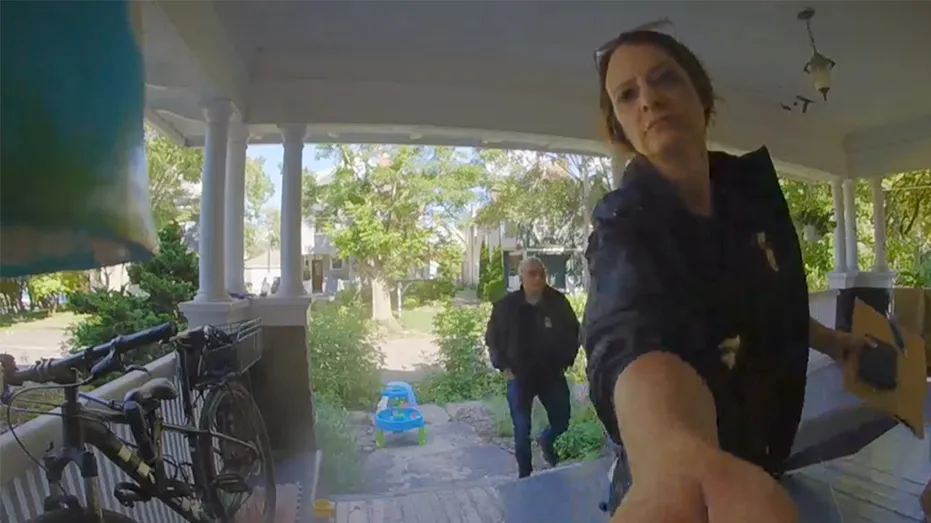
Months later, while Streever was traveling in Finland with his 7-year-old daughter, two ICE officers appeared at his Rochester home. They presented his wife with a “warning notice,” informing her that her husband might be in violation of federal law due to the email sent earlier that year. The notice urged Streever to cease his “behavior” and cautioned that it would be considered in any future “criminal activities” he might be involved in.
A Chilling Pursuit
Despite being informed that Streever was out of the country, the federal officers did not abandon their pursuit. Upon his return to Rochester later that week, they attempted to intercept him at a hotel in New York City, though hotel staff prevented the encounter. That same evening, Streever received multiple voicemails from individuals identifying themselves only as Homeland Security Investigations, repeatedly calling his phone.
The ordeal had a profound emotional impact on Streever and his young daughter. During their train journey home, Streever felt compelled to inform his daughter about the possibility of being confronted by federal agents. The news understandably distressed the child, who became tearful, fearing for her father’s safety.
Protected Speech or Federal Threat?
Representing Streever, attorney Adam Steinbaugh of the Foundation for Individual Rights and Expression (FIRE) asserts that the email constitutes protected speech under the First Amendment and does not pose a genuine threat. Steinbaugh highlighted the significant delay between the email’s dispatch and the ICE visit, stating, “If someone is really threatening a government official, you don’t wait five months to act on it. The fact that authorities didn’t respond immediately shows that David presented no threat. This pursuit is designed to intimidate lawful speech, pure and simple.”
Streever himself expressed shock at the government’s response. “I cherish our right to speak openly about issues of public concern,” he stated. “I hope others will not be discouraged from peacefully expressing their views, even when those views are critical of the government.” He further elaborated on his motivations, saying, “Like many Americans, I was deeply upset after the shootings in Minnesota and I felt compelled to do something. Writing an email to the head of ICE seemed like the least I could do to express my sense of outrage. I never dreamed it would lead to a knock on my door by federal officers or descending on my hotel in the dark of night.”
Broader Implications and DHS Response
The lawsuit seeks a court order compelling DHS and ICE officials to cease their alleged “coercion and retaliation” against Streever for exercising his right to protected speech. This incident occurred shortly after another New Yorker, poll worker Paigelynne Gonyea, reported being confronted by federal officers at a voting site. They questioned her about a social media post criticizing Jonathan Ross, the ICE officer involved in the Minneapolis shooting.
Gonyea believes her confrontation was linked to a January post where she shared a picture of Ross with the caption, “I think today is a great day for Jonathan to be indicted.” This post followed media identification of Ross as the officer involved.
A DHS spokesperson, Lauren Bis, addressed Gonyea’s situation, sharing a social media post where Gonyea allegedly revealed Ross’s address. Bis stated that Gonyea “committed a federal crime by posting the address of an ICE law enforcement officer online” and warned, “if you doxx our officers, we will investigate you, and you will be brought to justice.”
In response to inquiries, a statement from the office of Homeland Security Secretary Markwayne Mullin, as reported by the Associated Press, categorically denied any attempt by DHS or its components to suppress free speech, labeling such allegations as “categorically FALSE.”
Conclusion
David Streever’s lawsuit highlights a critical tension between government accountability and the protection of free speech. His case, alongside the experience of Paigelynne Gonyea, raises significant questions about the extent to which individuals can criticize federal agencies and their officers without fear of reprisal or intimidation. The legal proceedings will likely scrutinize the actions of ICE and DHS, particularly concerning the interpretation of threats versus protected criticism and the appropriateness of home visits and warnings in such contexts.


