




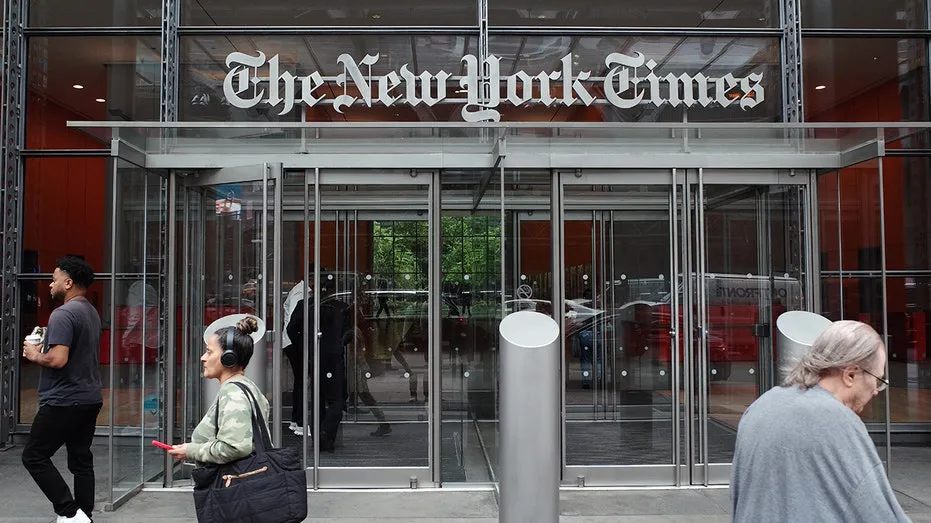
The New York Times has ignited a firestorm of criticism for its characterization of the American Israel Public Affairs Committee (AIPAC), a prominent U.S. lobbying group focused on strengthening the U.S.-Israel relationship. In a recent report, the newspaper described AIPAC as a “hard-right pro-Israel lobbying group,” a label that has drawn sharp rebukes from various commentators and observers who argue it misrepresents the organization’s broad political support and operational makeup.
Context: A Divided House Vote on Israel Aid
The controversy emerged in the wake of a House of Representatives vote on a bill proposed by Representative Thomas Massie (R-Ky.) to curtail military and humanitarian aid to Israel. While the bill ultimately failed, it garnered significant support from Democratic lawmakers, passing by a narrow margin of 103-98, with Massie being the sole Republican sponsor. This vote highlighted a growing rift within the Democratic party regarding aid to Israel.
The New York Times’ report on this vote noted an increasing trend among some Democrats to distance themselves from AIPAC, with several vowing to refuse donations from the organization. Historically, AIPAC has supported candidates from both major parties who champion a strong U.S.-Israel alliance. Representative Seth Moulton (D-Mass.), who is currently running for the Senate, was cited as one of the prominent Democrats who have pledged to forgo AIPAC contributions.
It was within this context that The Times included the phrase: “Mr. Moulton, who is running for Senate, has also said he would no longer accept donations from AIPAC, the hard-right pro-Israel lobbying group that has recently become a toxic brand among Democrats.” This specific phrasing has become the focal point of the ensuing debate.
Criticism Mounts Over AIPAC’s ‘Hard-Right’ Label
Commentators and figures within the pro-Israel community quickly took to social media and public platforms to challenge the Times’ description. Many pointed out that AIPAC’s membership and the politicians it supports span the political spectrum, with a significant portion of its base and endorsed candidates identifying as Democrats.
John Podhoretz, editor of Commentary Magazine, directly questioned the accuracy of the label, engaging with the Times reporter on social media. He expressed skepticism about the formulation, suggesting that the organization’s staff composition might lean heavily Democratic, questioning the rationale behind labeling it “hard-right.”
Karol Markowicz, a columnist for the New York Post, echoed this sentiment, stating, “I wish AIPAC was hard right. Or even kind of right.” This remark implies that the organization, in her view, does not align with the far-right political spectrum.
Joel Pollak, opinion editor at the California Post, offered a more pointed critique, arguing that labeling AIPAC as “hard right” is only plausible if one considers Israel’s self-defense as an “extreme” position. He suggested that such coverage demonstrates a disconnect between media narratives and the reality of pro-Israel sentiment, noting that a majority of American Jews who support Israel identify as Democrats.
Josh Kraushaar, editor-in-chief of Jewish Insider, further emphasized this point, exclaiming, “Shows how detached from reality a lot of media coverage of Israel has become. Most pro-Israel Jews are Democrats!”
AIPAC’s Mission and Historical Support
Founded in 1954, AIPAC states its mission is to “encourage and persuade the U.S. government to enact specific policies that create a strong, enduring and mutually beneficial relationship with our ally Israel.” The organization asserts that it works to support the election of both Democrats and Republicans who are committed to this alliance.
Historically, AIPAC has enjoyed bipartisan engagement. Prominent Democratic figures have frequently spoken at its annual Policy Conference. In March 2020, the last conference held before the COVID-19 pandemic, notable attendees included Senate Minority Leader Chuck Schumer, Senator Cory Booker (D-N.J.), Representative Hakeem Jeffries (D-N.Y.), and then-former Vice President Joe Biden, who delivered a video message. The previous year, then-House Speaker Nancy Pelosi (D-Calif.) addressed the conference.
Interestingly, while Representative Hakeem Jeffries voted against the recent bill to cut aid to Israel, Nancy Pelosi voted in favor of it, illustrating the evolving dynamics and differing stances within the Democratic party on this issue.
Shifting Political Landscape and Media Portrayals
The debate over AIPAC’s portrayal comes at a time of significant shifts in the political climate surrounding support for Israel, particularly among Democrats. Since the events of October 7th, public support for Israel has seen a noticeable decline within the Democratic party, while remaining strong among Republicans.
AIPAC has increasingly found itself a target for anti-Israel advocacy groups. These groups often promote narratives that falsely suggest AIPAC, an American organization led by U.S. citizens, is merely buying political influence. This framing overlooks the organization’s stated mission and its basis in American advocacy.
For progressive elements within the Democratic Party, taking a stance against Israel has become a key litmus test. This trend is widely expected to play a significant role in future presidential elections, potentially shaping the discourse and policy positions of candidates vying for the party’s nomination.
In response to queries regarding the characterization of AIPAC, neither The New York Times nor AIPAC provided comment to news outlets seeking their perspective.
Conclusion: A Contentious Label in a Complex Debate
The New York Times’ use of the term “hard-right” to describe AIPAC has underscored the deep divisions and evolving sentiments surrounding U.S. policy toward Israel, especially within the Democratic Party. While the newspaper’s reporting focused on a specific political trend of Democrats distancing themselves from the group, the chosen descriptor has ignited a broader conversation about AIPAC’s identity, its historical role, and the complex political landscape it navigates. The controversy highlights the challenges in accurately portraying organizations that operate within the nuanced and often contentious arena of foreign policy advocacy in Washington.


