
NYC Mayor Mamdani Critiques ‘Supremacy’ and Inequality in America 250 Speech
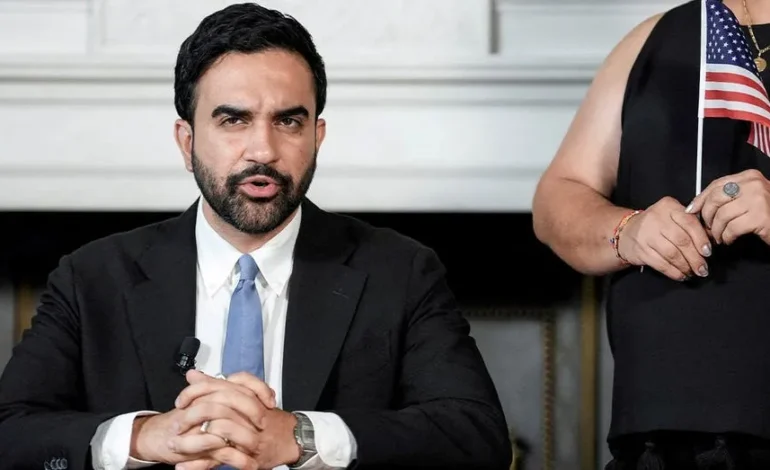

New York City Mayor Zohran Mamdani delivered a powerful address on Friday, just ahead of the July 4th holiday, using an immigration-themed America 250 celebration as a platform to critique what he termed the “arena of supremacy” within the United States. Flanked by eight individuals who had recently become U.S. citizens, Mamdani invoked iconic symbols of American immigration like the Statue of Liberty and Ellis Island, contrasting the nation’s historical ideals with contemporary challenges.
Targeting Wealth Inequality and Power Structures
Mamdani’s speech, delivered from the historic setting of George Washington’s desk, did not shy away from sharp criticism of both economic disparity and governmental actions. He pointedly referred to the “world’s first trillionaire,” a clear nod to Elon Musk’s recent financial milestone, and lamented a system where immense wealth is concentrated in the hands of a select few while children go hungry. “We see the wealthiest country in the history of the world, one where children go to sleep hungry while the world’s first trillionaire hungers for more,” Mamdani stated, without explicitly naming Musk. He further condemned the influence of monopolies and “oligarchs who buy elections,” painting a picture of a nation where power is wielded by a small elite.
The mayor also drew a stark contrast between the nation’s founding principles and the realities faced by immigrants and marginalized communities. He described “masked agents terrorizing our streets, eating food cooked by our undocumented neighbors before spiriting them away in unmarked vans,” a vivid image aimed at U.S. Immigration and Customs Enforcement (ICE) activities. Mamdani argued that the nation’s vast wealth has been generated by the labor of ordinary people, yet this prosperity is disproportionately held by a small, privileged group.
A Legacy of Resilience and Inclusion
Mamdani celebrated the enduring legacy of immigrants, highlighting their resilience in the face of adversity. He recounted how, despite federal laws aimed at restricting their entry, dangerous working conditions like sweatshop fires, and even violence targeting their very presence, immigrants have consistently built lives and contributed to the fabric of New York City. “That legacy of every generation of Americans insisting that the right to life, liberty and the pursuit of happiness extends to them, too, is no relic of the past,” he asserted. He connected this struggle for equality to historical movements such as the Great Migration of Black Americans, the influx of Puerto Ricans after World War II, and the arrival of countless others from around the globe.
Reflecting on his own family’s immigration story, Mamdani shared that while his family did not arrive by boat, the sight of the Statue of Liberty from a plane window still conveyed the promise of America. He spoke of the “beautiful patriotic work of rendering America, year after year, a little more faithful to its founding ideals.” His family’s background includes an acclaimed Harvard academic father and a mother who is an accomplished film director, though Mamdani did not dwell on his family’s affluence during the speech.
Challenging ‘American Exceptionalism’
A significant portion of Mamdani’s address was dedicated to deconstructing the concept of “American exceptionalism.” He challenged the notion that this exceptionalism inherently makes freedom more profound, questioning how it is often used to justify the nation’s actions and status. Mamdani argued that the narrative of American history has frequently been written by those in power, marginalizing the experiences of those who were not considered “exceptional.”
He cited the historical arrival of diverse groups – Puritans, Sikhs, Quakers, Muslims, Jewish people, peasants, and serfs – many of whom faced persecution or were treated as lesser due to their circumstances. “We are told that America is exceptional because we are richer, stronger, more powerful than everyone else. The truth, my friends, is that America is exceptional because here nothing is fixed into place,” Mamdani declared, suggesting that the nation’s true strength lies in its potential for change and reinvention rather than inherent superiority.
The Meaning of Patriotism and Dissent
Mamdani, who became a naturalized U.S. citizen himself in 2018 after moving to New York from Uganda at age seven, spoke directly to the recently naturalized citizens present. He emphasized the “special power” they hold to define what America truly means. He contrasted the vision of America held by the powerful – an “arena of supremacy” where freedom is limited to a select few – with a more inclusive ideal.
“America, if you ask them, becomes less the more people it welcomes. America, they will tell you, belongs only to those with the right accent or the right shade of skin,” Mamdani observed. He countered this exclusionary view by stating, “The powerful have always known their answer… How small they are, how weak, how unoriginal.” He asserted that those who advocate for exclusion and isolation seek power by dividing people.
Addressing the presence of ICE in neighborhoods, Mamdani stated, “We see America each time neighbors link arms with neighbors without asking how long they have lived here or what papers they have as ICE invades our neighborhoods.” He also pointed to voting lines and workers demanding better conditions as manifestations of the American spirit.
Mamdani directly confronted the “Love it or leave it” sentiment often directed at critics of the nation. He redefined patriotism not as blind acceptance, but as “every act of righteous dissent.” He concluded, “It is precisely because we love this nation that we will not leave it.”
A Call for Continued Progress
Concluding his address, Mayor Mamdani issued a call to action, urging everyone to harness their individual power to bring America closer to its ideals. He invoked the enduring vision of American greatness that has inspired people for 250 years. “What power each of us holds to bring America ever closer to the greatness so many have seen when they looked upon these shores. The greatness that for 250 years has been America. Thank you. God bless America. God bless New York City. And happy Fourth of July,” he finished.