




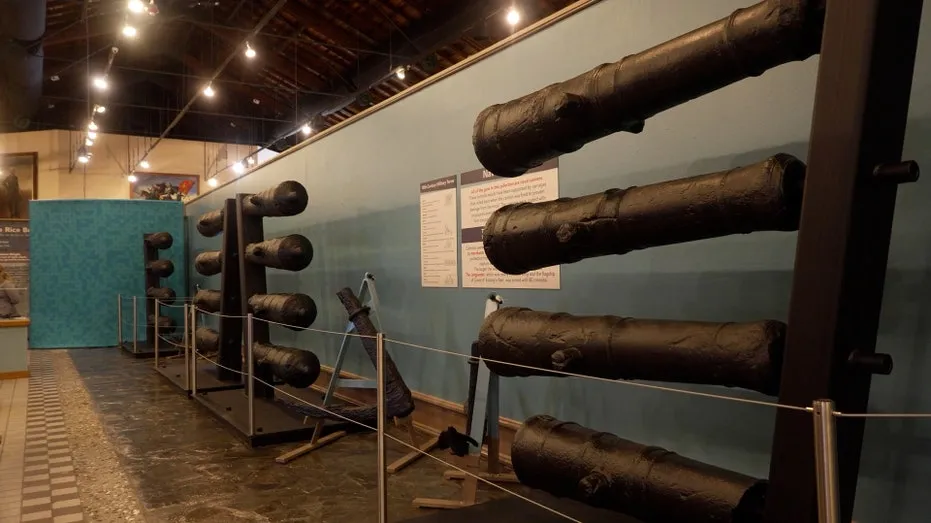
Nineteen cannons, silent witnesses to a pivotal moment in American history, have resurfaced from the depths of the Savannah River after more than two centuries. These artifacts from the Revolutionary War era are now the centerpiece of a new exhibit at the Savannah History Museum, unveiled just as the nation gears up for its 250th anniversary. The cannons, submerged for nearly 240 years, represent a significant archaeological find, marking the largest collection of 18th-century artillery recovered from a single naval engagement of the Revolutionary War.
A Submerged Secret Revealed
The remarkable discovery occurred in 2021 when a U.S. Army Corps of Engineers crew, engaged in dredging the river to accommodate larger vessels, stumbled upon the submerged cannons. “In total, they brought up 19 cannon and a dozen or so small artifacts,” explained Nora Fleming Lee, CEO of the Coastal Heritage Society. “They had quite a bit of concretion on them, oyster shells, all kinds of marine life that had attached itself to the cannon.” Some of these historic weapons were found remarkably intact, still loaded with cannonballs and gunpowder charges, alongside other small historical remnants.
The sheer scale and significance of the find were immediately apparent. “This is the largest discovery of 18th century artillery from a single Revolutionary War naval event,” Fleming Lee stated. “So the discovery is really significant nationwide, not just for Savannah.” The recovery of these cannons offers a rare, tangible connection to the naval strategies and conflicts that shaped the nascent United States.
From Riverbed to Restoration Lab
Following their recovery, most of the cannons embarked on a journey away from Georgia for a meticulous cleaning and preservation process. They were transported to a specialized laboratory at Texas A&M University, where experts worked to stabilize the iron artifacts for long-term display. “Running electrical currents essentially through a water bath that they were in, and it desalinates the iron works, so it stabilizes iron to be on land,” Fleming Lee described the intricate conservation method. “And then in the final treatments, they’re painted with acid and given a spa treatment and waxed and that they can have a very long life here on land.”
Out of the nineteen cannons, seventeen underwent this extensive restoration. The remaining two were intentionally left unrestored, providing visitors with a stark, side-by-side comparison that highlights the transformative power of the conservation process. This approach allows the public to appreciate both the raw, aged state of the artifacts and their stabilized, display-ready condition.
“Loyalists & Liberty: Savannah in the American Revolution” Exhibit
All nineteen cannons are now permanently installed as a central feature of the Savannah History Museum’s new exhibit, titled “Loyalists & Liberty: Savannah in the American Revolution.” This exhibit aims to illuminate Savannah’s complex role during the birth of the nation, moving beyond traditional narratives to encompass a broader spectrum of historical experiences.
Historians theorize that the cannons met their watery fate shortly before the dramatic Siege of Savannah in 1779. At that time, the city was under British control, and the strategic deployment of these cannons is believed to have been a defensive measure. “We believe these cannons are the last of several ships that were scuttled, at the narrowest part of the Savannah River to act as a blockade for the French fleet to prevent them from sailing up river and reclaiming Savannah for the American side,” Fleming Lee explained.
The sinking of these vessels occurred just weeks before the Battle of Savannah, a conflict infamous for its brutality and heavy losses, with over 800 casualties recorded in less than an hour. The battleground itself is historically significant, as it is located on the very land where the Savannah History Museum now stands, adding a profound layer of context to the exhibit.
Expanding the Revolutionary Narrative
The cannons serve as powerful, tangible links to the revolutionary era, enabling a deeper understanding of the period’s conflicts and strategies. “The cannons are really the tangible artifacts that are telling the story of revolution,” said Fleming Lee. “And through that lens, we’re expanding Georgia’s revolutionary story. More about the naval events, but more importantly, we’re telling the story through the lens of those who aren’t often focused on.”
The “Loyalists & Liberty” exhibit broadens the historical perspective by focusing on five distinct historical figures who experienced the Revolution in Savannah. This inclusive approach highlights the experiences of indigenous peoples, free and enslaved individuals, women, and children, offering a more nuanced and comprehensive understanding of Savannah’s pivotal role in the American Revolution and the nation’s founding. By centering these often-overlooked voices, the exhibit enriches the historical record and provides a more complete picture of the era’s complex social and political landscape.


