

Ex-Councilman Ricardo Pacheco Sentenced for Bribery Scheme
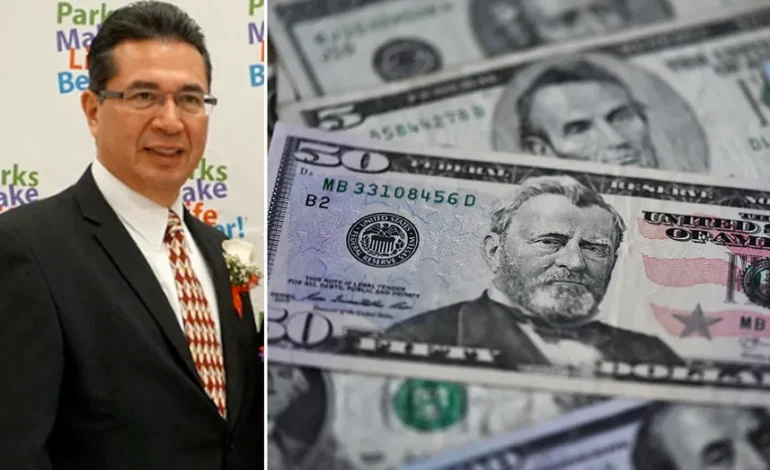

Former Baldwin Park City Councilman Ricardo Pacheco has been sentenced to 18 months in federal prison for his role in a bribery scheme that involved cash buried in his backyard. The 63-year-old politician, who served over two decades on the council before resigning in 2020, admitted to accepting bribes tied to a police union contract and commercial marijuana permits. Prosecutors revealed that Pacheco exploited his elected position, funneling illicit payments through his church and political organizations.
Unearthing a Corruption Scheme
The investigation into Pacheco’s activities came to light after the FBI discovered nearly $63,000 in cash hidden in his backyard. In total, federal agents seized $83,145 in cash proceeds from Pacheco. He was also ordered to pay a $10,000 fine and forfeit $219,755. A restitution hearing is pending.
Pacheco’s downfall began with a deal involving the Baldwin Park Police Association. Between January and October 2018, he solicited and accepted $37,900 from a local police officer in exchange for supporting the union’s contract with the city, a deal valued at approximately $4.4 million over three years. This officer was cooperating with the FBI, having approached the bureau with another officer to assist in the corruption investigation.
In a recorded sting operation at a Baldwin Park coffee shop in October 2018, the officer handed Pacheco a $20,000 cash bribe in an envelope. Further investigation revealed that Pacheco had directed an additional $17,900 in checks to his church and political action committees, which were reportedly controlled by him but established under other individuals’ names.
Broader Investigation and Co-Conspirators
Pacheco’s vote in favor of the police association contract occurred in March 2018. Following his apprehension during the FBI sting, Pacheco became an informant, assisting investigators in building cases that led to indictments against more than 20 individuals connected to local government and the marijuana industry.
The wider investigation implicated several figures, including former Compton City Councilman Isaac Jacob Galvan, 39. Galvan received an identical 18-month federal prison sentence and was ordered to pay $323,557 in restitution. Both Pacheco and Galvan were found to have engaged in corrupt acts while in office, including the exchange of bribes for political support and city permits.
The Marijuana Permit Pay-to-Play System
Baldwin Park’s foray into allowing marijuana cultivation, manufacturing, and distribution began in 2017. Prosecutors alleged that Pacheco soon started soliciting funds from businesses seeking development agreements and related permits.
Galvan, then a member of the Compton City Council, reportedly offered consulting services to W&F International Corp., a business aiming to secure a marijuana permit in Baldwin Park. According to the Department of Justice, Galvan facilitated approximately $70,000 in bribes from the company’s owner, Yichang Bai, to Pacheco in return for the councilman’s votes and political backing. Pacheco subsequently voted in favor of W&F’s permit in June and July 2018 and supported the company’s request to relocate its operations.
These payments were often disguised through checks from third parties, including some with blank payee lines. When Pacheco later sought funds for his legal defense, Galvan allegedly informed Bai that Pacheco was seeking $25,000. Bai agreed to provide $20,000, which was funneled through seven checks drawn from bank accounts not belonging to him or W&F International.
Tax Evasion and Guilty Pleas
Beyond the bribery charges, Galvan also admitted to failing to report roughly $560,525 in income to the IRS between 2017 and 2020, resulting in an estimated tax loss of $115,816.
Yichang Bai, the owner of W&F International Corp., pleaded guilty to conspiracy to commit bribery. In July, Bai was sentenced to 20 months in federal prison and fined $3,000.
The case underscores a pattern of alleged corruption where public officials leveraged their positions for personal gain, often obscuring illicit transactions through complex financial arrangements. The investigation, which began with a police union contract, ultimately unearthed a broader network of corruption involving permits and political influence.