




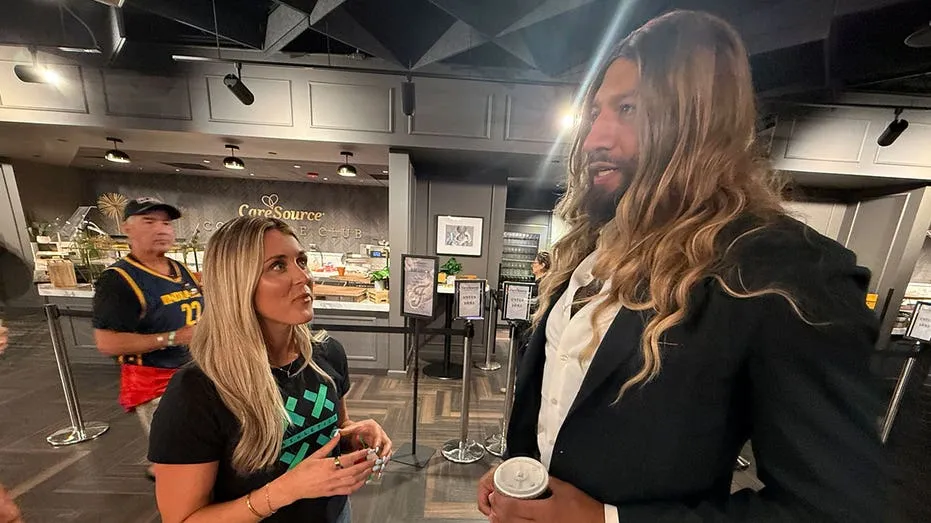
Riley Gaines, a prominent advocate for maintaining women’s sports for biological females, recently experienced starkly different receptions at two WNBA games, highlighting what she and others see as a broader issue within the league and its fan base. Her experiences suggest a divide in how her message is received, correlating with the political leanings of the host cities and states.
A Tale of Two Cities: Minneapolis vs. Indianapolis
Earlier this summer, Gaines attended her first WNBA game in Minneapolis, a city known for its progressive politics. She brought a sign supporting Indiana Fever player Sophie Cunningham, who had spoken out in favor of preserving women’s sports for biological females. According to Gaines, the reception in Minneapolis was hostile. She reported being booed, yelled at, and even spat on for her stance.
Fast forward to a recent Indiana Fever game in Indianapolis, a city located in a state generally considered more politically conservative. This time, Gaines found herself surrounded by supporters. She received hugs, smiles, and numerous requests for photos. Former NBA player Royce White, who has been vocal on similar issues and recently made a public statement identifying as a trans woman to highlight concerns about WNBA policies, also attended the game and was warmly welcomed.
Gaines contrasted the atmospheres, telling OutKick, “My main takeaway is that when Minneapolis is booing you, it’s generally a good sign,” adding with a touch of irony, “Especially for those of us with common sense and an ounce of integrity and a shred of honesty.” She noted the palpable difference in the crowd’s demeanor, describing the Indianapolis environment as significantly more positive and appreciative of her message.
The Red State, Blue State Divide in the WNBA
Gaines and others point to the geographical distribution of WNBA teams as potentially reflecting the league’s cultural and political leanings. Out of the 15 teams, only two are based in reliably red states: the Indiana Fever and the Dallas Wings. While states like Georgia, Nevada, and Arizona have teams, they are often considered purple states rather than solid red. The league is set to expand with a team in Cleveland in 2028, but the imbalance is expected to persist.
This geographical concentration, Gaines suggests, might contribute to the league’s perceived struggles with defining its identity and policies regarding transgender participation. The hostile reception she faced in Minneapolis, a blue city, versus the supportive welcome in Indianapolis, a red state, fuels her argument that a significant portion of the WNBA’s audience aligns with her views, even if the league’s leadership does not.
Challenging the Status Quo: White and Freedom’s Stunt
The conversation around gender and sports has taken unusual turns, prompting figures like Royce White and former NBA player Enes Kanter Freedom to adopt provocative strategies. Earlier in the month, both White and Freedom declared their intention to identify as trans women and pursue eligibility for the WNBA draft in 2027. This move, they stated, is a deliberate attempt to challenge the WNBA’s perceived lack of clarity and spine on the issue of transgender athletes in women’s sports.
Freedom, in particular, has faced direct opposition. He was reportedly ejected from a WNBA game in Chicago, with Sky player Natasha Cloud engaging in a verbal altercation with him. Freedom was subsequently banned from the arena. In contrast, White’s appearance in Indianapolis was met with respect and encouragement.
White commented on the disparity, telling OutKick, “You can’t expect that, it was overwhelming. But…I think people have a lot of appreciation for what Roysha is doing and some of the other people who are fighting as well. It’s just so crazy to me the difference in response here in Indiana versus in Chicago… But one city is run by people who have common sense and the other one isn’t, so there’s that.”
Gaines’ Perspective and Support
Gaines echoed White’s sentiments about the welcoming atmosphere in Indiana. “Let me tell you the difference, being here in Indiana, a home game for the Fever,” Gaines said. “The looks that you’re getting are smiles, people are winking. People are coming up and saying thank you. People are expressing their gratitude for the stance that I (have taken). Not the same response I had in Minneapolis.”
She acknowledged that her message often meets resistance in more liberal areas, requiring a resilient approach. Gaines expressed deep respect for White and Freedom’s efforts, seeing their actions as a bold way to force the WNBA to confront the complexities of its policies. She believes players like Natasha Cloud, who had a public dispute with Freedom, are missing the larger point.
“I was watching the altercation between Enes Kanter Freedom and Natasha (Cloud) where obscenities were yelled back and forth, at least on Natasha’s end at Enes, and I thought to myself, ultimately, Natasha really should be thanking Enes, because what he’s fighting for…is her,” Gaines explained. “He is fighting for her to have the opportunity and the ability to achieve and to exceed in her sport and even beyond.”
Broader Implications and Legal Concerns
The debate extends beyond the WNBA, with figures like Indiana Attorney General Todd Rokita actively involved in advocating for policies that protect women’s sports. Rokita, who attended the Fever game with Gaines, emphasized the biological differences between sexes and the importance of clear bylaws.
“I’m pleased to host my friend Riley Gaines tonight with her husband and we’re having a good time,” Rokita told OutKick. “But the fact of the matter is, there are a lot of leaders in this country who see the obvious, and the obvious is that sports teams should only have the same biological sex because there are differences. And I am so happy that these biological men (Freedom and White) are proving the point when they are coming to apply for the WNBA solely because the WNBA can’t get its own bylaws straight.”
Rokita expressed concern that the WNBA’s ambiguity on eligibility could set a precedent for other organizations. He stated that as Indiana’s Attorney General, he is scrutinizing bylaws of various entities to ensure they are clear, lawful, and non-abusive. “If the WNBA can’t make some simple decisions about what their bylaws should read, you may see a lot of states, a lot of my friends, get involved, including Indiana,” he warned.
The situation raises questions about whether the WNBA, despite its progressive image, might ultimately be influenced by conservative voices and fan bases, particularly if legal challenges arise from its current policies or lack thereof. The irony, some suggest, is that a league often associated with liberal politics could find itself needing intervention from those who champion traditional definitions of gender in sports.


