




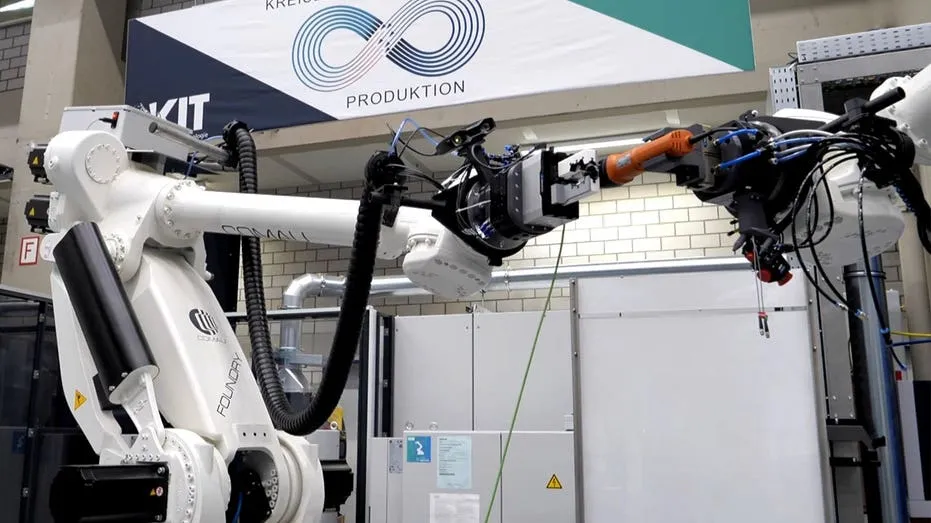
Robots have long been the workhorses of manufacturing, meticulously assembling the products we use daily. Now, researchers are equipping them with a new, crucial skill: the ability to take those same products apart when they break down. With over 4.6 million industrial robots already in operation globally and demand for automation on the rise, the question of what happens to aging machinery and complex products is becoming increasingly pertinent.
The Challenge of Deconstruction
Building a product on an assembly line is a highly predictable process. Robots follow precise, pre-programmed sequences, knowing exactly which part comes next and where it fits. Dismantling a machine, however, presents a far messier reality. Years of use can lead to corroded or damaged parts, and previous repairs might alter a product’s original configuration. This inherent uncertainty poses a significant hurdle for traditional automation, where a single unexpected issue can halt the entire operation.
Jan Baumgärtner, a researcher involved in the project, highlights this contrast. “When assembling something new, the steps are clear. When dismantling something broken, many things can go wrong,” he explained. This means robots need more than just a set of instructions; they require the capacity to adapt and reassess their actions based on real-time feedback.
A Smarter Approach to Disassembly
To address this challenge, scientists at the Karlsruhe Institute of Technology in Germany have developed an innovative robotic disassembly system. Rather than assuming perfect conditions, this system is designed to anticipate and handle the unpredictable nature of old or damaged machinery. It can recognize when a screw is stuck, a component is missing, or the machine no longer conforms to its original design, adjusting its plan on the fly.
The system begins with a CAD model of the product’s intended construction. The robot then uses this as a baseline to analyze how individual parts actually behave. It can detect deviations from the model, such as a component not moving as expected. If a screw, for instance, doesn’t turn correctly, the system incorporates this new information into its subsequent actions.
Probabilistic Planning for Uncertainty
At the heart of this adaptive capability is a technique known as a Partially Observable Markov Decision Process (POMDP). While the name might sound complex, the concept is quite intuitive: the robot acknowledges it doesn’t have complete information. Instead of adhering to a single, rigid plan, it assigns probabilities to potential issues and continuously refines these assumptions as it gathers more data. This probabilistic approach, combined with CAD data, inspection findings, and the robot’s own physical capabilities, allows for a much more robust disassembly process.
Real-World Adaptability in Action
The researchers put their system to the test in several experiments. In one scenario simulating a stuck screw in an electric motor, the robot initially attempted the standard unscrewing procedure. Upon encountering resistance, it didn’t persist in vain. Instead, the system intelligently switched tactics, opting to use a milling tool to carefully remove material and access the desired part. In another test involving an angle grinder, the robot detected a missing screw and efficiently bypassed that step, saving valuable time.
This adaptability proved particularly beneficial. While traditional, deterministic planning methods work well when everything proceeds as expected, the probabilistic system demonstrated superior performance in scenarios involving uncertainty. The researchers observed that as the likelihood of encountering stuck parts increased, the probabilistic planner achieved faster disassembly times, especially when alternative methods were available to reach the target component. These findings were presented at the 2026 IEEE International Conference on Robotics and Automation in Vienna.
Future Potential: Towards a Circular Economy
It’s important to note that the current research focuses on disassembling specific components like electric motors and angle grinders, not entire industrial robots. However, the underlying technology holds the potential for broader applications. Baumgärtner envisions scaling this system to utilize multiple robotic arms, each equipped with specialized tools, in dedicated disassembly facilities. This could effectively create an ‘assembly line in reverse’.
A primary goal driving this research is the promotion of a more circular economy. The aim is to enable manufacturers to recover valuable components from older products, thereby reducing waste. The system can even be programmed to prioritize the preservation of specific, high-value parts, adjusting its disassembly strategy accordingly. Ultimately, the researchers hope to develop automated processes capable of extracting faulty components, replacing them, and effectively rebuilding products.
Automated Repair and Economic Viability
The long-term economic ambition is to make automated repair so cost-effective that fixing an electronic device becomes cheaper than manufacturing a new one. While this remains a future aspiration rather than a current commercial reality, it points towards a significant shift in how products are managed at the end of their life cycle.
The implications for consumers and the environment are substantial. Currently, many electronics end up as e-waste because the labor involved in recovering individual components is often prohibitive. If robotic systems can efficiently handle damaged products, manufacturers could potentially reclaim more valuable parts, making refurbishment more economically feasible. Furthermore, intelligent disassembly could reduce the amount of perfectly functional hardware discarded simply because one part has failed.
A key factor for future success will be whether manufacturers begin designing products with automated disassembly in mind from the outset. As Baumgärtner suggests, considering how a product will eventually come apart during the design phase can greatly simplify the repair and recycling process.
Key Takeaways
The most compelling aspect of this research is the robot’s newfound ability to navigate uncertainty. Traditional factory robots excel in controlled environments, but broken products rarely cooperate. Equipping machines with the intelligence to recognize when reality diverges from the blueprint could unlock a wider range of applications, particularly in repair and recycling, where economic factors often dictate whether a product gets a second life or is scrapped.
While a full-scale repair revolution isn’t here just yet, the concept is groundbreaking. As robots become more adept at deconstruction, the recovery of valuable components becomes increasingly practical, reducing the need to discard entire machines due to a single failed part. The prospect of robots making electronic repairs more affordable than replacements raises intriguing questions about consumer behavior and the future incentives for manufacturers.


