




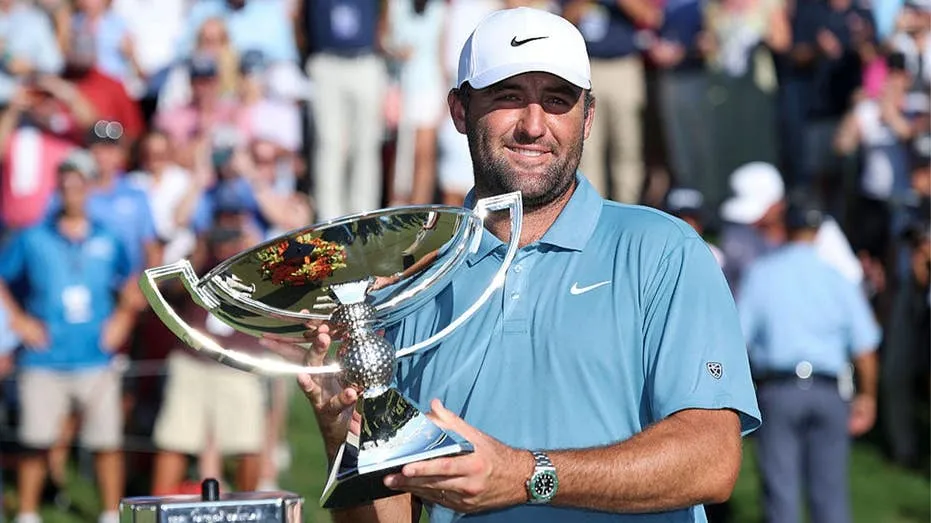
The narrative that Scottie Scheffler had somehow forgotten how to win golf tournaments, a storyline that gained traction throughout the 2026 season, has been definitively put to rest. Scheffler clinched the Tour Championship on Sunday, capping off a remarkable season that also saw him dominate the opening FedEx Cup Playoff event. His year concluded with three victories and earnings approaching $31 million, a figure that doesn’t even include lucrative bonuses. While the final round at East Lake lacked nail-biting tension, it nonetheless marked the 30-year-old’s 18th win over the past three seasons. Intriguingly, this win total mirrors that of Tiger Woods during the same age and time frame, prompting a familiar and compelling comparison exercise.
Scheffler’s Stellar Season and the Tiger Woods Parallel
Scheffler’s comfortable three-shot victory at the Tour Championship, a relatively serene cruise to the finish line, contributed to a subdued atmosphere. However, the golf world was also buzzing about Michael Block’s continued exploits on the senior circuit, which arguably drew some attention away from the main event at East Lake. Block, it seems, is a perpetual content generator. Meanwhile, the YouTube golf scene provided its own brand of drama throughout the week, involving a controversial ad from the group Good Good, the subsequent backlash, and Grant Horvat’s controversial pricing of children’s golf clubs. This piece aims to provide a final analysis of these significant happenings in professional golf.
The question inevitably arises: Is this iteration of Scottie Scheffler on par with the dominant Tiger Woods of yesteryear? The Tour Championship itself offered little in the way of surprises. The world’s top-ranked player, who demonstrated unparalleled consistency all season, rightfully claimed the FedEx Cup title. Scheffler’s iron play was exceptional throughout the tournament, and when he commands his irons with such precision, as he did in Atlanta, he becomes virtually unbeatable, capable of securing commanding victories. And that’s precisely what transpired.
Following Scheffler’s triumph, a comparison of his performance between the ages of 28 and 30 to Tiger Woods’ record during the same span began circulating. When examining the raw numbers, the resumes appear strikingly similar. However, the discussion gains nuance when considering Woods’ four major championships compared to Scheffler’s three, and Scheffler’s edge in the ‘strokes gained’ statistic. Strokes gained, it’s crucial to remember, measures a player’s performance relative to the entire field, not just against the course itself, and goes beyond simple metrics like greens or fairways hit.
If we adhere to the widely accepted principle that major championships hold the ultimate weight, then that version of Woods arguably surpasses this version of Scheffler. Yet, the true enjoyment lies in debating the depth and quality of the respective eras. Woods, during his 28-30 peak, contended with a formidable roster of rivals including Phil Mickelson, Ernie Els, Vijay Singh, Retief Goosen, and Jim Furyk. This suggests his era might have been more top-heavy with elite talent than Scheffler’s current landscape. But does that automatically equate to a deeper overall field in Woods’ time?
The evolution of technology has undeniably reshaped professional golf, leading to a PGA Tour populated by a greater number of elite players than ever before. This advancement, however, should not diminish the achievements of the current era. Just because times have changed doesn’t inherently mean the sport has become less meaningful or exciting. While no one is suggesting a comparison of their entire careers, Scheffler’s three-year stretch is, at the very least, comparable to that specific period in Tiger Woods’ career. Scheffler’s game might lack the flashy allure or the dramatic tension of Woods’, and he may be labeled ‘boring’ by some, but that doesn’t invalidate the statistical parallels.
Michael Block: The Unstoppable PGA Professional
Michael Block, who celebrated his 50th birthday in June, making him eligible for the PGA Tour Champions, has been making a significant impact on the senior circuit, often through sponsor exemptions. Competing on a sponsor’s invite at the recent Ally Challenge, Block had already demonstrated strong form, having not missed a cut in his previous four starts and securing two top-10 finishes. His consistent play has injected a welcome dose of excitement into the senior tour, positioning him as one of the standout performers, at least temporarily, on a circuit rich with golfing legends.
Block entered the final round of the Ally Challenge in contention, holding a share of the lead. Although he carded a 2-over 74 on Sunday, finishing T-3 and four shots behind winner Steven Alker, he undeniably stole the show, as is his custom. On the par-3 eighth hole, a particularly challenging 200-yard hole, Block delivered a moment of pure showmanship. After hitting his tee shot to approximately 15 feet, he decided to entertain the crowd. In a move that drew gasps and cheers, he tossed his club back to his caddie, snatched his putter, and began walking backward, exchanging fist bumps and high fives with volunteers lining the tee box. This spectacle occurred after what was, by all accounts, a standard approach shot. It was as if he had just sunk a tournament-winning putt, long before he had even reached the turn.
While such antics from another player might invite widespread criticism, Block’s flair for the dramatic is simply accepted as part of his persona. Whether one is a fan or not, his presence is undeniable and inescapable. He has a unique ability to command attention, turning even routine moments into memorable events.
Analyzing the Good Good YouTube Golf Controversy
The recent controversy surrounding the YouTube golf collective Good Good, their partnership with Callaway, the ensuing fallout, and Grant Horvat’s entry into the fray with his own branded children’s golf clubs priced at a steep $200, has been a significant talking point. This past week proved to be a trying one for the YouTube golf community and its millions of followers. Amidst the flurry of immediate reactions, one particular analysis, shared by Tweeth Mitchell on X, offers a compelling perspective that warrants attention.
We are living in an era where information and trends move at an unprecedented pace, and metrics like likes, shares, and engagement often dictate success. Good Good and Grant Horvat exemplify a generation and a group that operates within this paradigm. This isn’t a criticism of their choices, but rather an observation of the environment in which they have risen to prominence. Horvat, who does not have children, venturing into the market for children’s golf clubs, which appear to be constructed primarily from plastic and sold at a premium price point, certainly raises eyebrows. It presents an image of someone capitalizing on what they perceive as a lucrative, ever-expanding market driven by new generations taking up the sport.
While one cannot fault an individual for pursuing business opportunities, Horvat’s situation feels less like a risk and more like a calculated move, given his prominent position atop the Golf YouTube hierarchy. This perception contributes to the notion that it might be viewed as a significant money grab. As Mitchell aptly pointed out on X, in this fast-paced digital landscape, there often seems to be a lack of a guiding principle or a ‘north star’ to navigate these complex situations.


