




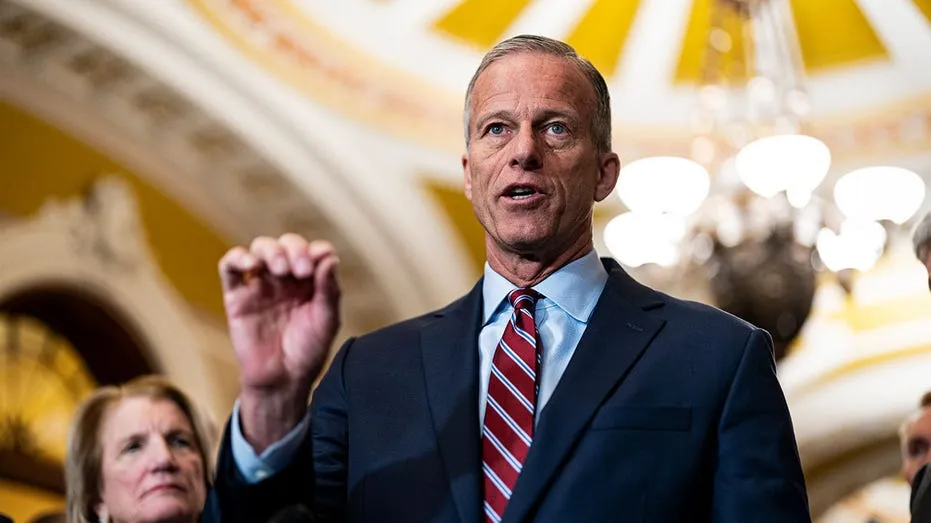
The U.S. Senate concluded its August session with an almost surreal display of unity, unanimously agreeing to an extended break that effectively sidelined President Trump’s signature legislative priority, the SAVE America Act. Despite calls from the President and some conservative lawmakers to remain in Washington for the month, the Senate adjourned in the early hours of Saturday, August 8th, not to reconvene for substantive debate and votes until September 15th. This lengthy hiatus, spanning over a month, was facilitated through a series of unanimous consent agreements, a procedural mechanism that requires the assent of all 100 senators.
The SAVE America Act: A Legislative Push
The SAVE America Act, championed by President Donald Trump, proposed significant changes to federal election laws, notably mandating voter identification and proof of citizenship for all voters. This legislative push gained traction among a segment of Republican senators, including figures like Mike Lee of Utah and Rick Scott of Florida, who advocated for the Senate to remain in session throughout August to deliberate on the bill. The argument was that such critical election integrity measures warranted immediate attention and debate, rather than being postponed during a traditional recess.
A Procedural Masterclass: Unanimous Consent
The Senate’s departure was not the result of a clandestine maneuver by Senate Majority Leader John Thune (R-S.D.), as some might suspect. Instead, it was a carefully orchestrated process built upon the foundation of unanimous consent. This Senate tradition, where all 100 members must agree for a procedural motion to pass without a formal vote, was the key to the extended break. Even those senators who supported the SAVE America Act’s objectives were, by their silence, complicit in the decision to recess.
The critical moments unfolded in the pre-dawn hours of Saturday, August 8th. As the Senate was nearing the end of a session that had already included votes on confirming Attorney General Todd Blanche and approving a Russia sanctions bill, Senator Thune approached the floor. He proposed a series of agreements to manage the Senate’s schedule, including the scheduling of brief, infrequent “pro forma” sessions throughout August and early September. These sessions, often lasting mere seconds with only a handful of senators present, are a formality and do not involve legislative debate or voting.
The “Pro Forma” Sessions and the Path to Recess
Thune meticulously laid out the schedule for these pro forma sessions, with dates set for Mondays and Thursdays in August and early September. Presiding over the Senate at the time, Senator Bernie Moreno (R-Ohio) posed the customary question: “Without objection?” The response, crucial to the Senate’s operation, was silence. This lack of objection signaled assent from all present, and by extension, all senators.
Later, as the Senate prepared to adjourn for what would be a substantial break, Thune made another request. He asked that upon adjournment on Thursday, September 10th, the Senate not reconvene until Monday, September 14th, with specific procedural steps outlined for that day. He also set the stage for a test vote on a cryptocurrency regulation bill for Tuesday, September 15th. Again, the presiding officer, Senator Cynthia Lummis (R-Wy.), asked for objections. Receiving none, the Senate was effectively scheduled for its extended recess.
The Power of One: How Unanimous Consent Works
The Senate operates on a principle of collegiality, where each of the 100 senators holds significant power. The reliance on unanimous consent for routine matters, such as scheduling and adjourning, underscores this. While major legislation typically requires formal votes, the day-to-day rhythm of the Senate often depends on all members being in agreement. A single objection can halt a unanimous consent request, effectively derailing a proposed course of action.
In this instance, despite the public advocacy from some quarters for the Senate to stay in session, no senator formally objected to the proposed schedule. This silence was interpreted as agreement, allowing the recess to proceed as planned. The process was further solidified by “hotline” notifications the evening before, where senators could privately signal any objections to proposed actions. When no objections were raised through this channel either, Senator Thune was able to proceed with his requests on the Senate floor with confidence.
A Small Victory for the SAVE America Act Advocates
While the SAVE America Act itself did not get the floor debate its proponents desired, the unanimous consent agreement did include a concession: a test vote on a voter ID bill, championed by Senator Jon Husted (R-Ohio). This measure, which aligned with some of the SAVE America Act’s core tenets, provided an opportunity for senators to go on record. All Republican senators voted in favor, while all Democratic senators voted against it. This roll call vote was seen as a strategic move, potentially offering Republicans fodder for campaign messaging in the upcoming elections.
However, this test vote, despite securing a simple majority, was ultimately symbolic. The unanimous consent agreement stipulated that the Husted measure would require a 60-vote threshold to pass, a target that Republicans, with their 53-seat majority, could not reach without Democratic support. Thus, even this small legislative win was designed to fail under the agreed-upon procedural rules.
Conclusion: A Collective Decision
The Senate’s decision to take an extended break, effectively shelving the SAVE America Act for the remainder of August and the first half of September, was not a unilateral action. It was the culmination of a process where all 100 senators, through the mechanism of unanimous consent, agreed to the proposed schedule. The calls for the Senate to remain in session were ultimately outweighed by the collective agreement to adjourn. When asked why the Senate did not convene for extended debate on election reform, the answer lies in the procedural reality: all 100 senators collectively agreed to depart Washington in the early hours of August 8th, opting for a lengthy recess over continued legislative work.


