




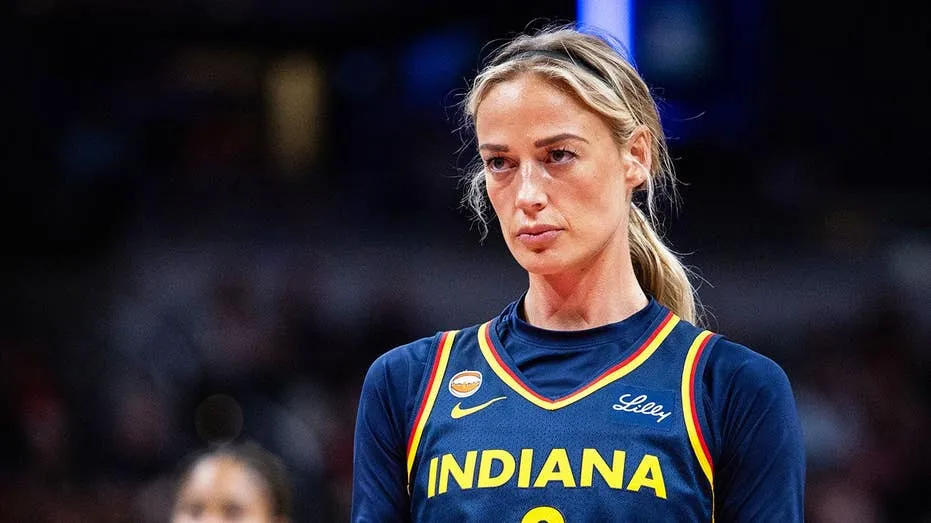
WNBA player Sophie Cunningham has ignited a significant debate with her recent remarks advocating for the protection of women’s sports. Her stance, which calls for excluding biological males from female athletic competitions, has drawn criticism from various media figures and even some fellow WNBA players. However, Cunningham has remained firm in her position. Adding an unexpected dimension to the discourse, her childhood friend and podcast co-host, West Wilson, publicly voiced his disagreement on the social platform X.
Podcast Partners Divided on Transgender Athlete Issue
Wilson expressed frustration with what he described as “right-wingers” amplifying the debate around transgender athletes in women’s sports, suggesting it has been disproportionately magnified. He argued that the issue is statistically marginal, stating, “Transgender athletes in American sports is such a borderline nonexistent issue that right-wingers have convinced a massive portion of people in our country that these people are a threat to sports in America when mathematically, that’s not the case at all.”
He further contended that by giving this issue such prominence, politicians are exacerbating societal divisions and marginalizing transgender individuals. Wilson pointed to the NCAA as an example, claiming, “There is, like, 10 transgender athletes in all of the NCAA.” He suggested that while unique cases might require individual consideration, allowing this debate to overshadow more pressing concerns like housing, healthcare, and international conflicts is misguided. “I think there are unique questions that can be handled on individual bases, but to allow this to take our attention from housing, healthcare, wars, all the other actual harmful s–t in our country is dumb,” Wilson remarked.
Nuances of the Debate: NCAA vs. Youth Sports
The perspective that the transgender athlete issue is exclusively a “right-wing” concern is a simplification, as individuals across the political spectrum have voiced concerns about biological males competing in women’s sports. Wilson’s focus on collegiate athletics, specifically the NCAA, also overlooks a significant area of public concern: youth and high school sports. Many parents and community members are particularly worried about the implications of transgender participation at these younger, formative levels, an area that has been extensively covered by sports journalism outlets.
This divergence in focus highlights a common progression in such debates, often moving from claims of rarity to acknowledgments of limited occurrence, a pattern some observers liken to a “slippery slope.” The differing viewpoints between Cunningham and Wilson present an intriguing dynamic, given their established partnership.
Navigating Differing Stances
Cunningham has articulated a clear and unwavering position on safeguarding women’s sports, even reinforcing her initial statements. Conversely, Wilson appears to hold a contrasting view, emphasizing the minimal statistical impact and the potential for divisiveness. While disagreements on policy matters like tax rates can often be navigated with mutual respect, the subject of transgender participation in sports remains a particularly charged and sensitive topic.
The extent to which Cunningham and Wilson will reconcile their divergent opinions within their professional and personal relationship remains to be seen. Both individuals appear committed to their respective viewpoints, suggesting that a resolution to their disagreement may not be imminent. Their public discussion underscores the complexity and polarization surrounding the inclusion of transgender athletes in competitive sports, reflecting broader societal conversations about identity, fairness, and inclusion.
The debate touches upon fundamental questions about the definition of women’s sports, the principles of fair competition, and the rights and inclusion of transgender individuals. As Cunningham and Wilson navigate this difference, their situation mirrors the broader societal challenge of finding common ground on these evolving issues. The conversation continues, with various stakeholders offering perspectives rooted in concerns for fairness, inclusion, and the integrity of women’s sports across all levels of competition.


