




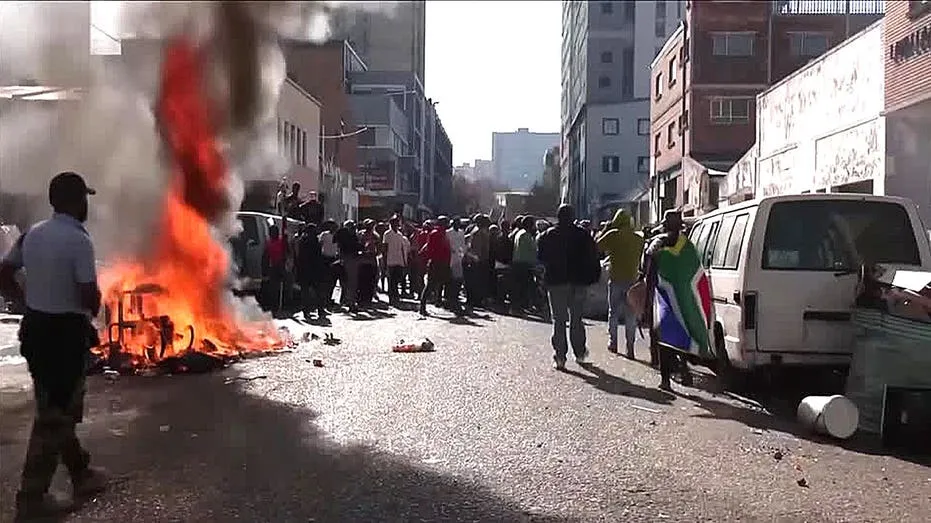
South Africa has mobilized thousands of police officers across the nation in response to escalating anti-immigration protests that have erupted in multiple cities, leading to violence and looting. The unrest, fueled by widespread discontent among some South African citizens who blame foreign migrants for job scarcity and rising crime, intensified ahead of a self-imposed June 30 deadline for the departure of undocumented immigrants. Reports indicate that at least four people have lost their lives as the demonstrations turned violent, with clashes reported in areas including Johannesburg, Durban, and Soweto.
Protests Escalate with Violence and Looting
The demonstrations, which drew thousands of participants, many of whom are reportedly from impoverished or unemployed segments of the population, have seen significant destruction. Businesses and properties have been vandalized, prompting many shop owners to close their doors and foreign workers to stay home out of fear. In some instances, landlords have allegedly evicted foreign tenants, leaving them with nowhere to go. Witnesses in Durban reported seeing around 100 Congolese nationals sleeping on the streets after being displaced.
While organizers of some marches have claimed they were peaceful, police have confirmed making arrests for looting and have deployed rubber bullets to disperse unruly crowds. In the Soweto township, protesters were seen looting the shacks of foreign nationals. The situation in Thembisa, a Johannesburg suburb, saw rioters throwing stones at police and individuals perceived as migrants, with sporadic gunfire also reported by onlookers.
In Benoni, east of Johannesburg, tactical police units were deployed and reportedly fired shots after confronting a group of approximately 500 protesters. The national police force has been significantly bolstered, with the military placed on standby to ensure public order. Lieutenant General Tebello Mosikili issued a stern warning, stating, “To those who intend to break the law tomorrow, our message is simple: do not test the resolve of the State.”
Organizers’ Stance and Government Response
One of the prominent groups behind the protests, identified as the “March and March” organization, has distanced itself from the violent incidents, suggesting they were spontaneous and beyond their direct control. Jacinta Ngobese, a leader with the group, stated that they cannot micromanage the behavior of every individual participating in the demonstrations. She indicated that the group intends to continue its weekly marches until their demands are met.
Ngobese articulated the group’s core demand: “For the next six months, we are asking for our national resources to be used to take the illegal immigrants out of this country. From building to building — they must go.” However, the South African government has officially rejected the June 30 deadline, emphasizing that only state authorities are empowered to enforce immigration laws.
Context of Migration in South Africa
These protests represent the most significant anti-immigrant unrest since a wave of violence in 2008. Despite South Africa’s high unemployment rate, it remains the continent’s largest economy and a significant destination for migrants from across Africa. Official statistics suggest that the immigrant population numbers around 3 million, constituting approximately 4% of the total population.
The tensions highlight a complex socio-economic landscape where economic pressures intersect with national identity and security concerns. While many foreign nationals had already departed in anticipation of the deadline, the underlying issues driving the protests continue to simmer. The government faces the challenging task of balancing the rights and safety of all residents, including foreign nationals, while addressing the concerns of its citizens regarding employment and security.
Broader Implications and International Scrutiny
The unrest has drawn international attention, with reports of alleged illegal evictions and displacement of foreign nationals underscoring the severity of the situation. The scale of the police deployment and the military’s standby status signal the government’s commitment to restoring order, though the underlying grievances remain unresolved. The ongoing situation underscores the deep-seated challenges South Africa faces in managing migration flows and integrating diverse populations within its borders.
The government’s response, while focused on maintaining law and order, will likely need to address the root causes of the anti-immigrant sentiment, including economic disparities and perceptions of crime. The coming weeks will be critical in determining whether the authorities can de-escalate the situation and find sustainable solutions that respect human rights and promote social cohesion.


