




Stars and Stripes Leaders Ousted Amid Editorial Independence Dispute
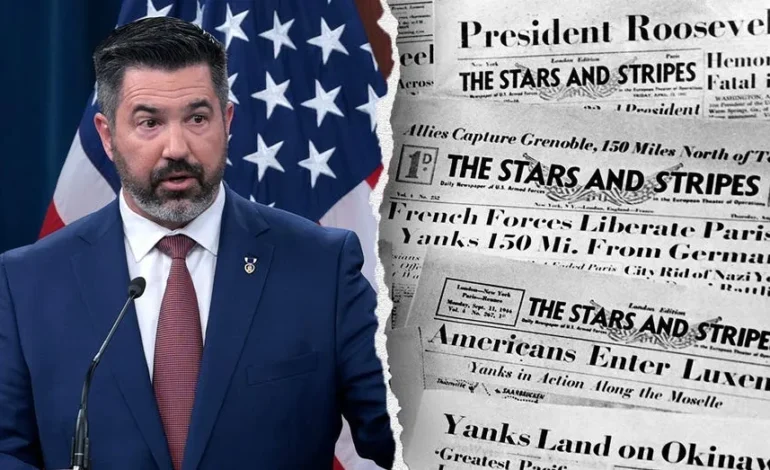

The Pentagon has dismissed the publisher, editor-in-chief, and a reporter from the storied military newspaper Stars and Stripes, citing alleged insubordination. The firings, which took effect Friday, involve longtime publisher Max Lederer, editor-in-chief Erik Slavin, and Middle East reporter Lara Korte. The actions appear to stem from an unauthorized appearance by Slavin and Korte on a CBS television program discussing the newspaper’s future, and Lederer’s subsequent refusal to terminate them as directed by Pentagon leadership.
Turbulence Over Editorial Independence
The controversy ignited when Slavin and Korte participated in a “CBS Sunday Morning” segment that explored the Pentagon’s plans to restructure Stars and Stripes. According to sources familiar with the situation, the Department of Defense leadership viewed this participation as unauthorized. When Pentagon officials reportedly instructed Lederer to dismiss Slavin and Korte, he declined, leading to his own termination.
Erik Slavin, who took the helm as editor-in-chief in September 2025 after a long career with the publication that began in 2005, stated that his dismissal notice cited insubordination for asserting that censorship of news for service members would cross a “red line.” In a statement, Slavin emphasized his commitment to the principle of editorial independence for Stars and Stripes, a tenet he believes is mandated by law and the Department of Defense’s own policies.
Lara Korte, who joined the newspaper in 2024, took to social media to express her reaction. She posted on X that she was informed of her dismissal for insubordination after telling a CBS reporter that her allegiance was to Stars and Stripes, not to the Pentagon, any administration, or specific policymakers. Korte articulated her belief that the institution and its service members, who have sworn to defend the Constitution, deserve a free and independent press. She also expressed pride in the work done by her colleagues, particularly their recent coverage of the conflict in Iran, and acknowledged the trust placed in them by military families and service members.
A Long History and a Contentious Future
Max Lederer, an Army veteran, has a deep-rooted history with Stars and Stripes, having joined in 1992 and served as its publisher for the past 19 years. His departure comes after he had already informed staff of his intention to retire at the end of September, citing “fundamental” disagreements with Pentagon leadership regarding the newspaper’s strategic direction. In his communication to staff, Lederer expressed pride in their collective achievements and confidence in their future endeavors.
The dismissed staffers have been granted a five-day window to appeal their terminations. When reached for comment, a Pentagon spokesperson referred to an open letter addressed to stakeholders by Captain William Urban, the Military Deputy to the Publisher. Portions of this letter were shared by Chief Pentagon Spokesman Sean Parnell on X.
Captain Urban’s letter outlined a vision for Stars and Stripes that aims to increase its digital reach and impact for service members, while upholding professional journalism standards and editorial independence. He acknowledged the challenges of replicating the influence of the newspaper’s World War II era in today’s media landscape but stressed the imperative to improve for the benefit of U.S. Armed Forces personnel.
Pentagon’s Vision for a Refocused Publication
Sean Parnell, the Chief Pentagon Spokesman, has been vocal on social media about the administration’s intentions for Stars and Stripes. In January, he announced the newspaper’s return to its “original mission: reporting for our warfighters.” Parnell stated that the goal is to modernize operations and refocus content away from what he termed “woke distractions that syphon morale,” adapting the publication for a new generation of service members.
Parnell elaborated that the revamped Stars and Stripes will be “custom tailored to our warfighters,” concentrating on topics such as warfighting, weapons systems, fitness, lethality, and survivability – “ALL THINGS MILITARY.” He explicitly stated an intention to move away from “repurposed DC gossip columns” and “Associated Press reprints,” emphasizing a commitment to preserving the outlet’s legacy of reporting news vital to service members.
This recent upheaval follows an earlier incident in April when the Pentagon dismissed the Stars and Stripes ombudsman, who had been a vocal critic of the previous administration’s oversight of the newspaper.
A spokesperson for Stars and Stripes indicated that the organization would not comment further, deferring to its own report on the firings. Neither Lederer nor Korte provided further comment when sought by Fox News Digital.
The Role and Independence of Stars and Stripes
Stars and Stripes has a long and distinguished history, serving as a vital news source for American military personnel serving overseas and domestically since its inception during World War II. Its mission has always been to provide news and information relevant to the lives and experiences of service members, often in challenging environments where access to civilian media might be limited.
The question of editorial independence has been a recurring theme in discussions surrounding the publication. While it operates under the Department of Defense, there has been a long-standing expectation and, in many respects, a legal and policy framework supporting its autonomy from direct editorial control by military or political leadership. This independence is seen as crucial for maintaining credibility with its readership and for fulfilling its role as a Fourth Estate for the military community.
The recent firings highlight the tension between the Pentagon’s desire to shape the narrative and ensure content aligns with its strategic communication goals, and the journalistic imperative for independence and the pursuit of truth, even when it might be uncomfortable for leadership. The appeals process will be a critical next step in determining the immediate future for the ousted executives and reporter, and potentially setting precedents for editorial freedom within military-affiliated publications.