


Supreme Court Upholds Birthright Citizenship, Dividing Lawmakers

The Supreme Court has delivered a significant ruling, upholding birthright citizenship and allowing children born in the United States to be recognized as U.S. citizens, a decision that has sharply divided lawmakers on Capitol Hill. The court’s decision effectively rejects a challenge brought forth by former President Donald Trump’s administration, which sought to end the practice.
Divided Reactions on Capitol Hill
Reactions to the ruling were swift and starkly different, reflecting the ongoing political debate surrounding immigration and constitutional interpretation. While many Democrats celebrated the decision as a reaffirmation of established law, some Republicans voiced strong disapproval.
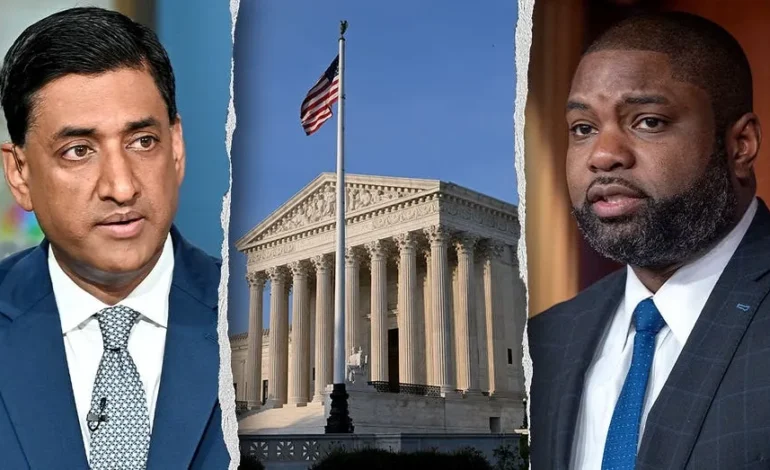
Representative Byron Donalds, a Republican from Florida, expressed his disappointment, calling the decision “terrible.” Meanwhile, Representative Ro Khanna, a Democrat from California, acknowledged the need for immigration regulation but emphasized that citizenship granted by birth within the U.S. should not be revoked. “In terms of the immigration process coming in, there should be regulation. Not that once you’re born here that we’re going to denaturalize you,” Khanna stated.
The Constitutional Debate
The case centered on an executive order from the Trump administration that aimed to detach birthright citizenship from the 14th Amendment. Many Democrats argued that any ruling overturning birthright citizenship would have been unconstitutional.
Representative Christian Menefee, a Democrat from Texas, expressed his satisfaction with the court’s decision, stating, “The Supreme Court said that the Constitution says what it says. That if anybody even has a question about what the 14th Amendment says, I think it’s a little embarrassing. So I’m glad they got it right.”
Echoing this sentiment, Representative James Clyburn, a Democrat from South Carolina, affirmed his belief in the Constitution. “I believe in the Constitution,” he said. Representative Seth Magaziner, a Democrat from Rhode Island, added, “The Constitution is the Constitution. If you don’t like the Constitution, you can try to change it.” He also suggested that the nation has more pressing concerns than questioning the status of birthright citizens.
A Setback for Trump’s Immigration Agenda
The Supreme Court’s 6-3 decision represents a notable setback for former President Trump’s immigration platform, as he had frequently characterized birthright citizenship as a significant draw for undocumented immigration.
Representative Sarah Elfreth, a Democrat from Maryland, criticized the former president’s approach. “I think the president has an obsession with immigrants in this country,” she remarked. “He’s hell bent on making it as uncomfortable as possible. We’ve seen that time and again with ICE, we’ve seen this with an attack on the 14th Amendment.”
Dissenting Opinions and Concerns
The dissenting justices—Clarence Thomas, Neil Gorsuch, and Samuel Alito—argued that the 14th Amendment does not inherently grant birthright citizenship to children born to parents who are present in the country unlawfully or temporarily.
Justice Alito, in his dissent, highlighted concerns about “birth tourism,” the practice of individuals traveling to the U.S. specifically to give birth. He suggested that this phenomenon could potentially pose national security risks if birthright citizenship is not more strictly regulated.
Other lawmakers, such as Representatives Ilhan Omar (D-Minn.) and Maxine Waters (D-Calif.), declined to comment on the ruling. However, Representative Bennie Thompson, a Democrat from Mississippi, offered a concluding thought: “Americans should be happy, because the Constitution means more than one guy’s opinion.”
Background on Birthright Citizenship
Birthright citizenship, often referred to as jus soli (right of soil), is a legal principle that grants citizenship to nearly all individuals born within a country’s territory. In the United States, this principle is widely understood to be enshrined in the 14th Amendment to the Constitution, which states: “All persons born or naturalized in the United States, and subject to the jurisdiction thereof, are citizens of the United States and of the State wherein they reside.”
For decades, this interpretation has been the bedrock of U.S. citizenship law, ensuring that individuals born on American soil are citizens, regardless of their parents’ immigration status. The Trump administration’s challenge sought to reinterpret this amendment, proposing that children born to parents without legal status in the U.S. should not automatically be granted citizenship.
Implications of the Ruling
The Supreme Court’s decision to uphold birthright citizenship has several key implications. Firstly, it maintains the status quo, providing legal certainty for millions of U.S.-born children and their families. Secondly, it reinforces the judiciary’s role in interpreting constitutional law, signaling that significant changes to long-standing legal principles require a more substantial legal or constitutional process than an executive order.
For those who advocated for the change, the ruling is seen as a missed opportunity to address perceived issues related to immigration and national security. Critics of birthright citizenship often point to the potential for it to be exploited by individuals seeking to gain a foothold in the U.S. through their children. The dissenting justices’ concerns about “birth tourism” reflect these anxieties, suggesting that the current policy may inadvertently encourage practices that could be detrimental to national interests.
Conversely, supporters of the ruling view it as a victory for constitutional integrity and human rights. They argue that revoking birthright citizenship would create a class of stateless individuals within the country and undermine fundamental principles of equality. The broad consensus among many Democrats is that the 14th Amendment’s language is clear and was intended to provide a stable foundation for citizenship.
The Path Forward
While the Supreme Court’s ruling settles the legal question for now, the political debate is likely to continue. Lawmakers who disagree with the decision may explore legislative avenues to restrict birthright citizenship, though such efforts would face significant constitutional hurdles.
The decision underscores the deep divisions in the country regarding immigration policy and the interpretation of foundational constitutional principles. As the nation moves forward, the tension between enforcing immigration laws and upholding established rights is expected to remain a prominent feature of the political landscape.