




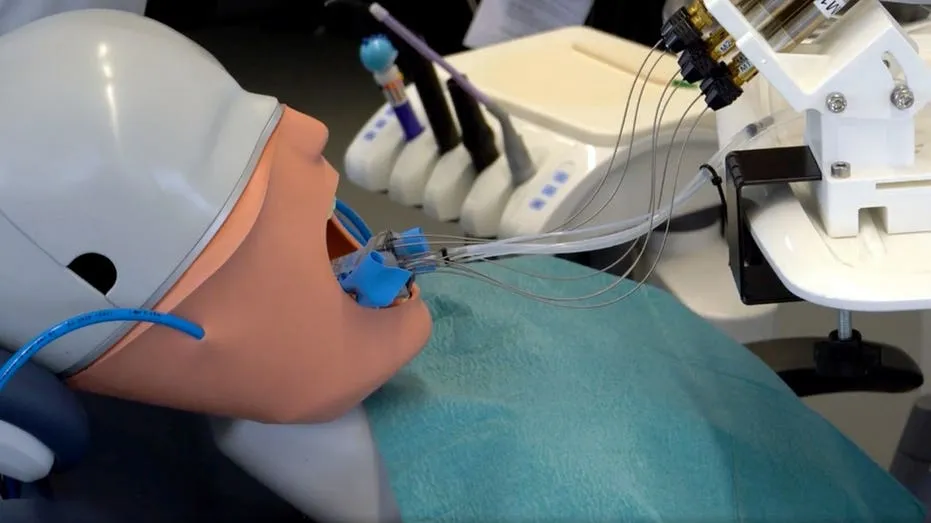
The prospect of needing a dental crown often brings to mind a tedious, multi-step process involving drilling, temporary fittings, and multiple appointments. However, a groundbreaking development from researchers at the University of Basel in Switzerland could soon streamline this common dental procedure. They have developed a prototype for a miniature intraoral robot, dubbed MIR, designed to prepare teeth for crowns with enhanced precision and potentially reduce the number of visits required for treatment.
Revolutionizing the Crown Procedure
Traditional methods for fitting a crown involve several stages when a tooth has a significant cavity. Dentists must first remove decay, then fill the cavity, shape the tooth, take an impression, and fit a temporary crown. The permanent crown is then fabricated and cemented in a subsequent appointment. This can be a time-consuming and inconvenient process for patients.
MIR aims to integrate more of this workflow into a digital process. The concept is that after a digital scan of the patient’s mouth, a dentist could precisely plan the amount of tooth material the robot needs to remove. This digital preparation could then allow the permanent crown to be ordered or even manufactured immediately, potentially eliminating the need for a second appointment.
How the Miniature Intraoral Robot Works
The MIR prototype is designed to be remarkably compact, roughly the size of a wine cork, measuring approximately 43 by 26 by 28 millimeters. This small size is crucial for comfort and maneuverability within the patient’s mouth. To keep the bulk of the machinery outside the patient’s mouth, larger motor and control components are connected to the intraoral unit via flexible drive shafts, cables, and tubes.
MIR attaches to a custom-fitted dental splint, created from a patient’s scan, which securely holds the robot in place relative to the teeth. A key innovation is that the robot moves with the patient’s head. This feature addresses a common challenge in dentistry: keeping perfectly still during procedures, especially when sensitive work is being done near the teeth. The robot is programmed to follow a precise digital treatment plan.
In laboratory tests, MIR has demonstrated its capability by preparing tooth models in a two-stage drilling process. Initially, a wider drill is used to reduce the top surface of the tooth, followed by a longer, thinner drill for preparing the sides. This controlled approach aims for accuracy and efficiency.
Precision and Safety Considerations
The research team has subjected MIR to rigorous testing on materials mimicking natural teeth, including synthetic resin and ceramic compounds with hardness comparable to tooth enamel. Even without integrated sensors for real-time position correction in its current iteration, the robot has achieved a positional accuracy of less than 0.2 millimeters. Furthermore, the forces exerted during the drilling process have been kept below five newtons, a level comparable to the gravitational force exerted by a half-liter bottle of water, suggesting a safe level of force application.
Researchers are also evaluating the robot’s noise levels to assess its potential impact in a clinical setting. However, the path to clinical application requires further advancements, particularly in safety and real-time feedback mechanisms.
The Road Ahead for MIR
Despite its promising capabilities, MIR is still a prototype and not yet ready for deployment in dental practices. The next critical development phase involves integrating sensors and a camera. These additions will enable the system to accurately track its position during procedures and monitor the treatment in real-time. This enhanced awareness is vital for ensuring patient safety, especially in the unpredictable environment of a human mouth.
Professor Georg Rauter, who leads the research group, emphasized the goal of enabling the robot to resume its task from the correct position even after an interruption, such as a power fluctuation, by utilizing sensor data. This level of operational awareness is paramount before the technology can be considered safe for use on actual patients. The complexities of a real mouth—including saliva, patient movement, pressure variations, nerve responses, and patient anxiety—present significant challenges beyond controlled laboratory models.
Collaborative Development and Future Vision
The MIR project is a collaborative effort spearheaded by researchers from the Department of Biomedical Engineering at the University of Basel, with initial concepts originating from the University of Zurich. Key collaborators include the BIROMED-Lab, the Clinic of Reconstructive Dentistry at the University of Zurich, Camlog Biotechnologies, and the ARTORG Center at the University of Bern. The project has received sponsorship from Innosuisse, and its findings have been published in the IEEE Transactions on Medical Robotics and Bionics.
The long-term vision for MIR is to facilitate a fully digital workflow for tooth preparation, enabling crowns to be manufactured using advanced CAD-CAM dental technology either before or during the preparation phase. This could significantly reduce chair time and the number of appointments needed for patients requiring crowns.
What This Means for Patients
For individuals who have undergone the process of getting a dental crown, the potential for MIR to accelerate treatment and reduce the number of visits is a welcome prospect. While the technology is still in its developmental stages, it represents a significant step towards a more efficient and digitally integrated future for dentistry. Patients should not expect to encounter MIR at their next dental appointment, as further research, development, and rigorous safety testing are required.
Nevertheless, the trajectory of modern dentistry, with its increasing adoption of digital scanning, computer-aided design, and guided procedures, suggests that robotic assistance like MIR could become a reality. Its potential to minimize repeat visits makes it a particularly compelling innovation to watch in the field.
Key Takeaways on the Miniature Dental Robot
- Potential for Efficiency: MIR aims to streamline the dental crown procedure, potentially reducing the number of appointments needed.
- Compact Design: The robot is small enough to fit inside the mouth, with larger components housed externally.
- Precision Testing: Early tests on models show high accuracy, though further development is needed for real-world application.
- Safety Focus: Integrating sensors and cameras is the next crucial step to ensure safe operation in a dynamic patient environment.
- Prototype Stage: MIR is still under development and has not yet been tested in clinical settings with patients.
The development of MIR highlights dentistry’s ongoing shift towards digital technologies. While the idea of a robot drilling in one’s mouth might initially seem daunting, the promise of a faster, more convenient crown procedure is a significant draw. The critical next steps involve ensuring the robot’s safety and reliability in the complex and sensitive environment of a patient’s mouth.


